
The Automatic Sprinkler Syndrome

Summer Rain
Summer Rain

Modern life is a mine field of behavioral traps that can turn intelligent humans into people who don’t even understand when it is raining.

While I respect the right of people to waste as much of their money as they want, I find it hard to remain calm when I am walking in the rain and notice someone’s lawn sprinklers running.

Once in a while, everyone goes off on a trip and leaves their sprinklers set to run.  As fate would have it, rain usually comes on days when you are traveling and your sprinklers are set to run.

It is not the unlucky travelers that drive me crazy, it is the folks who are too lazy to turn off their automatic sprinklers after a major rainstorm has passed through our neighborhood.

I often walk by a home where the sprinklers usually run three times a day no matter what the weather is.  The homeowner has drilled his own well and installed his own pump so it is his money.  However, unless I am mistaken he has drilled into the same aquifer that supplies our county with water.  So while he is spending his own money, I would argue that he is wasting “our” water.

I wonder whether the homeowner doesn’t know how to turn off his sprinklers or whether he is just too lazy to do it.  Recently I saw his sprinkler running during a storm that dropped nearly two inches of rain on us in just a few hours.  Even worse his sprinklers were running the next morning after the storm.

The homeowner isn’t alone.  I am surprised by the number of people who either don’t care enough to turn their sprinklers off or just don’t know how to flip the switch.

Did the invention of sprinklers make modern humans unable to understand how to tell if the ground is wet?

It is a little like the problem of  remembering phone numbers that has been brought about by the increasing use of cell phones.  If all your phone numbers are stored in your cell phone instead of your head, there is very little likelihood that you will remember any of the numbers.

Is it a good thing that modern conveniences strip us of some of our skills?  I doubt it.  While I know that there are people who are unable to mow their yards because of physical problems, I have to question if the typical riding lawn mower has been a good thing for modern men.

Once you start using a riding lawn mower it is hard to go back to pushing one.

Between GPS devices that have gradually taken the place of maps and web based driving directions, few young people have the skills to read maps.

Society will continue to hunger for the quick and easy way to get things done.  Unfortunately sometimes the device causes more harm than one might imagine.  I wonder if the folks who have lost the ability to turn off their sprinklers will eventually forget how to use a garden hose?

That is it from the Crystal Coast where summer is in full swing, and our new book, “A Week at the Beach, An Emerald Isle Travel Guide” is now available.  It is a great way to plan a wonderful family vacation in our Coastal Paradise.

Customer Feedback Should Not Be Ignored

Navajo White Paint
Navajo White Paint Label

We had an interesting experience recently.  It illustrates one of the biggest problems in both small and large businesses.

In spite of all the customer surveys and all the social media listening opportunities, businesses tend to ignore valuable feedback because solving a problem is often harder than just ignoring the problem and letting your customer continue to deal with it.

Our home is for sale and was under contract.  The Saturday before our contract fell apart, we took all of our old paint and chemicals to a special hazardous-materials collection.  That left us with no paint for touch-ups as we were preparing to get our house back on the market.

My wife hired a painter that we have used many times to do some minor painting that required matching one room’s paint.   Since it was such a small job, and he was squeezing our work in between coats of paint on a neighbor’s front door, she agreed to get the paint that was needed.

One paint that we required was a Benjamin Moore paint and another was Sherwin Williams Navajo White.  Our painter told my wife that she could save some time by just going to the Benjamin Moore paint dealer, and they could mix the Navajo White with their paint computer.

Sure enough my wife came back with a small can of Benjamin Moore paint labelled Sherwin Williams Navajo White.  The picture at the top left is from that paint can.   Our painter tried it on the spot we were trying to fix, and it looked terrible.  We thought perhaps our wall had faded, but my wife had a Sherwin Williams paint strip with Navajo White, and it matched our wall perfectly.  The other Benjamin Moore paint that had been matched with a Benjamin Moore paint chip worked fine.

My wife headed back down to the hardware store where she had bought the paint.  They completely ignored her request to try to fix our $22 quart of paint.  Their comment was that if our can of paint was computer mixed, they were not prepared to fiddle with the paint. I guess the computer is always right, and the customer just has to live with it.

A day or two later we stopped by Sherwin Williams and bought a gallon of their Navajo White paint.  That evening I painted the small area that needed fixing.  The paint matched perfectly.

I decided that we needed to get a refund on our Benjamin Moore Navajo White paint so I put a drop of it on the Sherwin Williams paint strip and headed off to the hardware.  I took the can to the front desk and asked for a refund.  First the lady offered to remix it, but I told her it was too late for that.

I showed her the paint strip which demonstrated how far off their Navajo White was compared to the real Sherwin Williams Navajo White paint.  She was completely uninterested.  At first she told me that if I wanted Sherwin Williams paint, I should shop there.   I told her that she should not sell Sherwin Williams labeled paint if it didn’t actually match Sherwin Williams paint, but she didn’t seem to care about my observation.  However, she did go talk to a manager.

We got our money back after the discussion, and I appreciate that.  However, they were uninterested in fixing the problem we uncovered.

I guess giving us back our money is easier than fixing the real problem of a paint matching computer that doesn’t work properly.  Still we ended up making three trips just to get the cup of paint that we needed.  Of course I won’t buy any more paint from that hardware store.

Hopefully they get few customers looking Sherwin Williams Navajo White paint, but my guess is that the next customer will be just as unhappy as we were if they are trying to match some paint already on the walls.

Like many businesses, our hardware store chose to ignore the real problem and leave a trap set for the next unsuspecting consumer.

Disposable technology by default

Bogue Sound Sunset
Bogue Sound Sunset

I was working for Apple Computer in January 1985 when the company introduced the LaserWriter, the first laser printer to be widely used.

The list price was $6,995 and more important to those of us lugging it around for demonstrations, it weighed 77 pounds.

I was happy that my previous career was running a cattle farm where I spent much of the winter hauling around 100 lb+ bags of feed.

It is a measure of the change in our society in the last seventeen years that the third week in December 2011, I bought a Brother HL-2270DW laser printer for $99.98.  It only weighed 15.4 pounds.

The original Apple LaserWriter printed eight pages per minute of 300 DPI text and graphics using a 12 Mhz Motorola 68000 chip.

The Brother printer that I bought prints at 27 pages per minute at up to 2400 X 600 DPI.  It has a 200 Mhz processor.  The new Brother printer comes with Ethernet and wireless connectivity.  The Apple LaserWriter only had LocalTalk, a very slow but revolutionary network for 1985.

The Apple LaserWriters were built like tanks.  Most of them lived to a very ripe old age considering how fast technology changes.

It is an interesting story about how I came to purchase my $99 laser printer.

A little over five years ago, we bought a second home on North Carolina’s Southern Outer Banks.   We were not on the coast very long when I decided that we needed a second office.

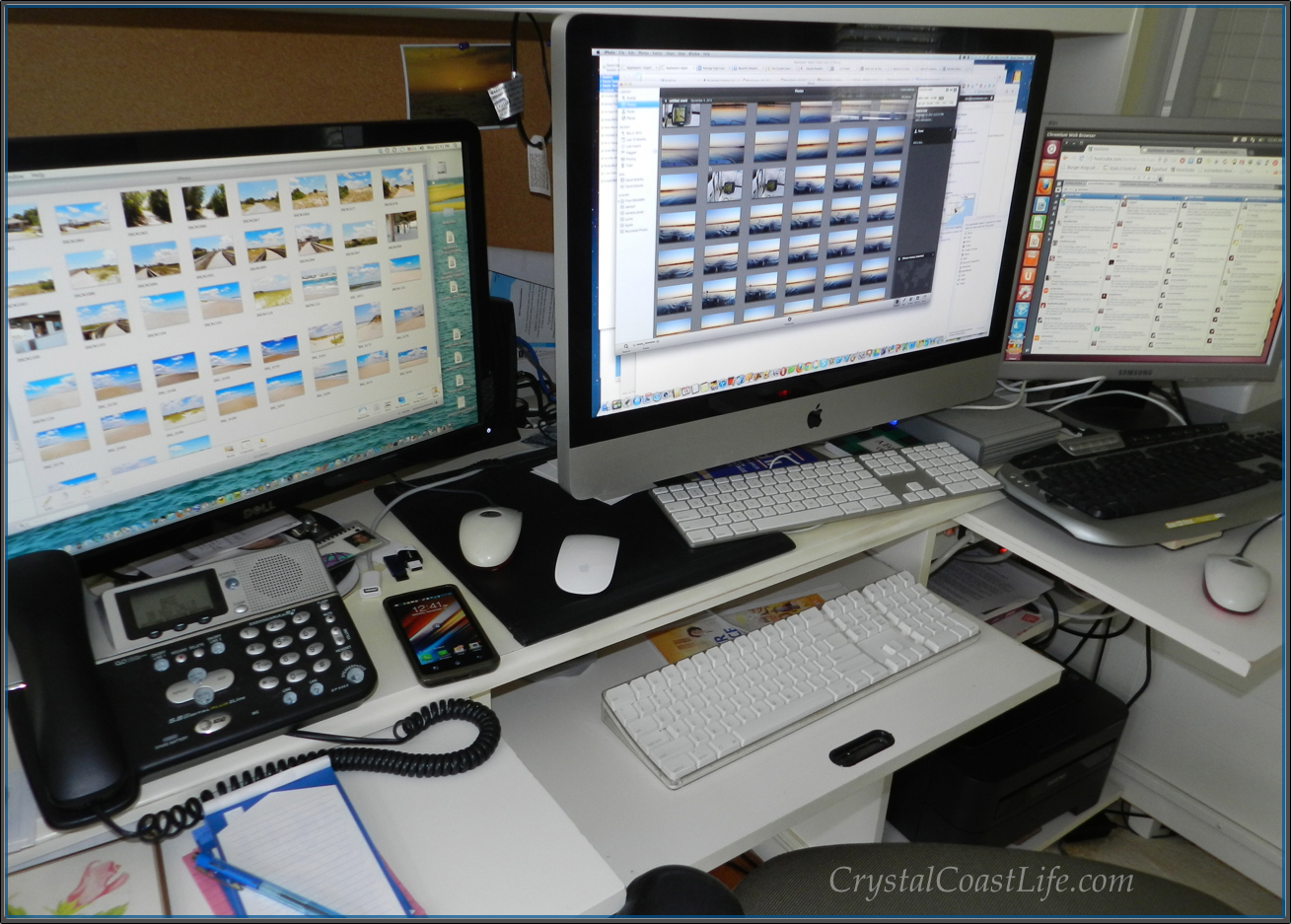
There is a picture of the office that I created in November 2006 at this post, The Not So Reluctant System Engineer.  In the picture, you’ll see the Brother 5250DN laser printer that I bought at the time.  It was virtually identical to the one in my Roanoke office.  I paid around $199 for it at Staples.

In the slightly over five years since I put together my office, there have been some changes.  I still have and use my Dual G5 Mac and my HP C6180 AIO Photosmart printer.

My Dell desktop system now runs only Ubuntu Linux, and I have added an I5 iMac to my coastal office.  The iMac nearly overwhelms my desktop.  My trusty MacBook that I bought in July 2006 recently gave up the ghost.  My main laptop since February 2010  has been a HP I7 with a 15″ screen.

About the middle of December I finished the first draft of a book that I am writing about my career of nearly twenty years at Apple.  My wife told me that she would only proof a paper copy so I printed one copy of the book.  At well over one hundred standard sheets of paper, it was the longest thing that I have ever printed.  I got a warning light on my laser toner, but I pulled the cartridge and shook it around like I have doing for years. The warning light stopped.

Around a week later after some additional miscellaneous printing, the laser printer stopped printing.  Both the jam light and the toner light were blinking.  Over the last year, the Brother laser printer had shown a tendency to jam while printing.  I did all my tricks, but I still could not get the printer going again.

I knew that it might finally be out of toner, but I was somewhat suspicious since the last page printed did not look like it had come from a printer running out of toner.  Also I have never seen a printer just stop printing because of lack of toner.

I went to Staples in Morehead City the next day to pick up a toner cartridge.  I was a little worried that it might not fix my problem with the printer.   When I got to Staples, I found than a new toner cartridge that prints something over 4,000 pages would cost me around $85.  As I was walking to the checkout counter, I found that I could buy a new laser printer with a starter toner cartridge for $99.  The starter cartridge would be good for 1,250 pages, over a year’s worth of printing for me, and a larger cartridge would only cost $44.

It didn’t take me long to decide, I took the replacement toner cartridge back and bought the new printer.  It only took me a few minutes that evening to get it working with everything.

My old printer is sitting in a closet waiting for me to bring down the toner cartridge from my printer in our Roanoke house.  If the toner works and fixes the problem, I will try to give the printer away.  If it doesn’t fix it, I will just recycle the printer.  I know from past experience that once a piece of electronics dies, investing money in it is mostly like a waste.

The new printer works fine and looks at home on the printer shelf.  I am not very comfortable being a member of the disposable society but economically little else made sense.

While we aren’t at the epicenter of the shopping world, fortunately we have plenty of services in the area and a Staples not far away.  While we don’t have an Apple Store here on the Southern Outer Banks, we  seem to manage pretty well in the world of technology.

Given the choice of another computer store or having fish and beaches in my backyard, I don’t think my vote will go to the computer store.

Pulling back a little from the wired world

Bluewater Cove, a place that I don't need to check in
A place that I don't need to check in

With a career that included nearly twenty years at Apple, it should come as no surprise that I have seen many forms of electronic communication come and go.

My kids were early users of AOLs chat rooms, and I at was Apple before AppleLink even existed.  When I started in 1984, we got one email a week.  I even remember Apple’s eWorld.

I have been quick to try most forms of electronic communication.  I built my first webpages with Adobe Pagemill in 1994 and went on to use an internal website that I created as a very effective team building tool.

I have been blogging since 2004 and have used almost all the popular platforms, some of which have disappeared. I now focus most of my efforts on Typepad and a WordPress site on my own domain, CrystalCoastLife.com.  However, I still have active blogs at WordPress, Squarespace and Blogger.

Last year I started evaluating how I was spending my time on the web.  I was spending a lot of time on the City-Data forum for our area.  While it wasn’t a waste of my time, it wasn’t a very productive use of my hours.  I got very little back for my substantial efforts so I quit posting there.

I have been using Foursquare for a while, and have had some fun with it, but one day it dawned on me that Foursquare was one of the least productive things that I do on the web.

The information that I got back from Foursquare was questionable at best, and few of the specials offered for users amounted to very much.   On top of that, I found it much easier to use Google maps and Latitude to communicate with the people who really need to know where I am.  I might not completely stop using Foursquare, but I doubt you will see me at the top of the leader board again.  It might hurt my Klout rating, but I am not going to lose any sleep over that.

Twitter is something that I actually find very interesting, and I also believe that I get back as much or more as I put into my tweets.  I will probably keep tweeting and regularly visit my Tweeter feed.

Facebook is an interesting challenge,  I find it useful for communicating with some folks who are hard to communicate with using more traditional methods. However, I have found Facebook to be of little or no use in a business sense.  It is also easy for it to be a distraction from more important things.

LinkedIn has proved to be valuable for staying in touch with business colleagues and getting opinions on important things.  I have also found ActiveRain very useful for staying connected with Realtors® outside my immediate geography.

Google+ which I have just started using seems to have some potential and a way to communicate with people without the means of communication getting in the way.  Actually I think that I am interested in Google+ mostly because Facebook seems to have become unwieldy.  The information that I get at Facebook can sometimes be marginal at best.  Most of the people I would like to hear from on Facebook, rarely post anything, so it ends up being another one way street.  Facebook is a good way for me to get information out to some people, but it turns out to be a poor way for me to hear back from people whose opinions I would value.

That leaves email and text messages. Email is something which I still value, and fortunately communicating by email just seems natural since I have been doing it for so long.  I give my Droid smartphone credit for keeping me from being a failure at text messages.  I hated doing them on earlier phones where you had to hit a key multiple times to get the right character.  Now I seem to have a little more credibility in texting with my grown kids who depend on it far more than I do.

As I look at the ways in which I communicate electronically, I want to make certain that I do not let electronic communication get in the way of real human interaction.  When I took the picture in this post, I was walking with my wife on the boardwalk in our waterfront community by the White Oak River.  Even the act of taking the picture was a distraction from an important real life interaction, and I am guilty of that far too often.  If you add checking in with Foursquare to the same situation, I think it takes away some precious moments that I would rather enjoy with the real live person beside me as opposed to with my electronic friends.

I have also gone to point of turning off the notification sounds on my Droid smartphone so that I will not be tempted to look at new emails.  They can wait until I am not in the presence of someone who really deserves my attention.

It is really nice to be electronically in touch with the large number of friends that I have around the world, but it is much more important tht electronic communication not get in the way of the very real and personal communication that needs to be at the heart of my life.

I will keep looking at how I spend my time electronically with the hopes of making sure it is actually worth the time it takes away from my life in the real world.

The Neighborhood Table

The Neighborhood Table

Years ago when I was growing up in the fifties and sixties just outside of Winston-Salem, NC, we managed to get together with friends and/or relatives on a weekly basis.

Often it was under the shade trees at my Aunt Molly’s home in Yadkin County.  In the summer there was watermelon and homemade ice cream.

It was part of life, it was expected, and everyone enjoyed it.  Depending on where we have lived, we have seen varying degrees of this over the years.

When we were living on our farm in Tay Creek, New Brunswick, neighbors would drop by regularly.  I often wondered if we got visitors because we were the only ones in the settlement with a private phone line which I had fought hard to get.

Our experiences with a party line in a much more isolated and not so friendly community in Saint Croix Cove, Nova Scotia were not my idea of fun.  It was also a different community.  One which was not nearly so open to outsiders.  Sometimes scenic beauty comes with a price.  While people dropped by then, I am pretty sure it was more of a spying operation then than a friendly visit.   As always there were exceptions like Joe, our sheep farming neighbor, whose visit were all part of just being neighborly.

When we moved to Halifax, Nova Scotia, we were in a wonderful neighborhood with lots of young children, sidewalks, and an inviting front yard strategically located on a corner.  As a result we often saw our neighbors.  I can even remember a couple of impromptu dinners where we all migrated to the kitchen and called for a pizza.  The neighborhood table ended up in our kitchen.

For some strange reason as we moved back to the states, gatherings all took place on the back decks of homes.  Even in the short time we lived in Columbia, MD, I can remember some nice crab cracking events.  Our house there had come with a board across the deck doors when we bought it.  Decks were optional in Columbia, and since for over half our time in Columbia, we were still paying the mortgage on our Halifax home which took a while to sell, we didn’t get a deck in Columbia until the summer before we moved.

The home we bought in Roanoke, Virginia is on the side of mountain overlooking the Roanoke Valley and downtown Roanoke.  It has a wonderful view and the house came with a huge deck.  In 2000, we did some major remodeling and made a our deck which is pictured above, a much more cozy spot.  It turned out to be a favorite gathering place for our neighborhood friends.  Many evenings were spent discussing our growing children and the issues of importance to the Roanoke Valley.

The sense of intimacy and privacy that we got from our deck was wonderful, but as our children have grown and our neighbors have drifted or moved away, it is now a rare occasion when we get together with friends on the deck. Some of that comes from spending most of our own time on the North Carolina coast where I am happy to report that I enjoy perching on the front porch and receiving visitors.

I often keep track of old friends through a variety of electronic methods from Facebook to LinkedIn and Twitter.  I am old fashioned enough to even use email, the telephone, and even personal visits.  I prefer personal visits, but I will use text messages to communicate with our grown children since that seems to be what they respond to best.

It occurs to me that often the kind of communication that we have on social networking sites is superficial at best.  Some people know how to work it better than others, but usually Facebook is at best a stopgap measure to prevent people you know or might have known from completely disappearing until you really get to visit or talk with them.

This year we have had a couple of long neglected friends come visit with us in North Carolina. I guess all my taunts about warm weather finally pulled them down from Canada.   It was really nice to renew the true personal connection and see how we have all changed. It had been twenty-three years since we had seen one couple and twenty-six years since we had seen the other.

One of the things I like about living in Bluewater Cove near Emerald Isle is that the climate is friendly to people being outside and to having visitors. This year April was a great time to be at the beach.  Even the changing patterns of spring weather didn’t stop the fun and warmth on the Crystal Coast after what was a harsh winter.

Our subdivision  is also a place where people enjoy walking either with a dog, alone, or with a partner.  Then there is the clubhouse with the pool where people love to gather in the summertime.  Still with a much wider span of ages than in our old neighborhood, pulling together a neighborhood table is a little more challenging.

I love to walk over on the Point where the sound, river, and ocean meet, and I do consider the beach part of my neighborhood.  Unfortunately most of the people you see there are strangers.  And even stranger is that many area residents don’t visit the beach as much as you might expect.  I am pretty sure that some residents hardly ever walk the sands over on Emerald Isle.

In talking to some older relatives recently, I found that even they have a hard time getting together with extended  family much less neighbors.  Modern society does a lot to connect us, but at the same time it also isolates us.

In our old farming village of Tay Creek, today’s newspaper came in the mail the next day, there were only two channels on the TV, and there was no Internet.  People got together to find out what was happening.  On our hill in Roanoke, a lot of information was passed about schools and children than never made it to the daily newspaper, and the Internet had yet to become a part of every kitchen. In those days, there were compelling reasons to gather and talk with neighbors.

There still are good reasons to keep working towards a neighborhood table where friends see each other eye to eye and pass on information that might not fit very well on Facebook or Twitter.

I hope to be part of the conversation instead of part of the problem.

Gadgets can be the antithesis of quality

Bluewater Cove March 29
Bluewater Cove March 29, 2011

I read with some alarm the recent post in the NY Times about gadgets that you should consider ditching or keeping.

One of my reasons for alarm was the suggestion that we ditch all our point and shoot cameras and just use our smartphones.  Well I happen to care about the quality of the photos that I take, and I find that I have a harder time taking a nice picture with my Droid than I do with a simple point and shoot camera.  I suspect people who take fewer pictures than me have even more challenges.

In the same vein, the author suggested that we give up video cameras for the high quality digital video that you can get with a DSLR camera.  While I can get very good video out of my Nikon 3100, it is not nearly as easy to accomplish as it with a dedicated video camera.  Trying to use all the features of a DSLR is not exactly a piece of cake.

Another less than brilliant suggestion is that we ditch all of our desktop computers, because laptops now have all the power of desktops.  Well laptops are great, I am writing this post on one, but when it comes to a system that will last for several years, you are far better off with a desktop.  It is much easier to upgrade components, and it doesn’t get the wear and tear that a laptop gets.

I will agree that some devices are probably worthless.  One would likely be  a dedicated GPS device  in an automobile.  My Droid phone is a far better GPS than either our nearly worthless Toyota GPS or my fairly good Acura GPS.  I recently had a friend from Canada show up with three GPS car devices, none of them worked very well.  I had some clients in town not long ago, and their car GPS was continually failing them.

If you want a very good GPS device, get an Android device with a good car charger.  However, don’t throw away your desktop computer, video camera, or point and shoot camera unless you want to be dealing with less than optimal results a few years down the road.

I still love maps, and they certainly help make GPS systems even better.  A good camera in your pocket can create  great memories not poorly lighted approximations.  A smartphone might do in a pinch for a photo or a movie, but chances are most people are better off with a point and shoot camera which can also do a decent short video clip.

At least that is the way that I see it here on the Southern Outer Banks of North Carolina where the Crystal Coast has just seen some great weather get derailed with a late season cold snap.

With instant communications, why do we make worse decisions?

Old road signs
Seen near Marshville, NC

For years we found out information from signs and books.

I sometimes joke that the best way to get information around the Emerald Isle and Swansboro area is to hang a hand lettered bed sheet at the intersection of highways 24 and 58.

Yet I know from my experience with lots of clients that almost everyone has a cell phone, and that an amazing number of people have smart phones.

Still we recently had an experience that made we wonder how in an age of instant communication, some folks felt compelled to make a really bad decision way too early.  On February 10 we were supposed to wake up with a chance of an inch of snow.

The afternoon before we heard on television that Camp Lejeune was closing the next morning in anticipation of this “storm.”  Only essential personnel were to report to the base.   It just seemed odd to me that a base full of young men who likely all have cell phones had to make an early decision based on what turned out to be a real miss on the forecast.

Somehow I expect our Marines to be a little harder to slow down in their home element.  With a forecast of  “one inch and less near the beaches,” it is a surprise so many places made a decision to close early.

Technology which could have easily let the Marine delay their weather closing to the last moment can also make for bad decisions.

I have had such good luck using my Droid smart phone for driving directions that I did not take the time to make a phone call or two before making a trip from Murrells Inlet, South Carolina to Cornelius, North Carolina.  I had asked a couple of locals in South Carolina and gotten the evasive answer that they “used a lot of back roads.”  That should have been a clue to me that I might be heading in a direction which required a little more research than Google maps on my smart phone.

The drive turned out to be an unpleasant one. and prompted me to write a post that people should consider how their retirement home fits in the scheme of trips they might need to make on a regular basis.

A little more use of technology could have made the Marines look a little less hasty when it comes to snow.  Just picking up the phone and calling someone that I knew in the Charlotte area could have saved me a lot of grief on my recent trip.

We have to make the best of instant communications and supplement them as needed with real conversations if we want to maximize the benefit of technology without throwing out common sense.

Technology that works for me

WAP and Router-Switch

We are much more dependent on technology that we were during the years when we were farming in Canada.

In the seventies, a calculator and a typewriter were about the limits of our technology.  In 1982, I got an Apple II+, and life hasn’t been the same since.

I will be the first to admit that some technology has gotten really complex.  We have a mixed wireless and wired network at our home along the Southern Outer Banks.  We came home from a trip last Saturday evening.  Our wireless network wasn’t working.  Most times it just takes a simple restart to fix that.  This time it was much more complex.

First I tried directly wiring a single computer to the cable modem. It did not take long to determine that the cable modem was thankfully fine.   I have recurring nightmares of being stuck in cable modem support hell.

Next I knew my Apple airport was configured to not work as a DHCP server.  I remembered that even my uber-geek son had challenges in getting the Airport to stop distributing  IP addresses so I pulled up a spare Airport and let it become the wireless point and the DHCP server.   That way I managed to get a wireless network going and get four of our six computers up and running.

Unfortunately that left two computers, my old Mac Dual G5, My Dell Linux box, and our two printers off the network.

My guess was that the Netgear router/switch had lost its configuration somehow.  I tried to communicate with the router via the standard browser method with a single computer hooked to it.  I had no luck so I pulled out an identical router/switch that my son had given me when he switched to powerline ethernet.  I downloaded the manual and started configuring the switch.    We have given the printers manual IP addresses so I had to find those.  Surprisingly I found the easiest place to get that info was my Linux box.

I did have one hitch.  One I configured the switch to match the subnet of the printers, I could not establish communication with the switch.  My son reminded me that I needed to reboot my computer.  I then added my OpenDNS server information and powered all the computers, Airport, and printers down.  Then I hooked all the wires into the newly configured switch.  I switched to the old Airport and brought it back up.  Then I booted all the computers and turned on the printers.

A quick test showed that the printers were working and the Airport network was functional.  I had to go change the network wireless settings on one of our Windows 7 laptops, but other than that everything worked.  I still have to see if the old router can be fixed, and if it can, I will add it to my other spare parts like the other switch my son left me just in case I needed a few more ports.

While all that sounds relatively simple to the geeks among us, it took be about 24 hours of working on it whenever I had some extra time.  Fortunately we had the adhoc wireless network that gave us everything we needed except printers.

This all works for me, but it occurs to be that I have the advantage of lots of spare gear that I have inherited from my son.  I have also lived in the world of technology for the last twenty-eight years, and I have a son who understand whatever I don’t.   Most people might have some challenges with this, but it likely that most people don’t need all the gear that I have to keep all my Internet projects running.

The one thing that I am really happy about is that I have removed servers from the equation.  I can still remember trying to get DHCP services set up using one of my Mac OS X boxes that I also used as a server.  I have given up on running a server at home.  It is just too much trouble when there are great services like DropBox around.  DropBox gives me online storage that automatically syncs across all my computers.

Maybe I will eventually get new gear that lets me have a less complex network, but when you are working with computers as old as seven years old, it sometimes helps to have some old gear around.

I think part of the great appeal of smartphones like my Droid is that they just work.  If we can have more powerful smartphone-like devices including printers that just work, we might get around much the complexity of a homegrown network.

Technology is too interwoven in our lives to disappear.  We just have to hope that we can stay on top of it, and that even more power technology will get easier and easier.  After all I think my Droid is a much more powerful computer than my original Apple II.

We have made lots of progress with technology,  I do not think the progress will stop.  I expect it will accelerate.

iPhone Dependence

Sail Boat Under Tow
ICW at Cedar Point, NC

We had our company holiday brunch today, and it came as no surprise that when the crowd was gathering, the talk turned to cell phones.

The conversation was very different from four years ago when I first became a Realtor®, but a little history is in order first

Back in that ancient time of 2006, there were phones and there Blackberries or Crackberries as we often called them in the Washington, DC area.   Being a long-time Apple employee, I had used AT&T for my cell phone service for a good part of my nearly twenty years with Apple.  Even when we lived in Roanoke, Virginia, and I worked in the Reston, VA area, I found AT&T service less than desirable.  I tried a number of phones, but none made a significant difference.

As a family we took care of the problem by having my wife carry a Verizon phone.  When we moved to the Southern Outer Banks, my wife’s Verizon phone hardly worked at all.  My AT&T phone worked from our front porch, but mostly it missed calls in our home in Bluewater Cove.   The real estate market was less than busy for those three years so we just lived with the missed calls and used the office voicemail.  We still had our home in Roanoke so keeping my wife on Verizon made sense for a while, but we eventually we got her a family plan line on my AT&T service.

Last spring I started to miss more and more calls with my AT&T flip phone.  I had long resisted the Blackberry or even the iPhone which Apple had introduced after I left the company.  Finally we got a mailer from AT&T about their 3G MicroCell™ which provides additional coverage for their phones in your home.  One rainy afternoon in March, we headed off to Morehead City to investigate the 3G MicroCell™.  It did not take me long to figure out that  by getting one those I was basically paying extra to fix AT&T’s terrible network coverage.

On a lark, we stopped in at the Verizon store to see if their service had improved any in the last three years.  They pointed out that they had bought the towers of a local cell phone company, and that they believed their coverage was now excellent on the Crystal Coast. They offered us a trial.  My son, who works for SAP in their division which moves text messages from one carrier to another, had gotten a Droid not long after they came out.  His experience seemed to be great, so I took the plunge and bought a Droid.  We got my wife a regular 3G phone since she only uses her phone occasionally.  Actually she claims the only reason she has one is so that I can find her when we go shopping.  My comment is we will get her a smartphone when GPS is more accurate, and I can really track her in SAMS Club.

Getting into the world of smartphones was probably a good thing.  I have run into more and more customers who are smartphone savvy which brings us back to our holiday party.  My Droid has a very useful tool in the world of real estate.

With that background we can get back to our holiday brunch phone conversations.  Some of our company’s original Blackberry users are now contemplating their next phones.  It seems most are looking at something besides Blackberries.

I listened with interest as a couple of iPhone users talked about how much they loved their phones. One even told me how great her phone service was in her home.  It did not take long for her husband to chime in that they had to buy one of AT&T’s 3G MicroCell™ towers to get that good service.  I related the story of a visiting friend from Canada with an iPhone. He had complained about getting no calls in our house, and I had suggested he take his calls on the porch which seemed to help.  However,  when we went for a walk in our subdivision the morning they were leaving, he did get a call on our walk, but he lost the signal three times.  I don’t think there is much of a case for iPhones in Bluewater Cove where we live.

Later at our brunch, I heard a couple of stories of people trying to call iPhone users who they could actually see in their cars.  The calls invariably went directly to voicemail.  Yet these folks who are missing their calls still love their iPhones.  As one person said, it seems that Apple could bundle up almost anything and add “i” to it and some people would buy it.  While I might agree to an extent, I do have a new I5 iMac on my desktop, and it is a very good though not perfect computer.

The iPhone is a great piece a technology, but if you need a cell phone along the Crystal Coast, your iPhone will be one useless bookend for much of the time.

My Droid has turned out to be a great phone.  Even if Verizon were selling the iPhone, I would stick with the Droid.  There are great choices on the Droid platform.  If you want an iPhone, you will get what Steve wants you to have.

I even have some complaints on iMac, but I have too many skills and years on a Mac to completely give it up.

Somehow the photo of the sailboat being towed down the Intracoastal Waterway reminds me of the iPhone and AT&T’s 3G MicroCell™.

On a closing note, my Droid works great from my skiff.

Technology can be a dangerous crutch

Boat GPS
Boat GPS

I will admit to loving GPS systems.  Well I love all of them except the one on my wife’s Toyota Avalon.  Even the passenger cannot use it when the car is moving.

My experience with GPS systems dates back to my second Acura MDX.  My first MDX was still running strong with just over 75K miles on it.

We made a service trip to the dealer, and I drove a new one with a GPS.  I was hooked.

When we bought our skiff, we got a GPS with it.  It has been indispensable at helping us make our way safely up and down the White Oak River.

Yet it wasn’t too long after I started using my first GPS that I realized it was very hard to get the big picture on a GPS.

We once took a trip to Greenville, NC and strictly followed our GPS, it took at least an hour longer than the route we got from some people who often made the trip.

We had some clients show up recently, their GPS had cost them at least a couple of hours.

After using our boat for a while, I realized that it was important to memorize landmarks because the GPS could break during a trip.

One day it stopped working, and I was grateful that I had in my mind landmarks that would make the route home easy.

Technology is wonderful, but it is even better if you don’t let it take over all the decisions.  Don’t make technology the answer to everything.

Many times it pays to talk to experienced people and use their opinions to balance what your latest gadget is telling you.