
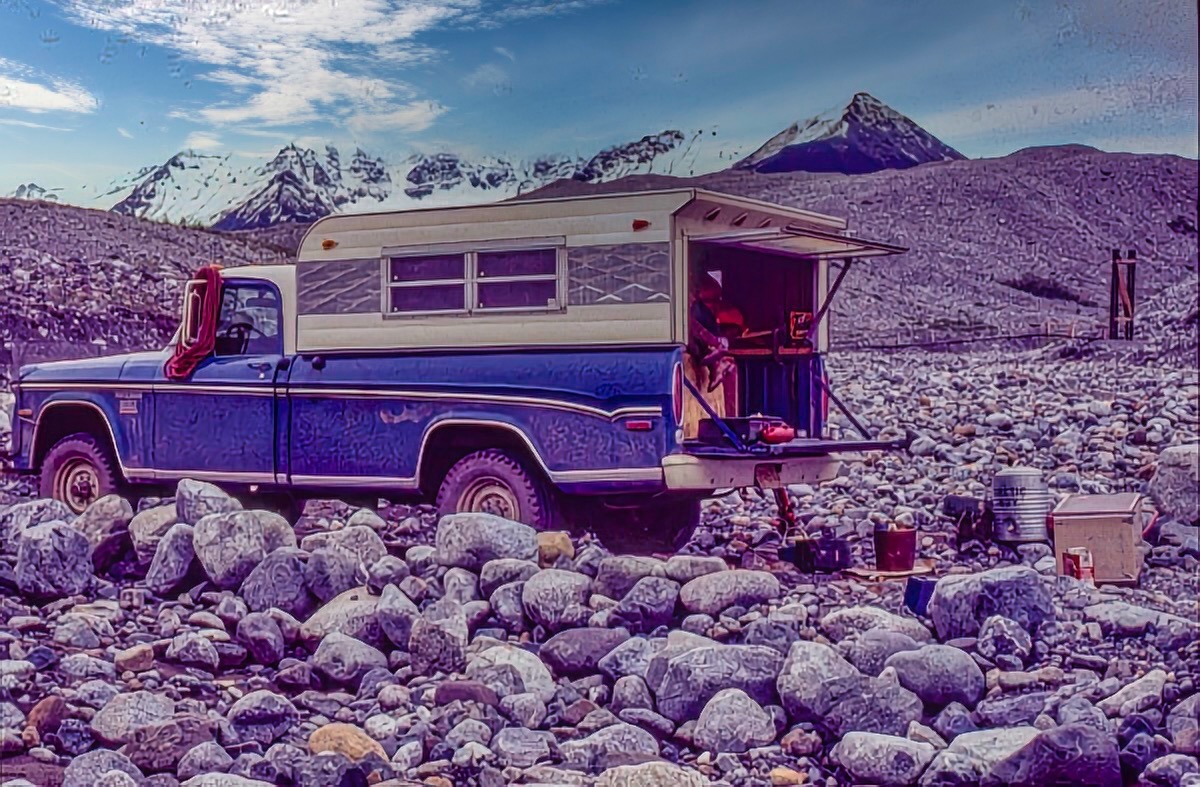
Americans are famous for their Sport Utility Vehicles (SUVs) that never leave the paved roads. Unfortunately, some people get behind the wheel of a SUV with the belief that it makes you invincible. There are a few things I have said in life that seem to have some staying power. One of them is that all an AWD, 4WD, or SUV will allow most people to accomplish is to get stuck in a more difficult to reach place.
I have been stuck or broken down in some pretty remote places like the one above a few miles off a road in Alaska. That vehicle had a winch and it was useless in that situation. Farms are places where people can really get stuck. However, the rule on a farm is do not get the biggest tractor stuck unless you have the gear to pull it out. We kept an old bulldozer around for that. It got used for that.
Our herd of cattle wintered in the woods about a mile from the barns and the area where I kept the round bales of hay. It was not unusual after a big storm to blow the road to cows at night. One night after a particularly nasty storm when the temperature had already dropped into the minus twenties, I was blowing the road. I had successfully cleared one lane out to the cows and I was headed back widening the cleared road. As you get within a quarter of a mile of the barns, the road dips down into a small valley and crosses a culvert. There is a small pond on one side of the road and the culvert that allowed for overflow from the pond on the other side. I had a rear mounted snowblower that cleared eight feet of snow at a time but because it was rear mounted, you backed the tractor as you blew the snow. That gets a little tiring after an hour or so. The tractor had a nice unheated cab, weighed about 12,000 lbs., and ring chains on the tires. They are necessary on farm roads which often have ice as a base coat.
Just as I started across the culvert one of my large rear tires slipped off the road into the pond. Fortunately the pond wasn’t very deep but it still put the tractor in a precarious position. Experience told me the best thing to do was to wait for daylight and get a neighbor to help me pull it out. I walked home and spent my dreams figuring out how to retrieve the tractor.
By the next morning the temperature had dropped to minus twenty-eight degrees, but it was no problem to get my farm helper who was in his sixties to go with me to unstick the tractor. It was a complex operation. I loaded a generator in the pickup, some salt and a chain saw along with our three quarter inch logging chain.
First we drove down to the tractor, started the generator and hooked it to the recirculating block heater that would hopefully warm the engine of the tractor so we could start it. Next we made cuts into the ice around the tractor’s wheel that was now frozen in ice. We put salt in the cuts in the ice. While all that was working we went to start the bulldozer. It was a very old Cat D5 bulldozer which originally had a small gasoline motor that you started and used to start the big old diesel. Unfortunately the gas motor had died shortly after I got the bulldozer and I found it would cost more to replace it than the bulldozer was worth. However, we quickly discovered that towing the bulldozer six feet would start it. I had another large tractor and we used that to start the bulldozer that cold morning.
I drove the old 16,000 lb. bulldozer down and positioned it so we could hook the big chain to it. My neighbor got in the stuck tractor and fired it up. All he was supposed to do was steer the tractor. I moved the generator to safe ground, got on the bulldozer and carefully pulled the stuck tractor out of the shallow pond. While the actual pulling seemed effortless for the bulldozer, It likely took us two hours to get to that point. It is unlikely that I could have gotten a wrecker out to do the same thing without the wrecker getting stuck. We were fortunate to have the equipment. Most of the time when you get stuck, you have to make do with what you have.
Not every time you get stuck is going to be that complicated but as I said if you wander far off the road, you run the risk of being stuck in a difficult place. We were actually stuck in the picture at the top of the post. The locking hubs on our four wheel drive quit working. I had to take one hub apart and adjust things. Fortunately, I had the tools to do it.
With many four wheel drives vehicles all you have to do is get one wheel spinning and your vehicle might as well be a turtle on its back. I am a big believer in chains for ice in spite of the pain putting them on a vehicle. Chains make more difference than either four wheel drive or AWD.
AWDs are also not all created equal. Some will get stuck in nothing and some will walk up a mountain of snow. My old Acura MDX has a locking mode that is amazing but I still avoid ice.
Just after the first big snowstorm of the year is not the time to figure out how good your vehicle is at getting stuck. At a minimum, an emergency kit includes a tow strap, shovel, a square piece of 3/4 inch plywood, gloves and a good jack which should be a bumper jack if you are headed into sand or mud. If you have a winch on your vehicle, be very careful, they are exceedingly dangerous if you don’t know what you are doing,
Sometimes I miss living up north. Once the ditches were full of snow, the safest thing you could do to avoid an accident was to drive into a snow bank and get stuck on purpose. I avoided a few accidents that way. Most were close to home and only walking distance to one of those big tractors.

 Our technological infirmity