Disappointed by Mediocrity


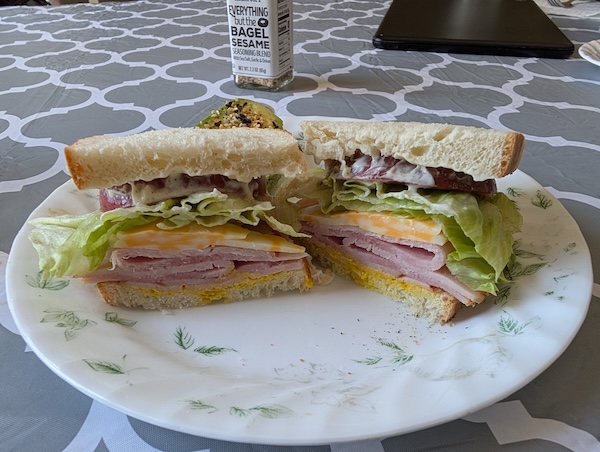
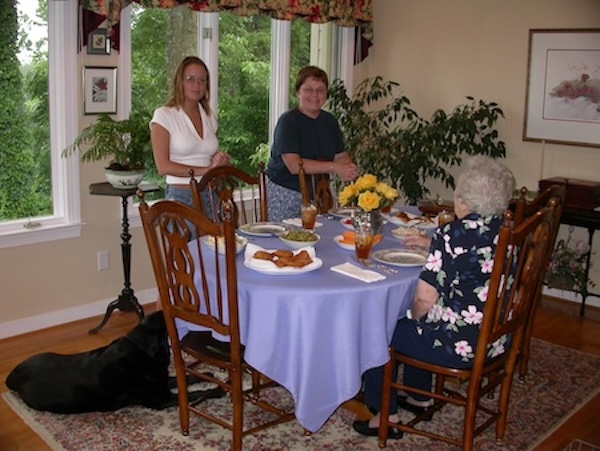
Tasty Homemade Ham Sandwich, Duke’s Mayo, Cherokee Purple Tomato, Sourdough Bread

My mother had few rules more important than be the best that you can be at whatever you choose to be. She had grown up with little education beyond the one room school house she walked to as a child, but she never let that hold her back. She learned how to drive and and left the fields of Yadkin County for the big city of Mount Airy, North Carolina where she owned a very successful beauty shop for a couple of decades. She also became the matriarch of her extended family. She was determined that her sister’s six children would have the opportunity for successful lives. Two of them followed her and became beauticians. They all leaned on her and came to think of the house where she lived in Mount Airy as a gateway to another world. In time as she aged, she would lean on them which is how families should work.
Mother was also a great cook and gardener. She made it clear from as early as I have memories that I was going to college. She expected no less and I felt bound by her wishes until I graduated from Harvard in the summer of 1971.
Mother lived to be ninety-three and six months. She has been gone for twenty-two years. She loved life, travel, gardening, and working. The other side of mother was someone who long remembered anyone she believed had wronged her or not delivered on their part of an agreement. She never believed that fancy had to part of our lives but that did not preclude things being special. Even in her seventies she would quickly choose to work three days putting together a family celebration rather that hiring someone to cater it. Part of that was her belief that she could do a better job than most caterers. Most family members would agree that she was right.
The world has changed a lot in the two decades since mother died and I have gotten a lot older. At one time matriarchs like my mother and her sisters could hold their families close together. It is much harder today. Families no longer work the land where they were born, they live where they can find jobs often in a different state. People have a harder time getting together because of distance and the divisive politics that now ravages our nation. We can no longer even agree on what the facts are. Even today’s newscasters are jokes compared to the giants of the past. Our economy is now filled with franchises where the locations are run by poorly trained teenagers working for minimum and caring even less. The soul seems to be gone from the economy. Now it is just about making money. When I joined Apple for a nearly twenty-year run, we were out to change the world with products that everyone still remembers. In the over two decades since I left Apple, my only enduring memory of the company is Tim Cook on bended knee with a gift for our morally challenged president.
Now the business model is come up with a good idea, hook people on it, and figure out how to make as much money as possible while making the product cheaper and sustaining it with often borderline deceptive marketing. The formula for government is worse. The party in power has spent the last thirty years convincing people that government is bad even though people really do want things like good roads, education, social security and medical care.
With evangelical Christians giving religion a bad name, Congress barely holding a 12% approval rating while clearly in the pockets of special interests, and families more challenged at staying close together than ever, things do not look great for our society.

I believe the only hope for society is to demand more from each individual. We should expect everyone to be proud of their accomplishments and the work they do while understanding the impact their efforts and words have on the lives of others.

Instead of the salesman who sold us our $40K plus new car telling us to contact the parts department to get the forgotten owners manual, go find one and drive it to us. I would have done that when I was selling computers in the eighties. I would not have thought twice about it. It is how I would have expected to be treated myself. My customers deserved no less.
If someone makes me a mediocre sub or sandwich that costs $10, I am going to let them know about it. On the flip side if someone does a great job and fixes me a memorable meal for a reasonalbe price at a restaurant, I am going to give them some praise including a positive Google review.
As much as I want to be surprised by the extra individual effort that can make difference from Congress to a sandwich shop, I am moving forward with the knowledge that I hold our Constitution in higher regard and understand more about its creation and protection than most representatives. I plan to keep explaining that to them until my digital ink runs out.

I can also make a better sandwich than any teenager in a sub shop. As the cost of eating rises, I expect to eat out less. There are already too many bungled orders to expect things to turn around soon. There are few things worse than spending hard-earned money for something that disappoints.

I will also continue to highlight those services that continue to deliver great value and are proud of the work that they do.

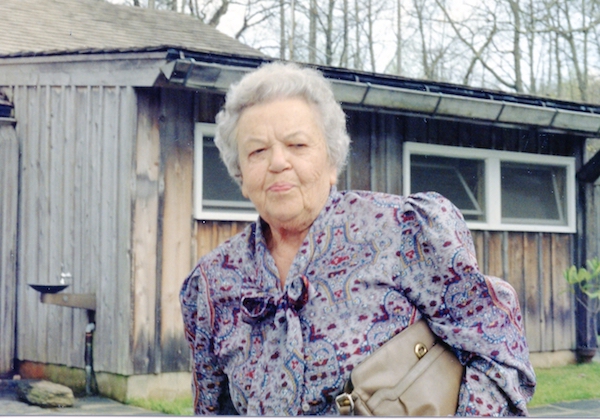
My Mother, Grand Lady of Pine Street

My mother was born in August of 1910. Had she not smoked for a few decades, she might have made it to one hundred, but it would be selfish to wish her here. When she died in March of 2004, she was ready to go. Her body had given out and even her most recent friends had passed. She was content with her life but still loved her family especially her grandchildren. She loved them with all her heart even if sometimes her words did not express it as well as she would have liked.
In her nineties, she was not happy that her body could not do the things that she wanted it to do so I am pleased that she left while her mind was still sharp and before she became too uncomfortable.
I remember lots of things about my mom including many warm beach evenings with her on the North Carolina coast. If you have followed my posts over the years, you might have read our chicken frying adventure which was inspired by her.
When I originally wrote most of this post on August 22, 2005, I enjoyed some cold fried chicken which to me is the comfort food from my childhood. Thirteen years later, I ate some fried chicken which of course was nowhere as good as mother’s chicken. Still, the chicken brought back some memories. I think the summer of 1962, when I was in a special summer school, over half of my lunches contained fried chicken. Mother could fry a chicken blindfolded.

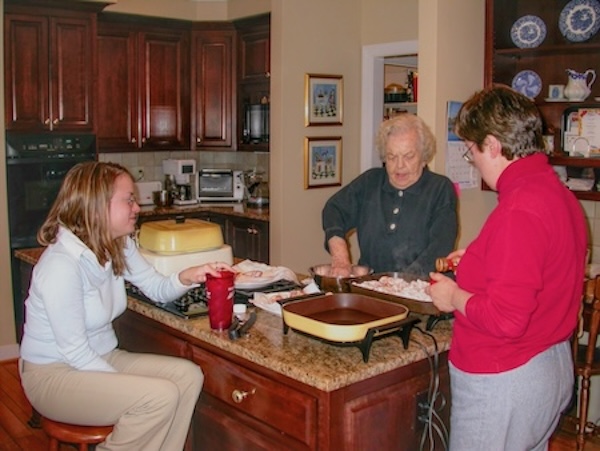
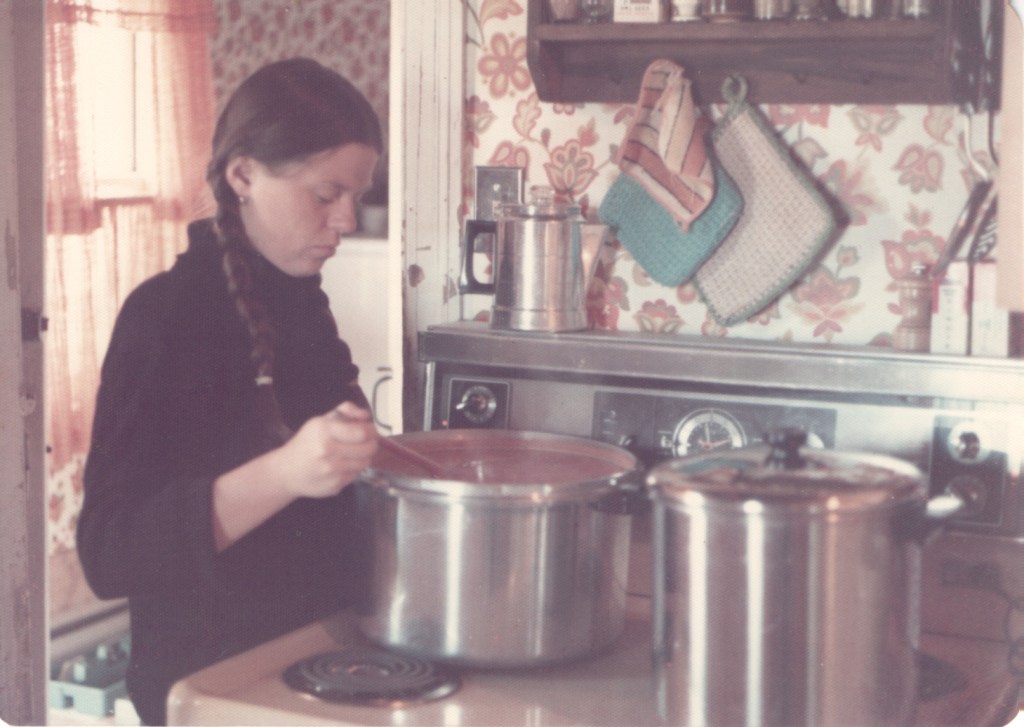
This picture is my mother cooking fried chicken for my birthday in March 2003. She died about a year later. That was the last chicken she fried. She was 92 and six months. She started cooking for her family when she was nine years old. Her mother had died. Mother used to tell us that she was so small and the cast iron pans were so large and heavy that her older brother had to put the pans on the wood stove.
Mother left home in the twenties when few women strayed far from home. She learned to drive a car while her sisters weren’t interested. Eventually she started her own beauty shop. For years her shop was on Main Street in Mount Airy, NC. Eventually, she had a very successful one in Lewisville, NC in the fifties until she retired and moved back to Mount Airy in the sixties. She lived there in the family house at 347 Pine Street until July 2000 when she moved to Roanoke.
It was a remarkable journey for a country girl who never had the chance to get a lot of formal education. She was a true matriarch who was willing to do anything for her family. I still remember my oldest cousin telling me the story of my mother deciding that he was going to military school. He didn’t want to go, but she would not take no for an answer. To this day, he believes that year in military school kept him from heading down a deadly path.
I learned a lot from my mother. She taught me to never be afraid of hard work and to be proud of my roots. Mother’s family was the source of her strength. She leaned on them and they leaned on her. One my cousins who grew up in a wonderful large family, tells the story that without my mother, they would have had no Christmas when growing up. Mother would drive home from Mount Airy to Yadkin County often getting stuck along the way. That was no problem for mom, she would just find a farmer to pull her car out. She never forgot to bring a car full of presents and clothing for her family.
The most important thing that I learned from mother was to live in the moment with an eye to the future. Mother never dwelled on the past. Mistakes were learning experiences. Mom also kept score so if you crossed her, she probably wouldn’t let you forget it. She also was never afraid of saying whatever crossed her mind which sometimes caused a few hurt feelings.
Mother was also a great gardener, a fantastic cook, and a loyal friend to many. Her one rule was to do whatever you were doing to the best of your ability. At the end that’s a pretty good way to live.
The one final thing that I learned from mom, is that material possessions really aren’t very important. The more you have, the more worries that you have. We’ve learned that lesson well, we have spent many years getting rid of things which we have accumulated over the years.
There still aren’t many days that something doesn’t remind us of my mother who was such an important part of our lives. She was never afraid to gamble on us and was always there for us when we needed her. She learned to navigate to Boston’s Logan Airport and fly to Canada at an age when many were afraid to leave home.
There’s probably no more relaxing feeling than coming home as a young adult and having your cares disappear into the walls of your family home as your mother’s home cooking completely finishes off your worries. Mother was an expert at creating that environment which could make your cares disappear in minutes though she apparently decided she would never make a homemade biscuit after she left home as a teenager. She did pop a few cans of refrigerated biscuits but my favorite were her rolls that melted in your mouth.
If we can provide that same spiritually nourishing environment for our kids, I think my mother might be proud of us even if we are amateurs at frying chicken.

Respect for Homesteaders

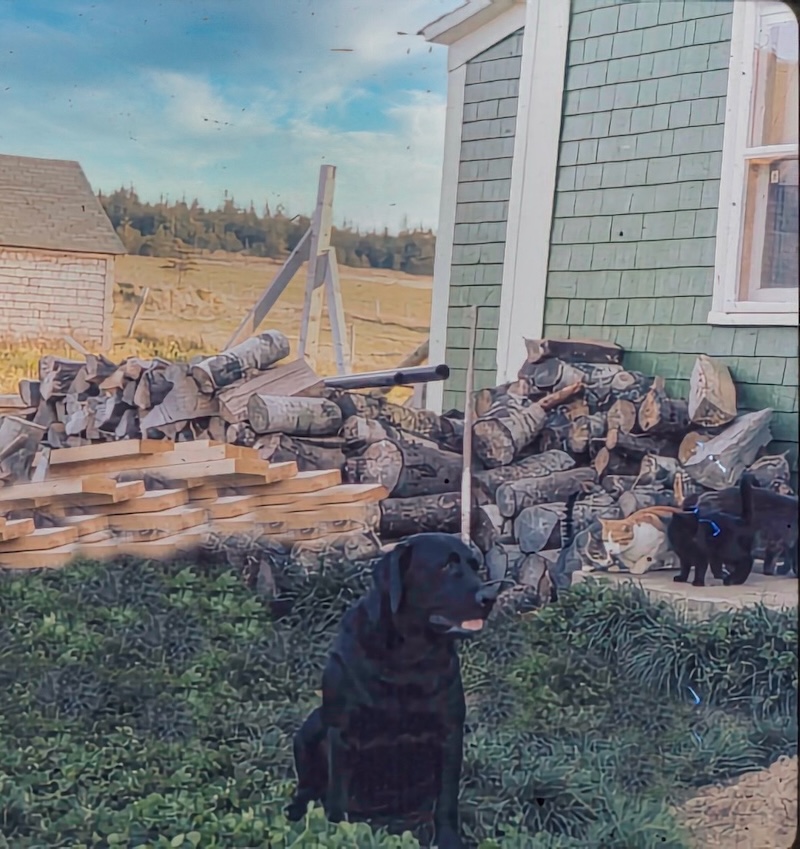
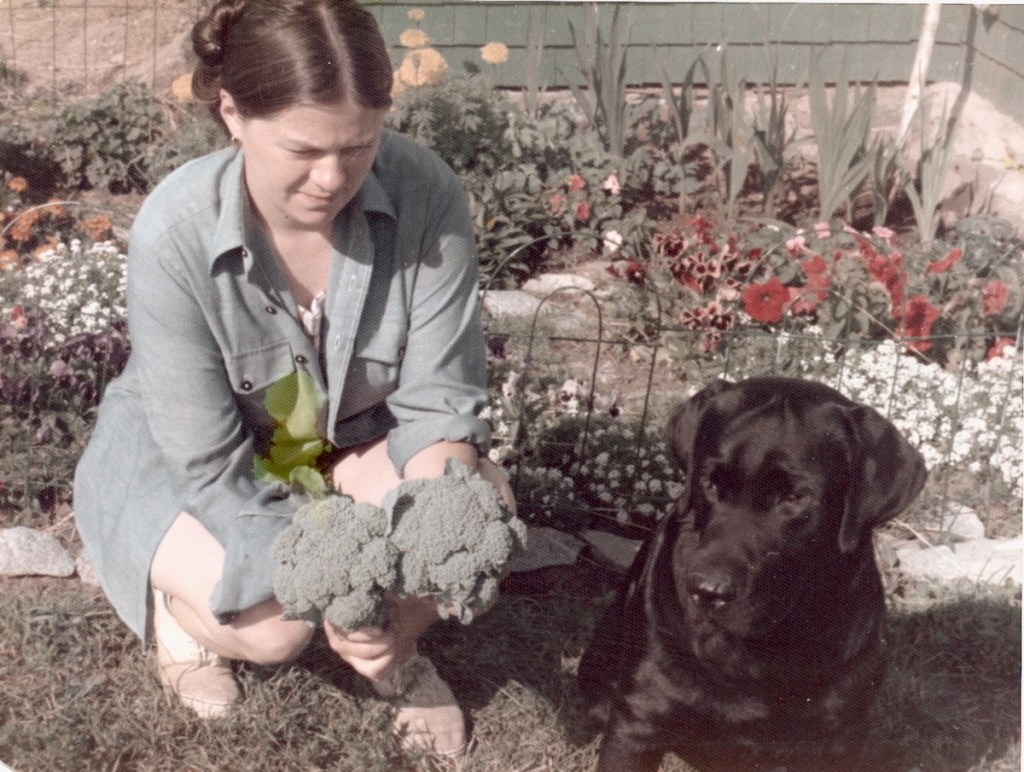
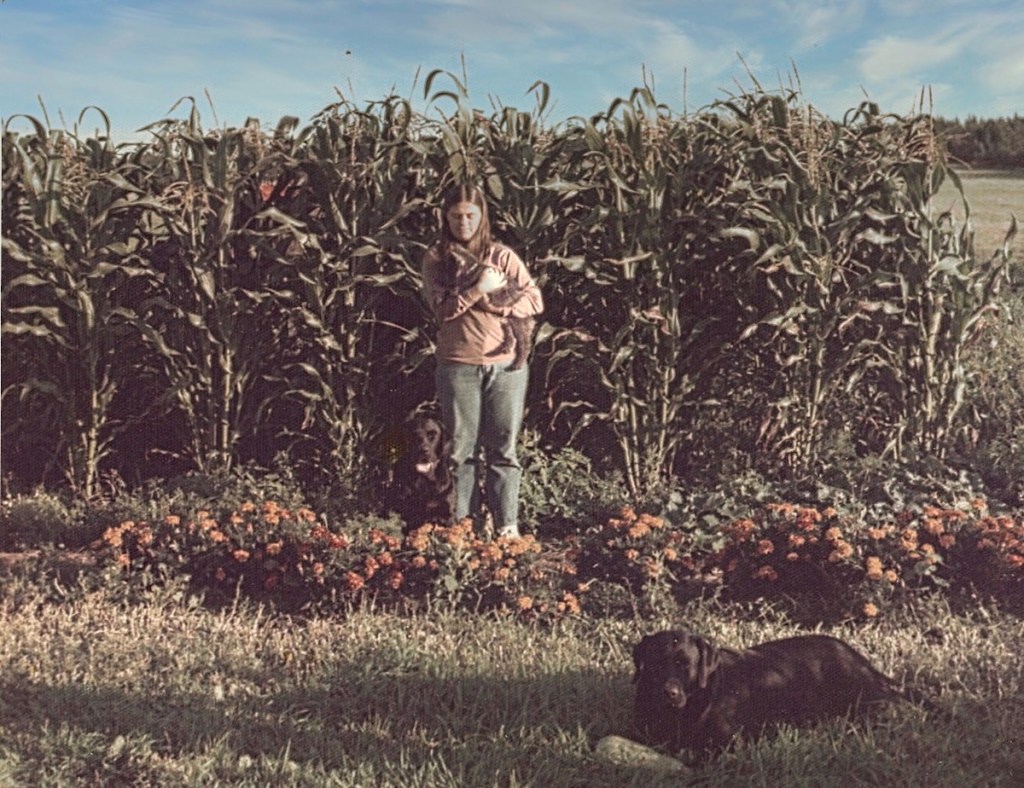
Our Lab Fundy, Summer of 1972, Guarding Our Woodpile

I spent fourteen years living very close to the land In Nova Scotia and New Brunswick from 1971 to 1985. We grew huge gardens, eventually had cattle, chickens, a milk cow, built large barns, cleared land, built roads, grew hay/oats, and heated with wood. We had a couple of Labs and a bunch cats. We could not have survived, much less farmed without the right tools.

I have great respect for this generation’s off grid movement. Going back to the land is not any easier today than it was fifty-five years ago. In some ways it was easier back in the seventies. I don’t think you had to get quite as far off grid to get back to land. Nova Scotia winters while sometimes wintery are no match for winters in Alaska and Northern Canada. Most of us just wanted to get away from the cities and did not care about proving that we could live in some of the world’s harshest climates.

Going back to the land and building a life there did not happen at once. For me it all started with the farm house, barn, and land along the Bay of Fundy shore in Nova Scotia. While we didn’t build a cabin on raw land, it was still an uphill battle to have shelter, warmth, and food from a garden.

The right tools and persistence are the keys to success in getting back to the land. In over four decades things have changed. Many tools that are now available were not around when we were living on the land. Surprisingly except for the rise of solar power, the changes are minor for small scale homesteaders and farmers.

What you buy first depends on your individual situation. The top brands have mostly changed in the last fifty-five years but I learned that cheap tools break far too often.

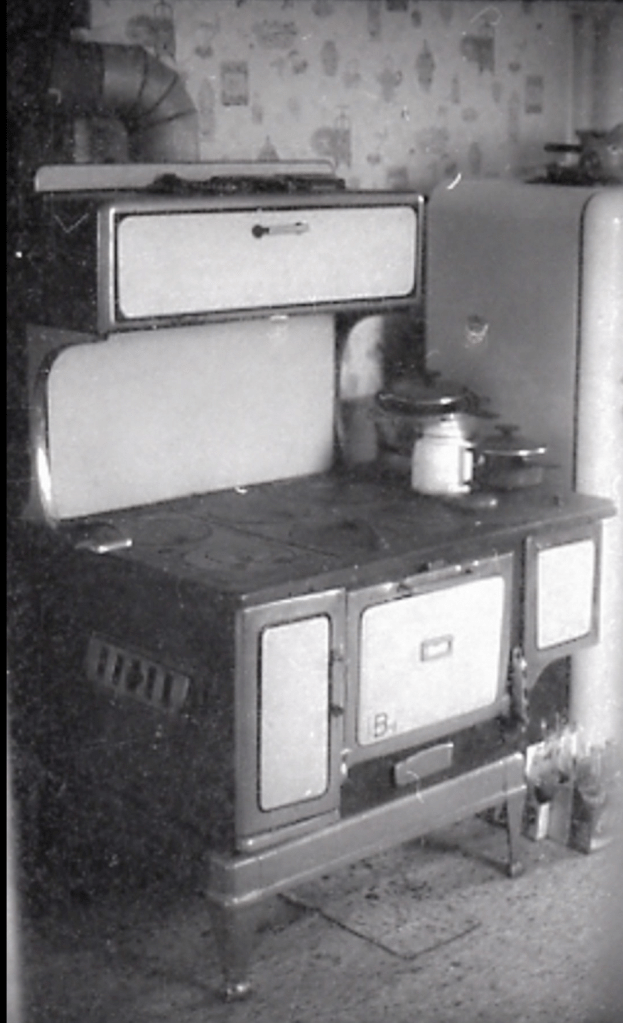
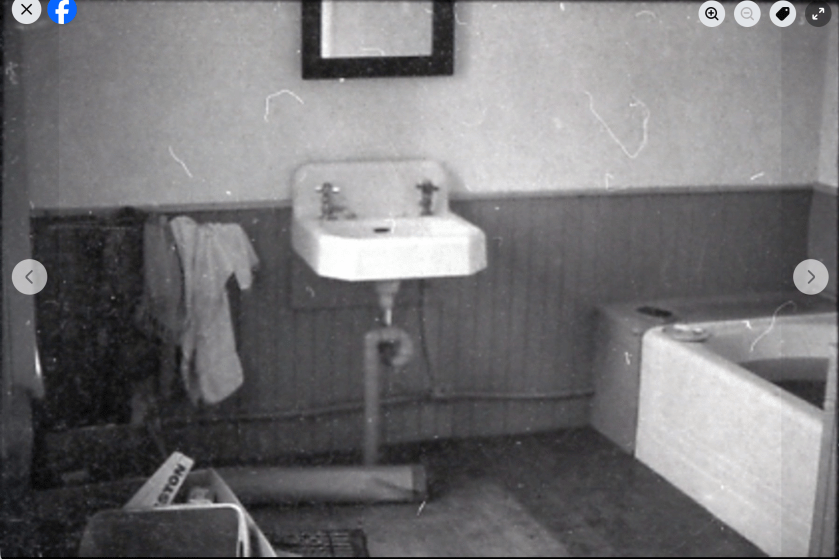
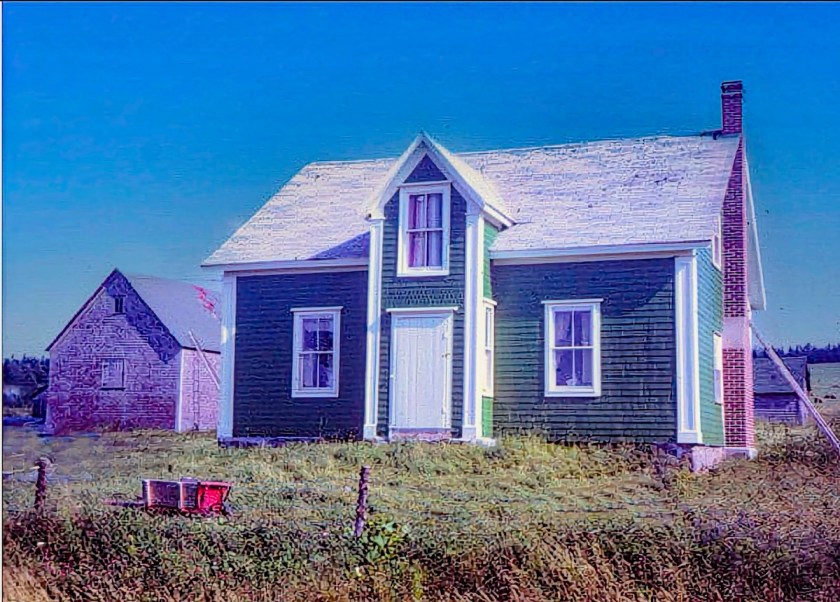
We moved into our 200 year old Nova Scotia farm house in the summer of 1971. While the house was in rough shape, it had electricity (30 AMP service), a small spring providing some water, a functional toilet but not much else in the bathroom, and an old wood kitchen stove with enough wood for a couple of summer months of cooking. We had the basics covered but the house needed a lot of work before fall and winter. The only hot water came from an electric kettle. We were lucky that there was a summer campground with showers (and a fried clam shack) just three miles away.

I bought the place for $6,000 Canadian. At the time the US dollar was worth slightly less than the Canadian dollar. Besides the house, there was a barn in need of a roof, a carriage house, and 140 acres with about 25 of those acres cleared. The soil was heavy clay and the 25 acres had been in pasture for decades. It also came with a huge chicken house that had not been used in a decade. Behind it was a giant pile of well-composted manure.

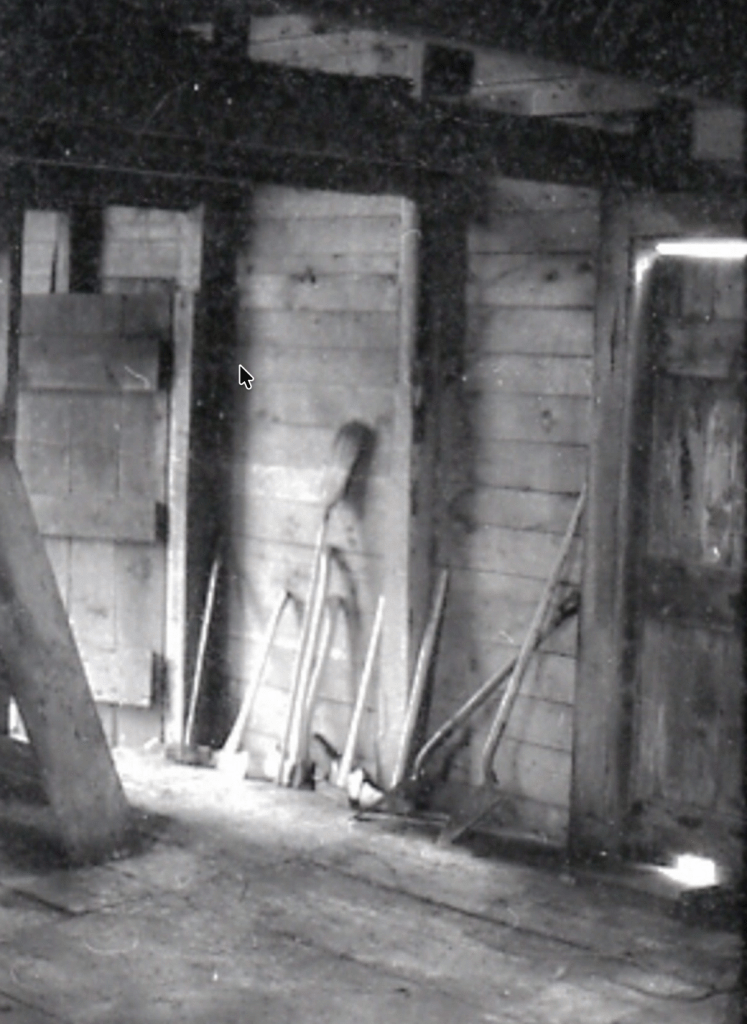
Going between countries was easier back then. I brought with me four former college roommates who had all except one just graduated from college. As I remember the first power tools we bought were a 10.25 circular saw and a three quarter inch power drill. We also got crow bars, hammers, screw drivers, a sledge hammer, an axe, a bow saw, shovels, brooms, and a ladder. Surprisingly basic tools were our best friends and I image they still are today. There were no nail guns in those days.

I brought two vehicles with me, a four wheel drive Dodge Power Wagon pickup with an 8,000 lb PTO winch on the front and a Land Rover that would go through almost anything but at a very respectful British dawdle. Considering what some people go back to the land with today, we were pretty well equipped at the beginning of summer. We even had a TV and could pick up two channels most days but CBC Radio was more reliable.

The early part of summer was spent tearing the old lathe and plaster off the walls and putting a new roof on the house which eventually meant tearing down the old chimney and moving all cooking to an electric frying pan and a Coleman camp stove. We actually got the house down to bare walls on the inside and started caulking the cracks and replacing any cedar shingles on the outside that had deteriorated.

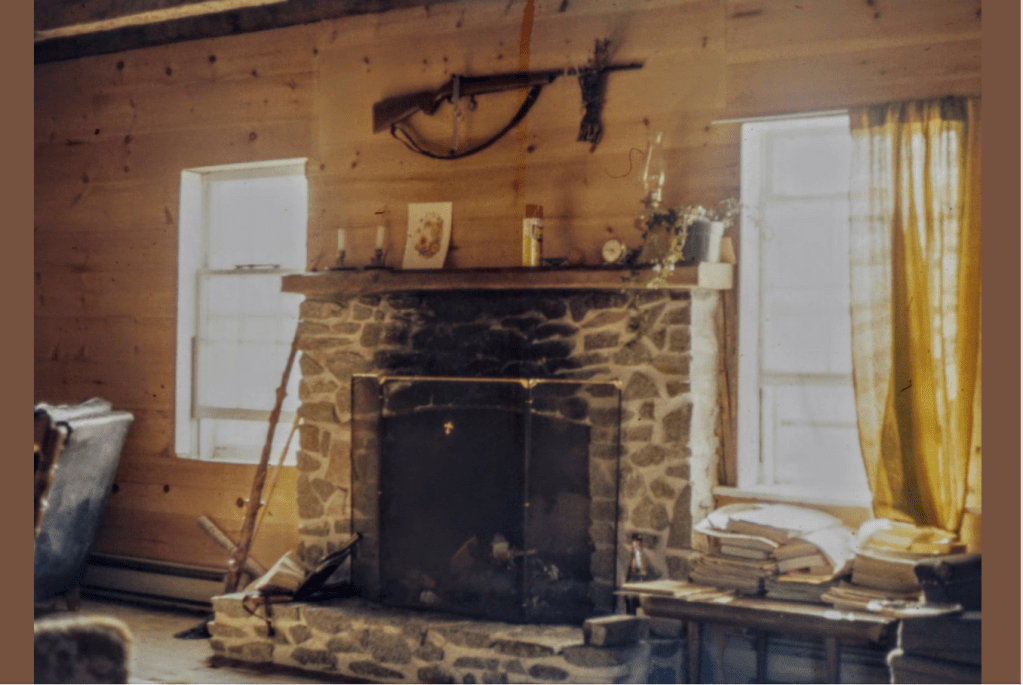
The first big decision was how to the heat the house. In spite of over one hundred acres of woodland, almost all of it was small wind blown spruce. Most of the farms along our road had wood lots with hardwood farther up the mountain. Our farm didn’t have one. After a lot of discussion, we decided to put in electric baseboard heat supplemented by a fireplace and eventually a wood kitchen stove. At the time it made sense. High efficiency wood stoves had yet to break into the market.

I became the electrician. I installed our 100 AMP electrical panel and ran wiring throughout the house. At the same time I hired someone to build us a new brick chimney and a stone fireplace. I also hired a local with a backhoe to run plastic pipe across our dirt road to a very good spring. Next I installed a shallow well pump in our cellar along with a hot water heater. I got the water running to the kitchen first. Getting the hot water to our newly planned bathroom in the upstairs of the house was a bigger challenge since we had to build the bathroom, install a toilet, shower enclosure, and sink. It was almost fall before my plumbing efforts got the shower running with zero leaks in the copper pipes.

Once the plumbing was installed and all the electrical wiring was done, we started installing our wall and ceiling insulation. We also started painting the outside of the house after all the shingle repairs. We got some of our tongue and groove pine paneling installed.

As fall approached, I bought a chain saw. I bought the easiest saw to get in the area. It was the first power of the tools to be replaced. I got it right the next time when I purchased a Stihl 028AV chainsaw. The Stihl stayed with me from around 1977 until I retired it 35 years later. The original circular saw and drill were also retired then. Good tools last.

The original chainsaw allowed us to cut a few pickup truck loads of wood each year while we lived in Nova Scotia. There was some hardwood at the edge of one my fields. The wood turned out to be more important than I first guessed when in September 1973, just after I got married, an early season snow storm took our power out for a week.

Early in that first fall, I installed a new refrigerator, new electric stove, a huge chest freezer and an electric dishwasher which was a gift from my mother.


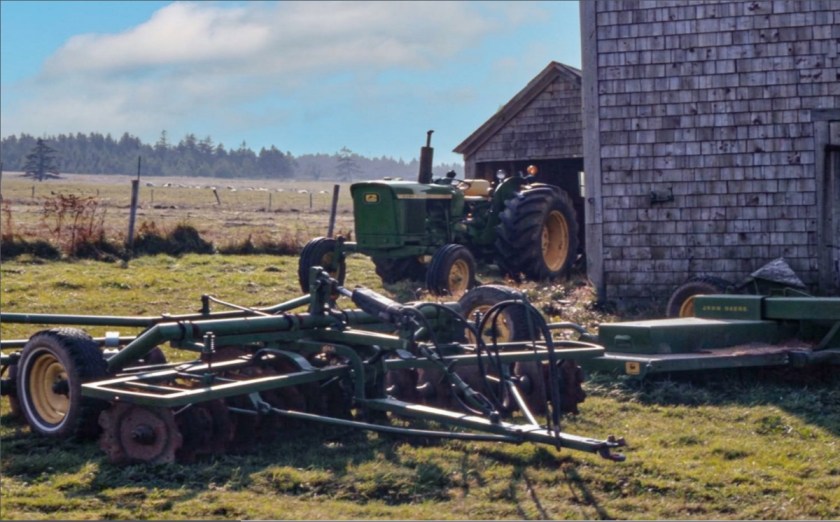
The next phase of the adventure started when at the end of September, I bought a tractor, disc harrow, mower, bush hog, plow, front end loader and manure spreader. They were all tools that would stay with me until I quit farming over a decade later.


By Thanksgiving of 1971, we had heat, the fireplace, a shower with hot water, a functional kitchen, one bedroom, our great room with a fireplace, and an upstairs still to be finished. Our kitchen cabinets were still wooden egg crates and our glasses were old mayonnaise jars.


That fall more college friends from the states visited us and we managed to cook the first turkey that any of us had ever cooked away from home.

The Leap of Faith

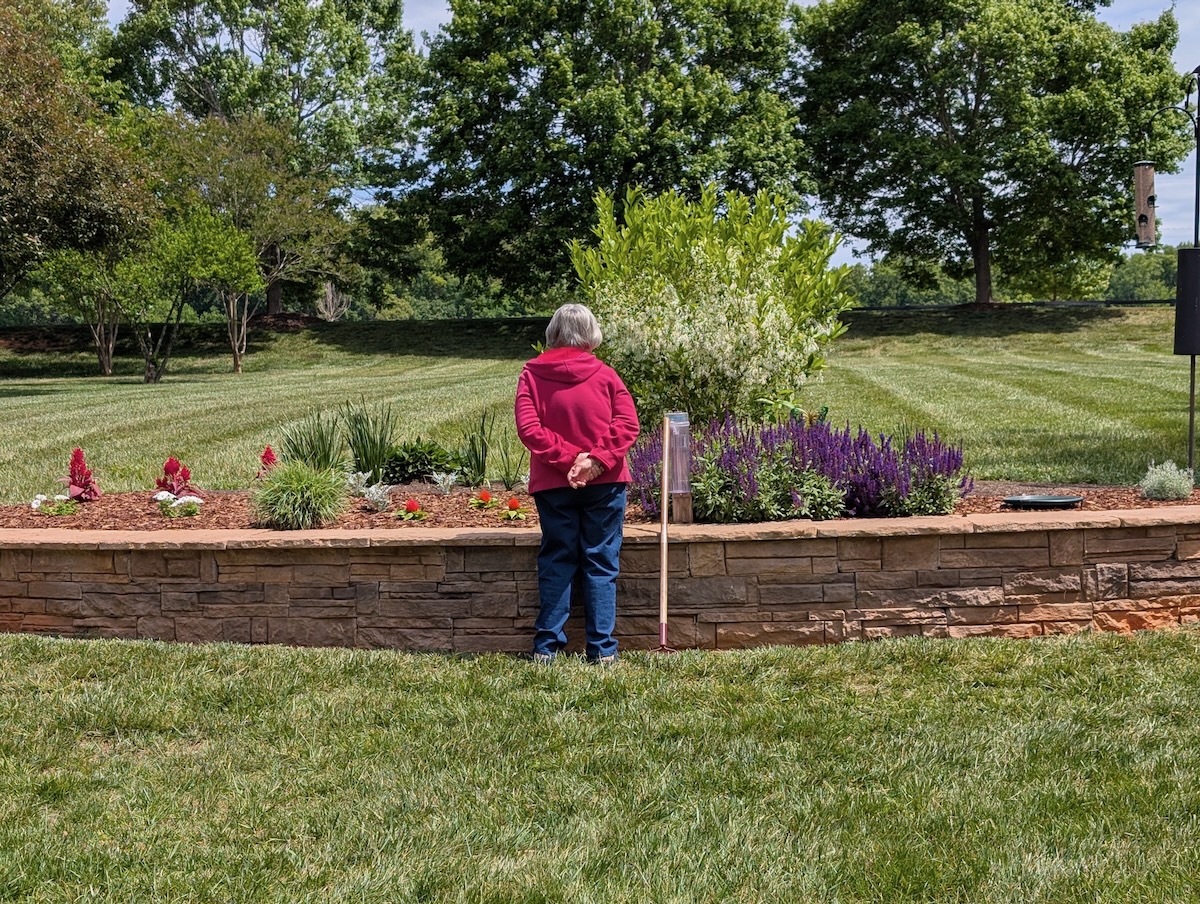
My wife deciding what plants are needed to finish out this year’s garden

Life is full of decisions. Some of them are major ones that can change the trajectory of your life and others are seemingly small ones like trying to decide which flowers we need to fill out this year’s garden. My wife has been handling the flower beds for over fifty-three years since she planted our first flower bed in St. Croix Cove, Nova Scotia. The flowers might not always have turned out as she planned but we have always enjoyed them.
Most would agree that our country feels different today than it did thirty years ago. A lot fewer houses have flowers now. My mother would have considered no flowers a dereliction of duty and a sign that no who cares about the world beyond them lives in the flowerless homes.
Even ignoring the toxic politics, people are more cautious especially since the pandemic. Also I see far less risk taking. No longer does the decision to stay close to home raise any eyebrows. Getting out on your own is an often insurmountainable challenge without help from others. The farther you are from home the farther you are from a supporrt network you can count on when you need it.
Planning for a move, assessing the potential benefits, and taking a risk on another life in an unfamiliar area far from home drove much of the change in our country until recently. Among my generation born around 1949, we could not wait to get as far away from home as possible. In my case, I started in North Carolina’s Piedmont, went to military school in Tennessee and college in Cambridge, Massachusetts. After college I moved north to Nova Scotia. It took thirty-five years to get back to North Carolina another fifteen to get within thirty minutes of where I grew up. It was a long circuitous jouney.
Life does not come with a manual that gives us instructions on the steps we need to take for a successful existence and there are no guarantees. If you are lucky enough to have older adults in your life, you can seek their advice but with today’s speed of technological change they might be of little help.
I grew up with a single mother who was born in 1910. I was the first of our family to go to college so I was on my own at a early age with just one piece of advice from my mother ringing in my ear. That advice, be the best that you can be at whatever you choose, was great advice but only covered a few situations.
The result was that I learned to think for myself at an early age. Not all my decisions were perfect but in the grand scheme of things they were all workable. The first big decision was to not take the law boards. Instead I took a $6,000 gift from my mother and bought 160 acres with a 250 year old farmhouse and barn on the Nova Scotia shore of the Bay of Fundy. It was a leap of faith for both my mother and me.
The move turned out to be good first steps to becoming a cattleman and eventually a director at Apple Computer. Times were very different in 1971, when I graduated from college. The only ways back then to research something was in person, by mail, books, or telephone. Long distance calls were very expensive and the mail took forever it seemed. Still those were the only tools available when making the final decision to buy my Nova Scotia farm.
Over the years my wife and I faced a number of big decisions that became turning points in our lives. Ten years and 200 head of cattle into farming in New Brunswick where we found the farm of our dreams, we were faced with twenty percent interest rates. We decided to sell our cattle and I would go to work in town. We had been successful because of the support network we had built in the tiny farm village of Tay Creek, New Brunswick. Even there it was not an unusuable decision in the world of small farmers to take a job in town. It was also a time when things especially in the computer world were moving rapidly. Two years after going to work in town, I was working for Apple and we were moving to the big city of Halifax, Nova Scotia.
Eventually, we made another leap of faith and moved our family of five to the states. It was a side step on my career but we judged it better than moving to Toronto. It worked out in the end eventually landing us in Roanoke, VA where all our children graduated from high school and eventually college.
Today is a different, less friendly world with steeper entry points to good jobs. I wonder if there is too much conflicting information available. It is easy to get overwhelmed with all the online opinions, evaluations and recommendations compounded with the difficulty of getting a good job. Making a meaningful decion is hard if your brain is overloaded with information. Much of the online informaiton is something of a rat hole which sucks you into vortex with no clear answers. To effectively make a decision you need to be brutal in discarding the opinions of others. What one person loves, you might hate. My wife and I have often made lists to evalutate our moves. We have moved enough that we can focus on the things that are important to us. We have learned it is important to set goals with our moves and to hold those goals tight.
Comparing the process for my first house purchase in 1971 to our most recent one in 2020, is an interesting exercise. We were in our fifteenth year living on the North Carolina coast when we made another leap of faith. We decided to leave the coastal paradise and people that we had grown to love. We wanted to be closer to our grandchildren, our remaining relatives, and better services especially medical ones than what we had at the coast. The Internet was our primary search tool. We made only two trips before picking a home, but we had a tight list of requirements that kept us focused on our needs. Moving during a pandemic was no picnic, but with the information that we could find on the Internet and a very good real estate agent, it was much less of a risk than my original move to Nova Scotia. Hardly anyone worked from a home office in the 70’s but today it is pretty common and my home-based job gave us lots of flexibility. It also helped that I was familiar with large part of the area where we moved from living here as a teenager.
The house purchase in 1971, involved a few letters, some tourist brochures, one trip to Nova Scotia to look at the house. Another trip a couple years earlier helped me fall in love with Nova Scotia and helped kindle a flame for Nova Scotia. Still it was a lot of faith for someone only twenty-two years old to pick up and move to another country where I knew no one.
I hope the environment in our country changes so people can take more risks that have the potential to improve their lives and the lives of everyone around them. If we had healthcare for all, mobility would be easier. There is an argument for staying in one place and developing intimate knowledge of one area. I know some people who have thrived living in one area and others who have become insular and perhaps jealous of others who have seen more of the world I believe the arguments are much stronger for spreading you wings and being the new person or outsider in the area a few times in your life. Living where you are the outsider builds tolerance, patience, and acceptance, all values that are hard to find today.
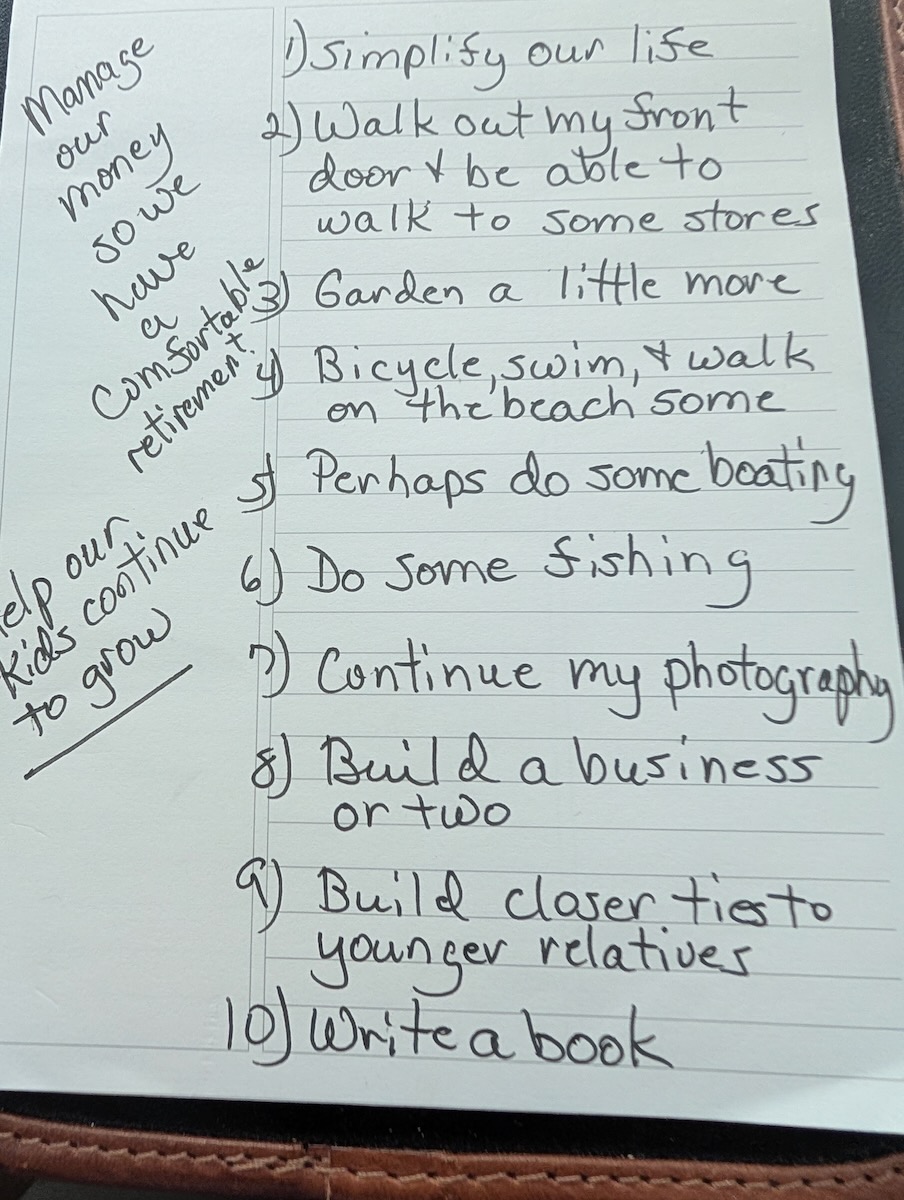
Below is list of goals that we drew up in 2005 before our move from Roanoke, Virginia to Cape Carteret, North Carolina. We did pretty well on the list.

We did simplify our life and downsized to a home one half the size of the one where we raised our children. We were unable to find a home we could afford where we could walk to stores but giving up the stores gave us better access to water.

We gardened a lot more, our beds produced three crops a year. In 2017, I did over 10,000 steps a day for 365 days with many of those steps being along the beaches of Emerald Isle. I could often be found biking in our neighborhood late in the evening or in the early morning swimming a few laps in the pool that was a five minute walk from our home.

I piloted my 20 ft Sundance Skiff over 600 hours on the White Oak River, in Bogue Inlet, and the Atlantic Ocean.. I was a regular feature on the White Oak River in my kayak which I could slide into the water from my backyard. I caught more fishi in the ocean and river than I dreamed possible.

I took hundreds of thousands of pictures, and even published a Kindle picture book. I tried a couple of small businesses on my own but the real estate world was in collapse so I ended up joining a fiber network startup as a Vice President. I spent the last fourteen years there until retiring in 2025. We didn’t have much luck with younger relatives but I did write five books and a few thousand blog posts. I feel the leap of faith that led to adventure was worth the risk.

A Measure of life we all should take

Sunrise on another day in our backyard

When my first grade career started under the watchful eye of my mother’s first cousin, Ms. Conrad, I was only thinking about what it would take to make it to the end of day. Then I could walk home, play a little football with friends, watch the evening news with my mother, and do my homework with some help from Whiskers, my cat. There was no thought of where the next seventy plus years would take me.
It is a lot easier to look back on seven decades than to imagine the future when you are six years old in a rapidly changing world. Now it makes sense for me to look back. I retired about a year ago when our company went out business. Our business dried up with changes in government funding. Since then I came back and worked one stray project but there haven’t been any others in eleven months. We weren’t building buggy harnesses, we were analyzing needs and designing fiber networks.
My first thought is that I am happy to have worked for the last fifty-six years in a number of productive roles. I consider myself even more fortunate to have worked from home the last fifteen years. I worked hard, maybe too hard during large parts of my life, but I do remain proud of what I have done.
Still it is important to acknowledge that your work career is not your life. How you measure your life probably says a lot more about the person you have become than almost any summary you could write.

My overall measure of life is to look and see if the places, people and organizations that I have touched are any better off for my having been there.

Digging deeper, I look at the kind of people that our children have become. Then, I look at the kind of life we have lived. Did we help others when possible, were we kind and respectful people, did we strive to give more in relationships than we took? I also look at what we learned from life, how much we enjoyed the things we have done, what kind of relationships did we build including those with our spouse, parents, children, grandparents, and friends. I don’t seek to measure anything precisely or to see how close to perfection we got, I just want to understand if our good intentions came through. To have more friends than we started with in first grade isn’t a bad accomplishment especially if you have managed to keep one of those first grade friendships going.
It is not important to me that every person I have met likes me because I have run into some not so nice people along the way. If they tried to harm me or those working for me, I hope they remember that I always stood up for what was right even if it made some people unhappy or came with a personal cost. There are also some people with extraordinarily thin skin who expect to be treated like the privileged person that they have adopted for their persona. You can never do enough for these folks because they will always be slighted by something you said or did which would not bother a normal person. I happy to let these folks stew in their own juices on the sidelines of my life. Whether they ended up liking me or hating me is irrelevant. That handful of people like that intersected my life for varying periods of time is hardly matters because they were just passing through.
Finally in measuring our lives, we have to look at the times we have lived through. I lived in Canada for sixteen years and over sixty years in the United States. I can remember things that touched me throughout life, the polio epidemic, President Kennedy’s assassination, Nixon’s election, the Watergate hearings, Vietnam demonstrations, moving to Canada, the energy crisis of the seventies, 20% interest rates in the early eighties, the Quebec separation crisis, the 9/11 attacks, the Iraq and Afghanistan wars, Obama’s election, COVID and Biden’s four years in office. I have lots of other memories especially of farming in Canada, my twenty years with Apple, and the fifteen years living on the North Carolina coast. For over fifty years the challenges thrown our way have been ones where we could adjust our lives and get on with it. Only recently has that changed.
Governments have come and gone, we have lived our lives. Then Trump and the MAGA movement showed up. The first four years were bad but largely erased by the peace and sanity of the Biden years. Now Trump is back and the threat to our country and the life we have lived is immeasurable. We wake every day wondering what the idiot in the White House has done overnight. If we were ten or fifteen years younger, we would move back to Canada. I don’t want the final chapters of my life written from within the confines of Trump’s world of hate and violence. I fight Trump world with the written word and my voice. The hope we nourish is that we can finally have justice in the White House. We must demonstrate to the world that no man is above the law in America.

Yards Connect Us To The Soil

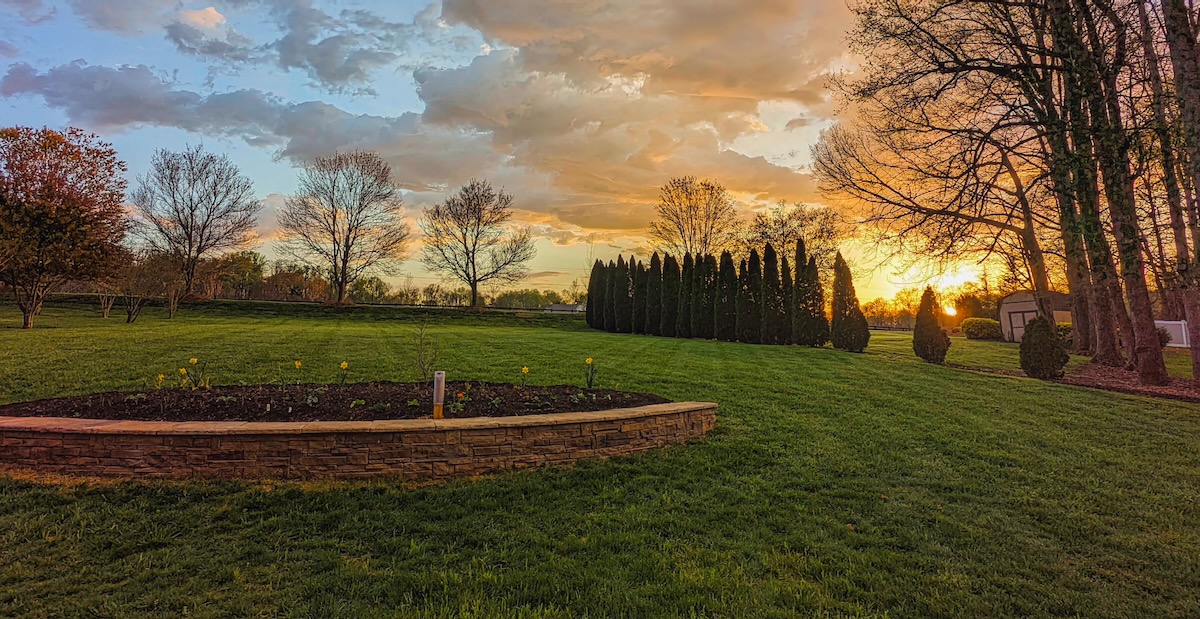
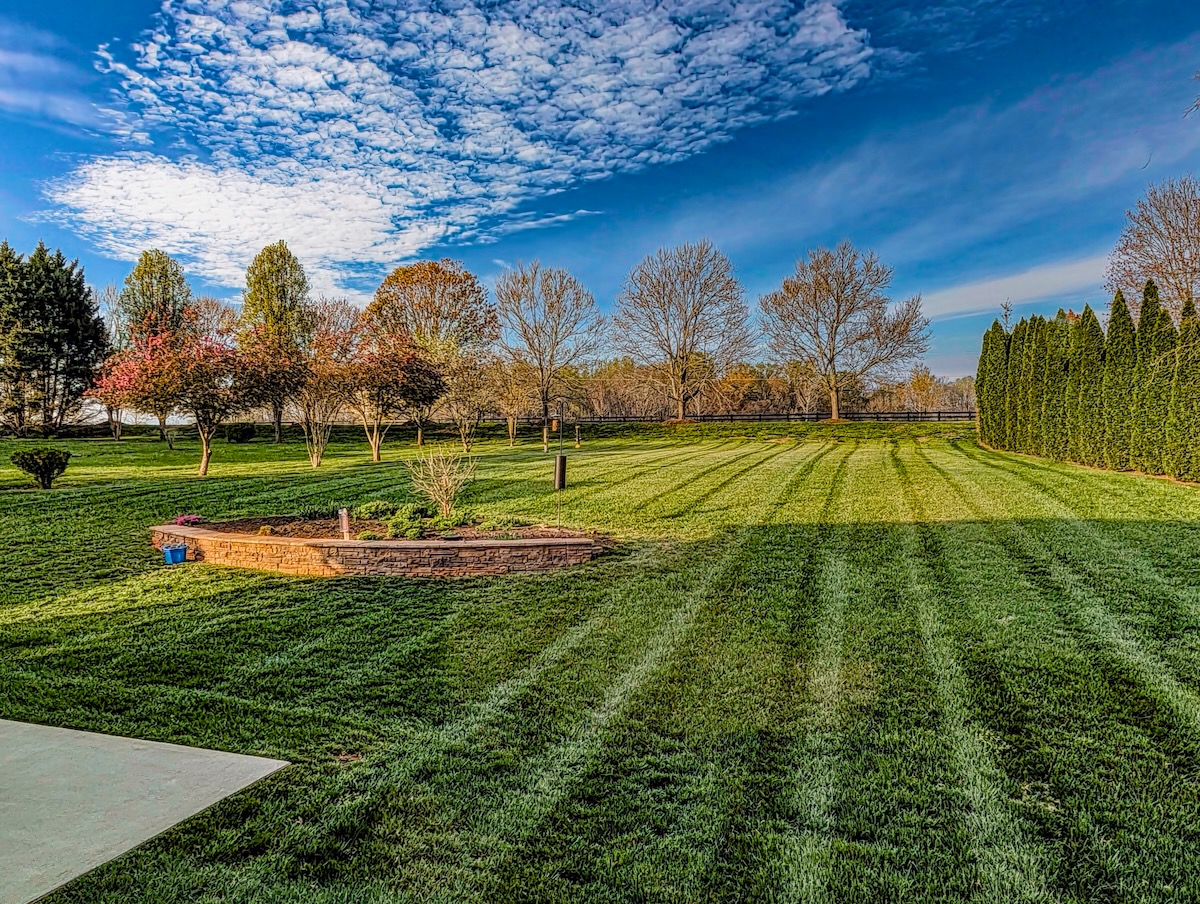
Our Backyard After The First Mowing Of 2026

People outside the cities in the first half of the twentieth century likely kept their connection to the soil by gardening and small-scale farming. By the time I was growing up in the fifties in Lewisville, North Carolina, yards, flowers, and shrubs had largely replaced gardening for food as a connection. As a youngster the condition of our grassy yard often stood between me and a trip to my uncle Henry’s fishing ponds. My mother who claimed the only yard she had as a child was packed dirt swept with broom straw wanted our American-dream yard neatly clipped. In driving by our old home, I am little disappointed the town did not put in sidewalks in front of our house during my youth. It would have eliminated the slope on the front yard. It was by far the hardest part of the yard to mow as a youngster.

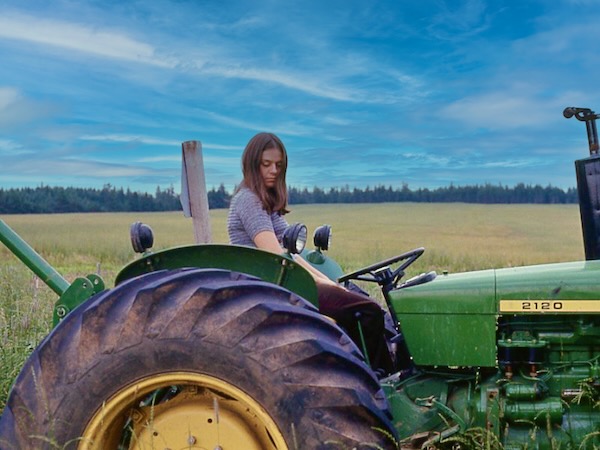
Going away to military school (high school) and then college got me out of mowing yards for almost a decade. My first home after graduation was a two-hundred year old farm house located in a sheep pasture on the Fundy coast of Nova Scotia. No sheep came with the old farm house but long grass around the house did not bother me as a young farmstead owner. When I first moved there in the summer of 1971, the yard was the least of my worries. Getting hot water plumbed and running so we could stop taking showers at the local campground was close to the top of the list. By the second summer I had a tractor with a nine-foot-wide bush hog which I used to mow around the house a couple of times a summer. That was all I judged it needed in my days of being single. After all, I mowed plenty of mature grass or hay, starting with the twenty acre field behind the house which served as one of the few very nice backyards in my adult life.

Then came the summer of 1973, and I married Glenda, the love of my life. She came from the world of well-manicured yards in North Carolina. Her mother often mowed their yard twice, the second time against the grain, just to catch any grass that might pop up after the first mowing. Sometime during the summer of 1974, Glenda decided the long grass had to go. She and my neat-lawn-loving mother who was visiting us formed a conspiracy. They drove down the mountain to Bridgetown ten miles away and came home with a Toro push mower. The yard became manicured soon afterwards. I spent much of the next forty-forty years sharing the task of mowing whatever yard happened to be attached to our personal home.

For the ten years or so when we lived on our farm in Tay Creek, we had a nice riding lawn mower which was adequate for much of the yard. Even Glenda did some mowing. When we lived in Halifax, our yard was postage-stamp sized. By the time we arrived on the mountain in Roanoke, Virginia, I had come to somewhat enjoy mowing. There are those times in your life when something as simple as mowing a yard can be very satisfying because you can actually see what you have done.

One of the immutable laws of mowing is that the farther south you live, the more miserable the task of mowing can be. Sometimes, even the most careful home yard person can end mowing in the oppressive heat of the day like I did more times than I want to admit after we moved to the North Carolina coast. As I wrote then, there is a true brotherhood of Southerners (both men, women, and teenagers) who have mowed yards when they never should have. I almost had a heat stroke once mowing our big yard there.

Mowing is one of those circular things in life. In your early years, you are too young to push a mower, so it seems fitting that in the later years of life, it is also okay to be too old to push a mower. You come to a point when you are faced with either hiring someone to mow the yard or buying a riding mower which I’m told requires better reflexes than we older folks have. Since I spent many years straddling a John Deere farm tractor, we chose not to revisit those days after a back problem slowed me somewhat. For a couple of years, I shared the task with our mowing service, choosing the hard spots that required a push mower for myself. However, it was an easy transition to giving it all up. When we made our 2021 move from the land of coastal centipede grass back to the fescue grasses of the Piedmont, we left our third Toro mower with the father and son team that was doing our mowing. I even gave them my gas-powered trimmer. After all by then i was over 70 years old.

When our current, very capable mowing team shows up, I know the noise will be over with in a few minutes as opposed to the hours that it would have taken me with a push mower. I still enjoy our green space especially the backyard which is the nicest we have had since that twenty-acre field that came with our first home.

We are trying to go more natural in the backyard by not using any chemicals or herbicides. I would like to see more fireflies and butterflies like I remember from my youth. No one ever worried about a little clover showing up in your yard in those days.

We continue to garden a little like old southerners are supposed to do. However, I have backed off the serious gardening that I did in 2023 and the slightly less ambitious garden of 2024. My six Cherokee Purple tomato plants produced over four hundred and eighty tomatoes in the summer of 2024. We had to sell some at a produce stand after we filled our freezer. Last summer we cut back to three tomato plants. This summer maybe we will have one or two, but I have already been out digging in the garden getting it ready. There is no danger of me losing my connection to the soil for a while longer.

Travel Enriches Life

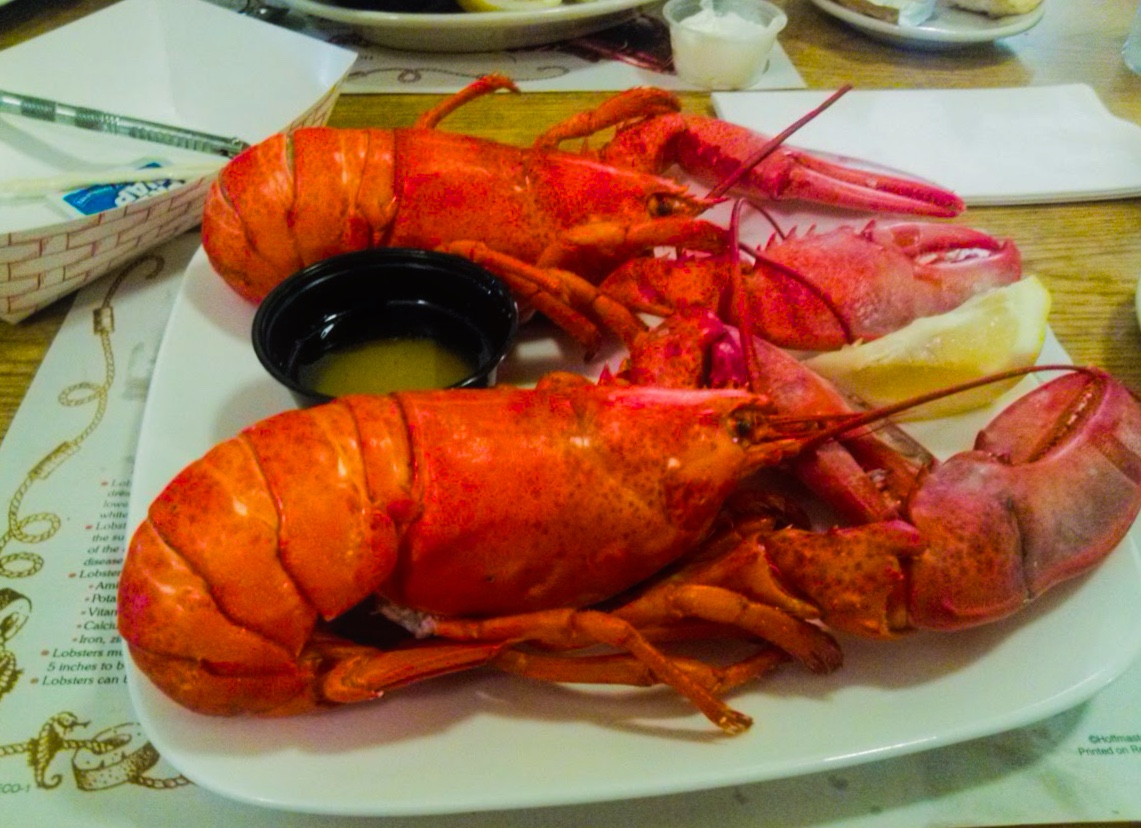
Maine Lobsters from a 2012 Trip to Canada

I have been accused of being born with wanderlust in my soul. I suspect it is true. The urge to travel was nurtured by mother was traveler in her own right. At the age of twenty-six she went to the World’s Fair in New York City, managed a boat trip up the Hudson, a visit to Niagra Fall, and took the train to Chicago and dropped down to Kansas for a visit. She might have had someone with her on the New York part of the trip but I am pretty sure that she was alone on the Kansas leg of her journey. She was a single mother, but she would throw me into the old 1953 Ford, hand me a map, and say let’s go to the beach. Often the back seat had two or three of her neices that were ten years older than me. When she was in her late sixties, she managed a solo air trip from North Carolina to Nova Scotia by way of the ever complex Boston airport. She was never afraid to travel and once she call too old to make long drives herself, she always found a driver. I like to think she taught be how travel and enjoy it with not a lot of money
There are people who never want to leave home. I am not one of those people. Part of me wants to see what is around the next curve or over the top of the next hill. Not only do I want to see it, I want to experience it. I still remember seeing the Montana mountains towering above the plains on my first cross-country trip when I was seventeen and traveled with a nineteen year-old friend in 1966. Seeing mountains so different from those near me made me want to see more serious mountains. We briefly slid into Canada into on that first trip. In 1969, I got another opportunity when a college roommate and I drove to Alaska. We went right up the spine of the Rockies.
While some take pleasure in knowing a community intimately, I find my pleasure of living in a community is greatly enhanced by having seen and even lived in other communities. Living in a wide variety of places makes you appreciate where you live. For the most part, the communities that I have figured out have been warm welcoming places where you feel like making a home and improving your surroundings.
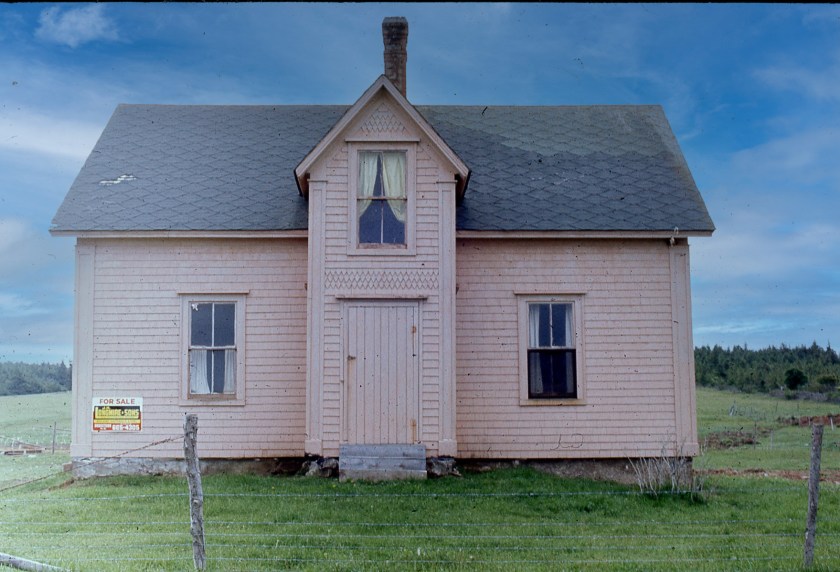
One rule has been my companion, always try to leave a place better than you found it. The first house I bought for six thousand dollars was pink and something of a wreck when I first found it and convinced my college roommates to help remodel it. Though it was not finished when I left three years, it had been stripped to walls, insulated and rewired. It got copper pipes, a new roof, new pine paneling, a new chimney and fireplace, a new bathroom and water supply. We also created a great organic garden and put new roofs on the barn and brought the hayfield back to life. The house looked a lot different when we left.
St. Croix Cove along the Bay of Fundy was not the right place for cattle so we found an old farm in New Brunswick. We didn’t do much to the New Brunswick farm house other than paint it and add a chimney but we built two huge barns, renewed some pasture, and turned another abandoned farm into great hay fields. We farmed until twenty-two percent interest rates pushed me into a job in the city.
By then responsibility for a family had put my wanderlust in the backseat so we went where the job took me and that was Halifax, Nova Scotia. Halifax was a wonderful place to figure out. We would still be living there but we learned most children had to go to Toronto, Alberta, or British Columbia for jobs. We fled back to the states and eventually ended up on the top of mountain overlooking Roanoke, Virginia. We were there when we took our children on their three week journey around the country. I hoped that travel might get in their blood, but perhaps home was too comfortable a place. Though they have traveled, it has never been just for the thrill of it like I have done most of my life.
When I was still living in Nova Scotia and not yet married, I ventured off to Newfoundland and dreamed of homesteading there. My new wife put an end to that but she was okay with farming in the hardwood hills of New Brunswick where we built our cattle operation. She was also okay with leaving all the friends we made during our twenty years in Roanoke for an extended adventure on the North Carolina coast which she grew to love.
We went to the coast wanting to be out on the water. At the age of fifty-seven, I began the journey of becoming a capable boater in the challenging waters of the White Oak River, Bogue Sound, and the Atlantic Ocean. I logged over 500 hours at the helm of my skiff until someone convinced me that seventy years was too old to be boating out in the Atlantic by yourself. Figuring out the coast and how to prepare a house and boat for a hurricane was a lot more complicated than I imagined, but we did it. We stayed through Category 3 Irene and in sixteen years there only evacuated for Florence. While living at the coast, we made a trip back to our Canadian stomping grounds in 2012. On that trip in Bangor, Maine, was where I found those beautiful lobsters.
You can have wanderlust but still want to enjoy and thrive where you are. We added to and improved every house where we lived. We made the places ours . Even after leaving the farm, isome places we were able to have extensive gardens. Our gardens were amazing around our coastal home and here in the Piedmont.
Perhaps the most unique change we made to a place was the small house that we built on the upper back porch of our coastal home. we created an amazing home but there too many steps for our aging knees. In 2021, we looked foreward to a move from the coast to the piedmont. Because we were old there was some exhaustion mixed with excitement, but we have enjoyed getting to learn our new area. I still miss the marsh and all the creatures there, but I have lots of pictures. The trips now are much shorter now but my mind wanders freely.

Where the roads end

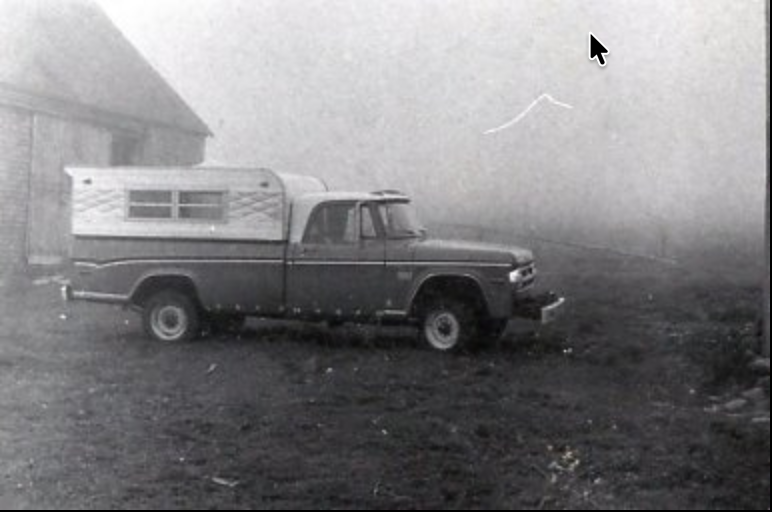
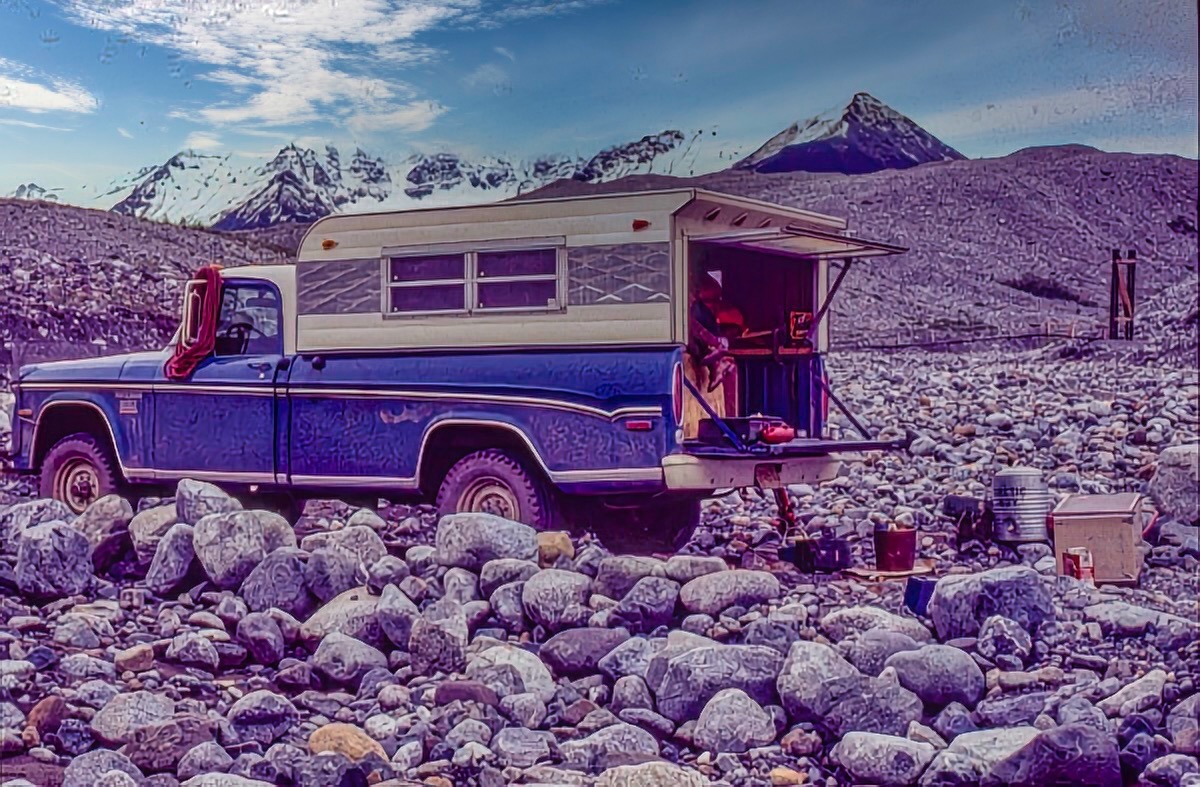
My Dodge Powerwagon at the end of the road on the way to Denali, Summer 1970

Americans are famous for their Sport Utility Vehicles (SUVs) that never leave the paved roads. Unfortunately, some people get behind the wheel of a SUV with the belief that it makes you invincible. There are a few things I have said in life that seem to have some staying power. One of them is that all an AWD, 4WD, or SUV will allow most people to accomplish is to get stuck in a more difficult to reach place.
I have been stuck or broken down in some pretty remote places like the one above a few miles off a road in Alaska. That vehicle had a winch and it was useless in that situation. Farms are places where people can really get stuck. However, the rule on a farm is do not get the biggest tractor stuck unless you have the gear to pull it out. We kept an old bulldozer around for that. It got used for that.
Our herd of cattle wintered in the woods about a mile from the barns and the area where I kept the round bales of hay. It was not unusual after a big storm to blow the road to cows at night. One night after a particularly nasty storm when the temperature had already dropped into the minus twenties, I was blowing the road. I had successfully cleared one lane out to the cows and I was headed back widening the cleared road. As you get within a quarter of a mile of the barns, the road dips down into a small valley and crosses a culvert. There is a small pond on one side of the road and the culvert that allowed for overflow from the pond on the other side. I had a rear mounted snowblower that cleared eight feet of snow at a time but because it was rear mounted, you backed the tractor as you blew the snow. That gets a little tiring after an hour or so. The tractor had a nice unheated cab, weighed about 12,000 lbs., and ring chains on the tires. They are necessary on farm roads which often have ice as a base coat.
Just as I started across the culvert one of my large rear tires slipped off the road into the pond. Fortunately the pond wasn’t very deep but it still put the tractor in a precarious position. Experience told me the best thing to do was to wait for daylight and get a neighbor to help me pull it out. I walked home and spent my dreams figuring out how to retrieve the tractor.
By the next morning the temperature had dropped to minus twenty-eight degrees, but it was no problem to get my farm helper who was in his sixties to go with me to unstick the tractor. It was a complex operation. I loaded a generator in the pickup, some salt and a chain saw along with our three quarter inch logging chain.
First we drove down to the tractor, started the generator and hooked it to the recirculating block heater that would hopefully warm the engine of the tractor so we could start it. Next we made cuts into the ice around the tractor’s wheel that was now frozen in ice. We put salt in the cuts in the ice. While all that was working we went to start the bulldozer. It was a very old Cat D5 bulldozer which originally had a small gasoline motor that you started and used to start the big old diesel. Unfortunately the gas motor had died shortly after I got the bulldozer and I found it would cost more to replace it than the bulldozer was worth. However, we quickly discovered that towing the bulldozer six feet would start it. I had another large tractor and we used that to start the bulldozer that cold morning.
I drove the old 16,000 lb. bulldozer down and positioned it so we could hook the big chain to it. My neighbor got in the stuck tractor and fired it up. All he was supposed to do was steer the tractor. I moved the generator to safe ground, got on the bulldozer and carefully pulled the stuck tractor out of the shallow pond. While the actual pulling seemed effortless for the bulldozer, It likely took us two hours to get to that point. It is unlikely that I could have gotten a wrecker out to do the same thing without the wrecker getting stuck. We were fortunate to have the equipment. Most of the time when you get stuck, you have to make do with what you have.
Not every time you get stuck is going to be that complicated but as I said if you wander far off the road, you run the risk of being stuck in a difficult place. We were actually stuck in the picture at the top of the post. The locking hubs on our four wheel drive quit working. I had to take one hub apart and adjust things. Fortunately, I had the tools to do it.
With many four wheel drives vehicles all you have to do is get one wheel spinning and your vehicle might as well be a turtle on its back. I am a big believer in chains for ice in spite of the pain putting them on a vehicle. Chains make more difference than either four wheel drive or AWD.
AWDs are also not all created equal. Some will get stuck in nothing and some will walk up a mountain of snow. My old Acura MDX has a locking mode that is amazing but I still avoid ice.
Just after the first big snowstorm of the year is not the time to figure out how good your vehicle is at getting stuck. At a minimum, an emergency kit includes a tow strap, shovel, a square piece of 3/4 inch plywood, gloves and a good jack which should be a bumper jack if you are headed into sand or mud. If you have a winch on your vehicle, be very careful, they are exceedingly dangerous if you don’t know what you are doing,
Sometimes I miss living up north. Once the ditches were full of snow, the safest thing you could do to avoid an accident was to drive into a snow bank and get stuck on purpose. I avoided a few accidents that way. Most were close to home and only walking distance to one of those big tractors.

The Worthwhile Journey North

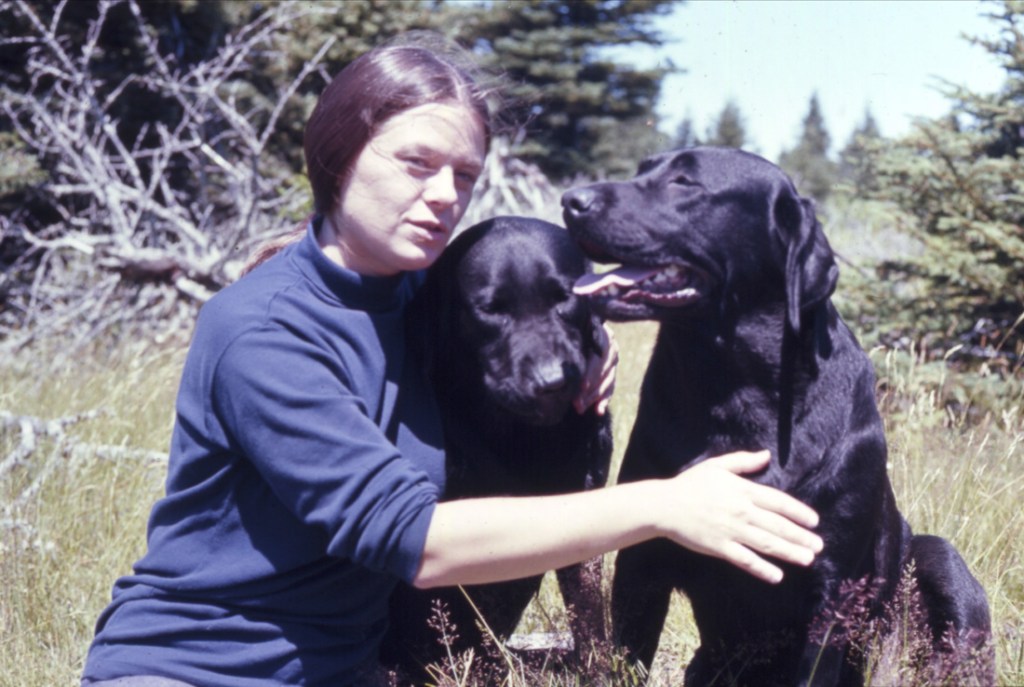
My wife, Glenda, at the head of our hayfield in St. Croix Cove, Nova Scotia. She is accompanied by Tok, one of our Labrador Retrievers

My seventy-seventh birthday is coming up in a few weeks. The thought of being that old has prompted a lot of introspection. Someimes we know why we do something but there are some forks in the road where our motivations might not be so clear. There are also things you remember which make you wonder how much influence they had on your decisions. I was in high school, a military one, when President Kennedy was assasinated. I remember the deaths of Robert F. Kennedy and Martin Luther King. I also vividly remember the election of Richard Nixon, the Vietnam War demonstrations and the feeling of relief when I found out that I wasn’t going to get drafted to fight a war which I thought was wrong on more than one level. When I graduated college, I went back to the land on shores of the Bay of Fundy in Nova Scotia. Some dissatisfaction with the political direction in the United States helped direct me to the north in 1971.
I spent first weeks of 2026, entertaining myself with YouTube videos of the new generation of homesteaders. Many of them are young, and all that I have seen appear to be healthy enough to handle all the wood splitting required to live off grid. I often wonder how their lives might change a few years down the road when their families include two or three children who need educating while the unrelenting work taking care of farm animals demands much of their time. Some of these homesteaders seek purity and will not even consider using a chainsaw. Others seem to believe that doing everything with used equipment shows their dedication to a different kind of life with ingenuity and a dose of poverty. Some fully embrace ATVs, snowmobiles, tractors and even excavators. Most it not all of them embrace solar power. There is a propensity for them to have goats and chickens with few pigs and cattle sprinkled around. Some have subsistence permits and live off Alaska’s. bountiful salmon and wild game. No one seems to have the land to grow their own hay, but many are investing huge effort into growing vegetables in places were vegetables are very hard to grow. Some have very young children but very few have teenagers. I am sure there are many reasons why they are living off grid or in my world have gone back to the land. They will likely wrestle with their decisions as they get older. A few have figured out how absolutely brutal longterm homesteading is on the homesteaders. It will be interesting to see how many are still around five eyars from now.
Long before I graduated college in the summer of 1971, I wanted to move north There were all sorts of reasons but four years at military school along with four turbulent years at college set the stage. My freshman year (1967) at Harvard, I was one of three students out of 1,500 in our class from North Carolina. At the time North Carolina was a rural place, and I had grown up loving camping, fishing, and wandering the woods. No one from our family had ever been to college so there was no famial advice to lean on for a career. My single mother raised me by running a beauty shop in the back of our house. Her one piece of advice was whatever I chose to do, I should do it to the best of my ability. She had grown up on a mill pond with a father who was a miller. She had become the lady of the house for her five sisters and brother at the age of nine when her mother died in 1917 flu pandemic. She left home by her middle teenage years when her father remarried..
With those ties to the land and the family of one of mother’s sisters still farming, it was not a stretch for me to want to go back to the land and farm. A trip to Alaska and another to Nova Scotia fanned the flame. In the spring of 1971, I found an old farm on the Nova Scotia coast that was listed for $6,000. It included an old farm house and 140 acres with about thirty acres of that in a hayfield.
Restoring the old house, buying some farm equipment and a few cows are all part of my history. When we decided to get serious about farming we moved to New Brunswick where we built a farm where we eventually had sixty-five cows calving every year.
There were lots of other easier paths to take to adulthood. I needed a path that let me learn everything the hard way. I learned how to wire a house and do copper plumbing by reading Sears How-to-do-it pamplets. I learned to farm by reading books and listening to my neighbors in most cases. I built barns with just common sense, skill saws, and a chainsaw. We only left the farm when interest rates got to over 20%. We also made the decision three years after leaving the farm that we wanted our children to know their North Carolina based grandparents and hopefully find lives not far from us.
It was a huge effort to move from the farm to Halifax, Nova Scotia, where I went to work for Apple. It took even more effort to move back to the states.
Now as I sit in my comfortable house eating food from local farms and exotic places like Trader Joe’s, I struggle to remember the day to day challenges we faced on the farm. I can remember all the wood splitting, the hauling it into the woodshed, the years of milking our Guernsey, Rosie. I also remember all those trips, often three times a night, to check for new born calves in the depths of winter. All the work that went into haying and gardening is clearly burned into my mind. The freezers were always filled with beef which is a luxury today. We had more garden produce than we could dream of eating but it was a lot of hard work especially when the black flies were around. We saw weather as cold as minus forty with sixty mile per hour winds and heat over one hundred degrees. We lived on the edge of civilization but most days we had power. We also had the equipment to move snow and take care of 200 head of cattle without hiring another person. There was a ten year stretch with no vacation. When we finally did get a vacation to Prince Edward Island, we did not know how to act on vacation. Farm life was brutally hard at times, often money was very short, but we all slept well at night.
Even with all the hard work, I would sign up for it again but with fewer cattle if somehow I miraculously got a body forty years younger. Whatever the reasons behind this generation going back to the land, it might well burn brightest in their memories like it does in mine.

The Lost Art of Calling Home

The rotary telephone in my home bedroom until 2004

I took a course in college my senior year. It was decades ago. The class focused on communications. Computers were not on the desktop, cameras were film based, and telephones were analog with rotary dials. There was no Internet much less text messaging or cell phones. People still wrote letters on paper by hand. I still have some of my old ones. The other choice for a was a typewriter. In the seventies it was not unusual to find people who did not know how to touch type.
I went away to boarding school at the tender age of fourteen. The weekend call home from the telephone booth in the hallway was a lifeline to family and all that was familiar. You might not be able to predict the person who would answer but you learned how to make the most out of whomever you got on the phone. The old fashioned telephone was a great leveler. If you called one of your friends, you could get their parents, but back in the fifties and sixties, we learned how to talk to adults respectfully.
The weekend call became more of a ritual than a lifeline when we started farming in Canada. It was something that kept us connected long after the art of writing letters disappeared. I still love phone calls to my Canadian friends. I enjoy talking to my friends whether I reach the wife or the husband. These calls keep the web of friendship healthy.
A couple decades ago, a friend died. I did not have the opportunity to say good bye to that friend. It caused me to recommit to finding people who had been important in my life. Over the years I made several car trips to Ronceverte, WV, because that was the only way to really visit with my high school Latin teacher who never went beyond the telephone in the world of electronics. He was a little hard to talk to on the telephone but I treasured our visits. He has been dead several years now. I never regretted the effort I made to stay in touch.
Our trips to Mount Airy, NC and Yadkin County, NC to visit friends and family have gotten fewer and farther between each trip as we have aged. The time we spend with elderly relatives is precious. We have lost several over the last few years but the time spent with them was well spent.
Sharing our lives and communicating with others has given us strength to do things we never would have done by ourselves. It has also connected us to history and stories that we might never have known
We were living at the coast when Hurricane Irene made landfall on August 26-27, 2011, about 35 miles to the east of our home near the beaches of Emerald Isle. We received a lot of phone calls from friends and family prior to Irene’s arrival urging us to head for higher grounds than our six feet above sea level. Irene was our first serious storm in our first five years on the coast.
Interestingly, none of the calls came from our three grown children who ranged in age at the time from the late twenties to the mid thirties. I told myself at the time that they knew we were well prepared and tough enough to handle the storm. At sixty-one, I think that was a fair description of us. We were not people who had led quiet lives in one place all their lives. Still Irene roared for thirty-six hours but we only used our generator for three hours.
Perhaps there was something else at play. Most of us older adults have noted that today’s young adults rarely communicate even though they have far more ways to connect than our generation ever had.
One of the other things besides the weekly phone call that happened at military school when I was fourteen was we had an assignment to write a letter home every Sunday night. It was graded, and mailed home for us complete with red marks. Of course no useful communication ever took place in the letters. The weekend phone call was the lifeline to home.
While I quit shining my shoes every morning like I did in military school when I went away to college, I didn’t drop the ritual of the weekend call home and writing letters. Even after graduating from college, moving to Nova Scotia to farm, and getting married, the calls continued. We added a weekly call to the parents of my wife, Glenda. We also wrote letters in cursive to family and friends. Long distance calls for much of our early married life were extremely costly but they remained important to our mental health so we rarely missed one.
Calling home for all those decades was always something of a surprise, you never knew who was going to answer the phone, but 99% of the time they were happy to hear your voice if not your message. Almost always you felt better after talking to them.
I think the old cold calling home on a rotary phone helped us be the people we are today. It helped us build strong networks of support and advice. It gave us skills that the current younger generations may never master. The world will be lonelier and poorer because of that.

Stay up with the Goose Speaks commentary on our country’s situation in “Time to Trust Our Own Eyes” either for free at Substack on as a simple HTML flat file with a different name, “Time to Speak Out,” at my Crystal Coast website.