
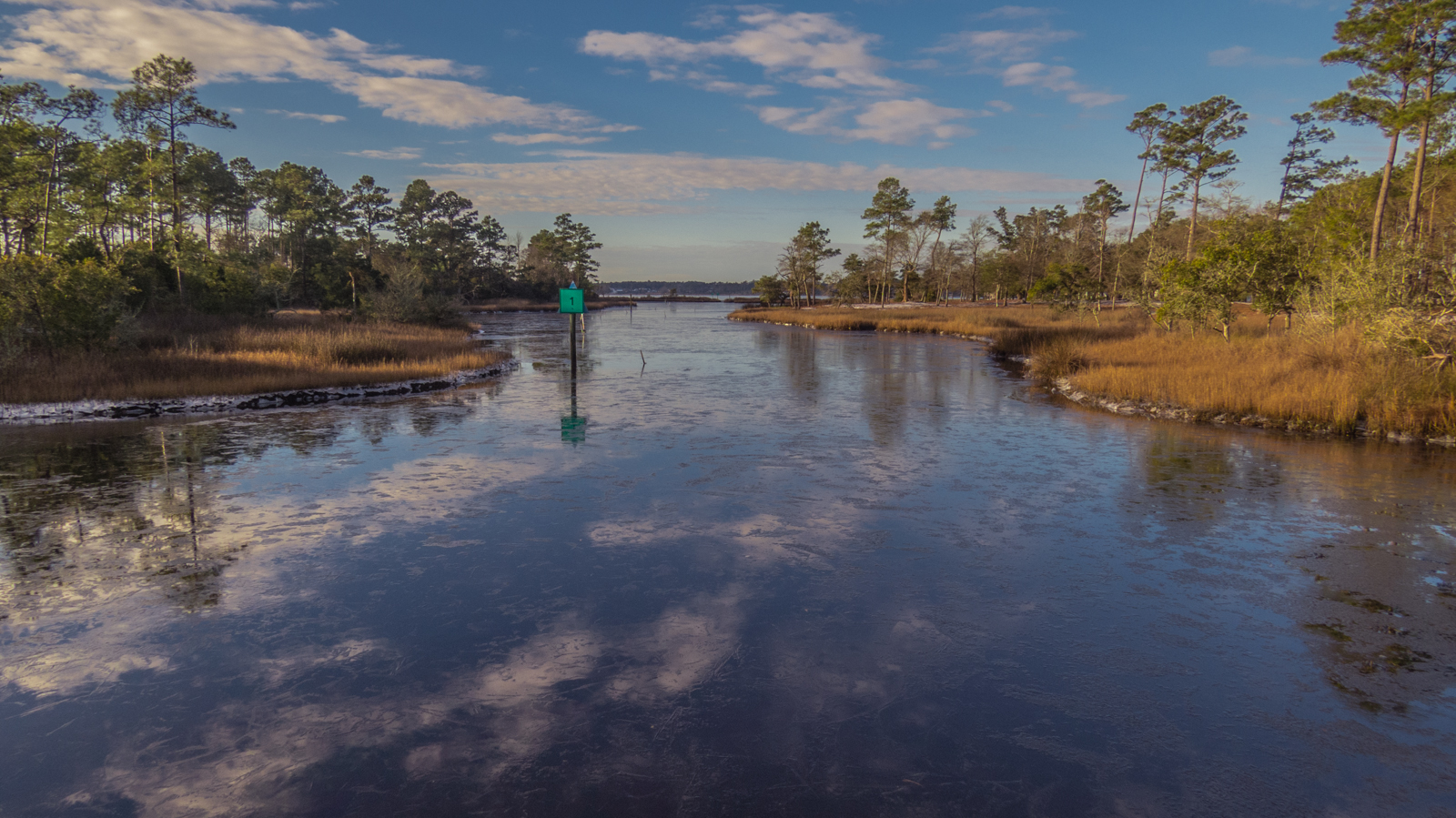
When we living on the North Carolina coast, we always considered the first cold day to be the one when we had to give up wearing shorts. Only the first two weeks of February were reliably cold. The picture of the frozen body of water (Raymond’s Gut) was taken during a Febraury cold snap in Carteret County. The trouble with packing your shorts away was that warmth could descend on the coastal area almost at any time. The result was that I rarely gave up my shorts while living at the coast. When I lived on the farm in Tay Creek, New Brunswick, the first cold day was when I had to start wearing mittens. That was actually a whole lot colder than you might think. I rarely used mittens until it got below zero Fahrenheit.
Growing up in North Carolina, cold is not something you think about very much. To me it was cold when the red dirt banks sparkled with frost crystals. As I got older and went winter camping with our Boy Scout Troop 752 at Camp Raven Knob, I got to know real cold. There is nothing like rain and chilly weather to make you appreciate a nice warm home. Still it was not serious cold.
The first serious cold that I remember was on a trip freshman year (1967) from Cambridge to Dartmouth in Hanover, New Hampshire. I cannot remember why we went, but I do remember it being minus twenty-four degrees Fahrenheit the Saturday morning we left. Fortunately, serious cold does bother you very long if you are in a car with a functioning heater. Still it left an impression. While temperatures in Cambridge got down into single digits, they could not come close to the Hanover freeze.
Sometime in my college years I caught a snow-loving virus. That and a obsession with having some land of my own led me to head off to Maritime Canada after graduation. In the early seventies land was cheap in Nova Scotia and life seemed like a throwback to life in the fifties in the United States.
The old house that I bought on the shore of the Bay of Fundy was not exactly the warmest house around. In spite of lots of efforts and a newly built fireplace, it could still be cold especially since the wind often howled in St. Croix Cove where the house was. That part of Nova Scotia was famous for storms that went from rain to snow to sleet to freezing rain back to snow accompanied by bitter cold.
Fortunately, for the snow loving part of me, the lousy Nova Scotia weather was also bad for running cattle outside so my wife and I decided to move to New Brunswick. Without much thought other than falling in love with the farm, we ended up in Tay Creek, New Brunswick in the middle of New Brunswick’s snow belt. Our first winter we had over twenty feet of snow. We also got to endure minus twenty-eight Fahrenheit that first year. In January of 1982, when our youngest daughter was born one January, the thermometer dipped to minus forty with an accompanying blizzard and high winds.
Most years in New Brunswick the first real cold came in the first week or so December just about the time busy mothers needed to finish up their Christmas shopping. You could tell the real cold weather had arrived when on successive days the previous day’s low would become the next day’s high temperature. Things would continue that way as we started plugging our cars in until the temperature bottomed out at something seriously below zero Fahrenheit.
I endured some bitter cold on our New Brunswick farm but I doubt that I ever felt colder than when I went fishing in a skiff on the rainy, wind morning of October 25, 2005 with the temperature in the forties. When we finished fishing that morning and I was dropped off at the dock, it only took me about a block of walking before I realized that I could not feel my extremities. There is nothing like being completely soaked in the wind to make cold penetrate to your bones. I had to spend some serious time in a very hot tub bath before I recovered. It is no surprise that I did not feel cold while I was catching all the fish. That fishing trip remains one of my coldest memories next to sitting on a brick hard seat in my pickup at minus forty.
Since we have moved back to North Carolina’s Piedmont, cold weather has become a little more dependable. Most years we see a little snow. In 2024, our first frost was October 20th. ‘We have already beaten that. It looks like that in 2025, the first chance for frost will be no earlier than Wednesday, October 23 when our low temperature is forecasted to reach 36F.
This potential frost got me to thinking about the tales that my mother used to tell. She was born in 1910 and told us of stories of her father taking teams of horses out on their frozen mill pond to cut ice and store it for the summer in a deep hole insulated with saw dust. That would not be too much of a surprise had she not lived in the foothills of North Carolina, just west of Winston-Salem. The mill pond which was part of so many of her stories was near Yadkinville, North Carolina which is not exactly known as one the earth’s cold spots.
A little climate research indicates western North Carolina the earlier 1910s was cooler than our current weather. Since then the trend has been steadily warmer with a noticeable peak in the 1950s.
I cannot remember anyone telling me about people skating on ponds in central North Carolina during the fifties when I grew up. There certainly was no report of driving teams of horses onto the frozen ponds. I cannot even remember a pond freezing over.
My son pulled our tomatoes out yesterday but that was more from being tired of looking after tomatoes than the danger of frost. Needless to say, I will still be wearing shorts when I go out to the front porch to read the next few days. When I change to blue jeans, it is going to have to be a whole lot colder. The weather might be sweatshirt worthy.
 Our technological infirmity