
Years on the farm, calving season

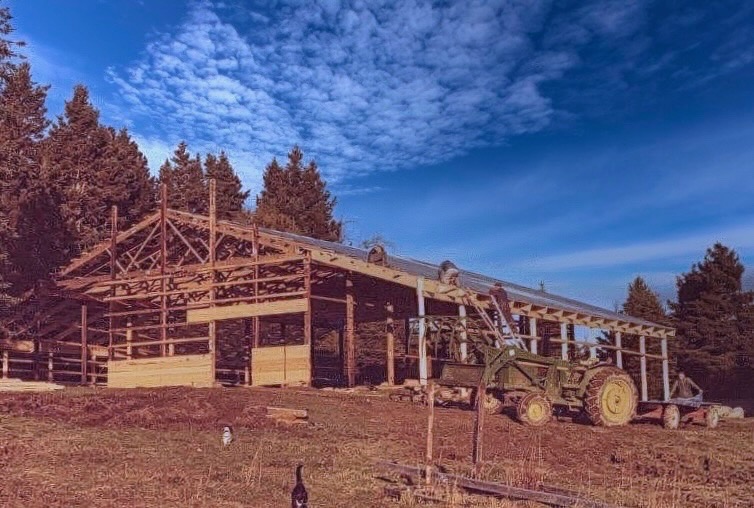
Calving barn under construction 1975

Many years ago in the seventies my wife and I were running a cattle farm located about twenty miles north of Fredericton, New Brunswick. This is the first in a series about our life on the farm

We eventually had about two hundred head of cattle with around 65 calves being born each year. The calves were typically born in February and March which as you might guess is a cold, snowy time in the part of Canada where we lived. For some reason, most calves like to be born at night.

Raising cattle is not the kind of thing where lots of help is available unless you have a a large family. Calving season is especially tough because it demands 24 hours a day attention. I would make two to three trips a night to our calving area which was in the woods around the second barn we built. It is hard to get out of a warm bed, suit up for the cold, and head outside not knowing what you would find.

The walk up the hill to the small field by the woods where the cattle were fenced was not a long one. Even with the walk back to the house it was only about six tenths of a mile. It seemed much longer in blowing snow especially since a good part of the walk went through the grove of tall spruce trees that separated our farm house from the barns.

Of course there were no street lights in the spruce forest. You had to go on that walk no matter what the weather. If I found a cow that had calved, I would walk the new calf to the barn between my legs and the new mother would follow. I would put the calf and cow in a stall filled with nice clean straw. Sometimes there would be more than one birth during a night. Depending on the weather the cow and calf would stay in the open front barn two to three days and then go back to join the herd. I had a larger pen in the barn where I could turn the cow and calve if things got crowded in the individual pens.  

Once the cow and calf went back with herd, the calves had a special place for protection. The front part of the barn was arranged so that the calves could get under cover on dry straw during wet weather. With the barn facing south it made a nice place for them on a sunny day. Sometimes the straw looked like it was blanketed with calves. I remember looking over there one time and my oldest daughter who had just started school was sitting there in the sunshine in the middle of a dozen sleeping red and black Angus calves.

My relatives who were back in North Carolina asked me more than once if the walk in the dark scared me. I would always calmly tell them that walking through the dark woods in area most would call wilderness was safer than walking around Boston when I was in college.There was nothing in the woods that could harm me especially in the winter. All the bears and there were lots of them were hibernating. The moose were deep in the swamps and the rest of the critters were more afraid of me than I was of them.

There is one thing almost certain about the northern woods. When the temperature is down around minus twenty-eight Fahrenheit, there are no crazed muggers hiding in the three to four feet of snow in the spruce forest. They would be frozen like a Popsicle pretty quick.

The only good thing about calving season was that it was over in six to eight weeks. Getting the calves out of the snowy, wet weather was a good prescription for healthy calves. No one at the department of agriculture told us that this was the way we should raise calves. We figured it out ourselves. They also though that it was impossible to raise cattle using round bales. We put up over two hundred each year and proved that they worked. We could have used another barn for the bales but there was not a lot of money in cattle at the time.

In our ten years raising cattle, we never had a vet on the farm for a sick calf. I sometimes struggle to believe that myself and the fact that I cannot remember ever losing a calf. There were plenty of other adventures like the time a teenager on a motorbike chased a dozen heifers deep into the woods. It took most of the summer to get them back but that is a story for next time.

A Life On The Edge

Tree Canopy, Rich Park, Mocksville, NC

The small town about twenty-five minutes from where we live today was in my young mind on the edge of a wilderness. The area was very different over six decades ago. When I was a small boy, the land there was very rural and not just a bedroom community for Winston-Salem.

The books I read in those days about Daniel Boone and eventually the television shows I saw about Davy Crockett only reinforced that view of wilderness at our doorstep. Daniel Boone was something of a local legend. His parents had a cabin about five minutes from where we live today. We also have a Boonville in the area.

My great grandfather ran Styers ferry that crossed the Yadkin River back in the early part of the last century. There was ground behind the homes along Styers Street and Shallowford Road where we lived. Mostly the vacant land grew up in broom straw since no one farmed it regularly. Once in a while a homeowner would carve out a garden for a few years. Farming in Forsyth County was on the decline even back then. It would remain strong just across the river in Yadkin and Davie Counties.

I guess those were my hunter-gatherer years because I was uninterested in gardening or farming, but I loved to wander the deep, dark woods with rock outcroppings and small brooks at the base of the hills. It was a paradise for little boys who had yet to be seduced by TV, video games or smartphones . In the summer we would stop by home only long enough to eat. The idea of staying inside on a beautiful day was as foreign as the idea that the Yankees might lose a World Series.

In the evenings, we did come out of the woods and often played capture the flag in the string of yards that we called our home turf. When we got older some of us started going to a Boy Scout Troop several miles away. Eventually, adults and a few of us with our recent scouting experience brought Troop 752 back to life. Being a Boy Scout was a great experience and camping out in the woods and cooking over an open fire made it even more special. In the summer going to Camp Raven Knob was like going to another world in what appeared to a real wilderness.

The last thing that I did with my old troop and by then I was senior patrol leader was to hike Daniel Boone’s Wilderness Road. It was a little over twenty miles and it is still the most that I have ever hiked in a day. It made me appreciate how hard it was to be a pioneer.

After the hike I went away to military school. It was not Boy Scouts, and there was no camping in the woods. There was a lot of marching. As a boarding student I got an early introduction to dorm life. I was very happy to go off to college, but I promised myself that I would never let dorm life again take me away from the out of doors. I was pleased when our freshman Geology class went camping and loved that a roommate’s father had a cabin on some wild land near Plymouth, Massachusetts. Maine and its rocks and coast became a favorite refuge.

The pull of the outdoors was so strong, that four of us managed to wander off to Nova Scotia and Cape Breton Island during an extended Thanksgiving break. I felt like I had found home. The wildness of the place, the water and rocks seem to be just what a soul battered by college during the sixties in a big city needed. I had been trending towards wilderness for a while. An overland trip through Colorado, Wyoming, and Montana and eventually into the Canadian Rockies and up the Alcan Highway to Alaska had shown me real wilderness. I loved the taste and the challenge of being on the edge of civilization.

Sometime during my last months in college, a plan germinated. Nova Scotia became my goal. After a couple more trips to the Annapolis Valley, I bought an old farmhouse and 140 acres on the North Mountain along the Bay of Fundy coast of Nova Scotia. It was my first adventure as an adult living beyond just beyond civilization. It was not the last.

Some friends helped me partially renovate the two-hundred-year-old house framed with hand hewn beams. In the end as all but one drifted back to civilization, the house became my project and along the way I learned to do practically everything a good homesteader might need to know from butchering a steer and hogs to gardening, wiring, plumbing, welding and making hay. Two Labrador Retrievers, one named after an Alaskan town, Tok, and the other named Fundy, after the Bay of Fundy became my constant companions.

Eventually, I married a talented southern lady who was not afraid of gardening and canning, living on a farm, or driving a tractor. We moved to better cattle country in the hardwood hills north of Fredericton, New Brunswick. There we built a cattle herd and the barns to handle calving and our fast-growing yearlings.

Tay Creek, New Brunswick at the time was a wonderfully wild place. We had no fences at the back of the farm. There was no place for the cattle to go. We cleared old hay fields and eventually were baling close to 350 big round bales for our herd of 200 Red and Black Angus. Our three children was born while we were living on the farm and we buried our two Labs there in the apple orchard during our last years of farming.

After ten years of farming and the heavy hit of 20% interest rates, we dispersed our cattle and I took a city job. Eventually, when I went to work for Apple, we moved off the farm to Halifax, Nova Scotia and then to Columbia, Maryland, but those were the last cities to grasp at us and they only had us for five years,

In 1989, we moved to the side of a mountain overlooking Roanoke, Virginia. Lots of wild country was to the west of it. Our next Lab, Chester, and I cleared miles of trails on the mountains that gone back to wilderness after being farmed when my grandfather was running Styers Ferry. In 2006, we headed to the North Carolina coast and I know my son felt we lived beyond the edge of civilization there on the coast. There were places along the far stretches of the beach that felt as wild as any spot on our farm in New Brunswick. Maybe it was a different kind of wild but it was still wild.

In 2021, we came back to North Carolina’s Piedmont but we remain on the edge of civilization tucked away just down the road in farm country. There’s a huge field across the road from us and you don’t have to travel far to find cows and farms. I think this rural area is where I belong at this stage of life, but given the chance, I might head to wilderness once again if it gets too crowded here. We managed to get away from the coast just before they cut all the trees down turned much of it into a huge housing development. For that I am grateful.

We might travel a long way in life but usually we come back to what made us comfortable. Big trees and a touch of wildness will always make me happy.