Competition and the Internet

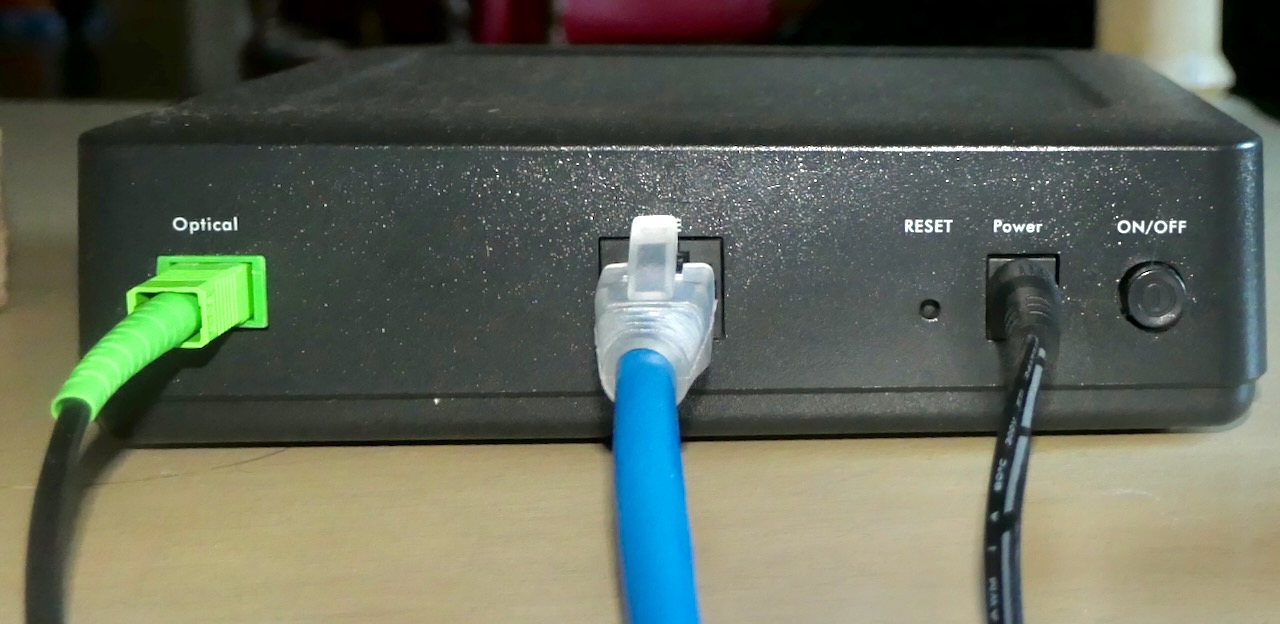
Fiber Optical Network Terminator (ONT)

I like white button mushrooms. They are a favorite in omelets, salads and all sorts of things. Six years ago we were living on North Carolina’s Crystal Coast which is roughly defined as the area from the White Oak River in Swansboro to Town of Beaufort. It is a very unique area because most of the year there are less than 70,000 people in residence but for six to twelve weeks during the summer, the population more than doubles. In order to feed all those people staying in rental homes, the area has an abundance of grocery stores.

Yet for our first eleven years on the coast, button mushrooms remained relatively expensive. Whether you went to Harris-Teeter, Lowes, Publix, IGA, or Piggly Wiggly, button mushrooms seemed priced higher than I expected.

Then almost simultaneously Aldi and Lidl opened stores in the area. Instead of paying $2 to $3 a box for mushrooms, you could get a box for ninety-nine cents. It was a welcome change which I expected to go away, but it didn’t and to this day, white button mushrooms are more competitively priced than were before Aldi and Lidl came to town.

Studies show that less than ten percent of households in the United are not connected to the Internet. However, a larger portion of those connected people in effect only have one provider that delivers anything close to the speeds needed in our wired world. Usually those with only one option find their Internet is more expensive than what can be found in areas with competition.

Much like my expensive button mushrooms, it doesn’t really matter if you have five grocery stores in your community if they all charge similarly high prices. What it took to get the price of mushrooms down was a different kind of grocery store with a different pricing model.

There are a number of factors which affect competition for Internet services. Much like the grocery stores that all sold mushrooms at a similar price, Internet Service Providers (ISPs) often set their pricing to be very close to other ISPs. Some providers even charge people with slow Internet the same as people getting faster Internet. That is the classic definition of tier flattening.

Fiber Internet connectivity is the gold standard for home Internet. In general national providers are competitive with their fiber pricing. Competition for new fiber customers is fierce right now with some great offers and pricing that is unlikely to stay that low without competition.

It is really a golden age for faster Internet because fiber is more widely available in more neighborhoods and there are more fiber providers. Fiber Internet service providers have figured out that very few fiber customers change providers once they get on fiber. The reason for this is two fold. One is that fiber Internet is so much better than other copper-based or wireless Internet services that few will ever go back to slower cable, DSL, or wireless. The second reason is very few areas have a choice of two fiber service providers.

In most communities, the ISPs have a captive audience—a local monopoly. It is very difficult for a second (competitive) provider to make a business case to build a second fiber network in community where there is already an ISP offering fiber Internet. According to a recent study only 12% of homes have access to two fiber providers.

Unlike copper-based cable and DSL Internet, a fiber network can easily carry several competing Internet services. Cable and DSL are like a two lane road.  They can only handle a limited amount of traffic. Fiber is like a superhighway with unlimited lanes. You can have multiple service providers offering services over the network—this is known as the “open access” business model.  

We have built networks that have six service providers offering service from a single fiber network. Service providers can focus on delivering differentiated services without the immense capital costs of constructing a second (or third) fiber network. In this scenario, one party owns the network—it can be a local government, a nonprofit, or a for profit company. Service providers can each sell their own services, Internet packages, and offer their own pricing on the single high performance fiber “road.”

Amazon, UPS, and USPS do not each build a road so they can deliver packages; the government builds roads and all public and private businesses use the one shared road system to deliver goods and services.

Until recently, most Internet Service Providers have resisted this “shared network” model because they prefer having monopoly control over customers and pricing—that is, they do not want to compete.

Currently, some state and Federal grant money is being channeled directly to ISPs, which enables them to expand their monopoly network to more customers. A better solution is to use state and Federal funding to build open access networks. Some local and regional governments have embraced this model and have a long track record of success. And there are now ISPs that recognize open access networks as a business opportunity.

Modern fiber Internet networks are easy to build and to operate. Local and regional government that adopt the open access model create private sector jobs and business opportunities, and help keep the cost of Internet affordable for businesses and residents.

Design Nine has been a pioneer in assisting with the development of open access networks. Visit our website Designnine.com for info or send me an email: dsobotta at designnine.com or dsobotta at wideopennetworks.us .

 1TIER FLATTENING: AT&T and Verizon Home Customers Pay a High Price for Slow InternetJuly 31, 2018- National Digital Inclusion Alliance – by Bill Callahan and Angela Siefer

2Fiber Broadband Association Reports North America Hit Highest Annual FTTH Growth Record- Fiber Broadband Association -December 11, 2023

Still Using Macs

Goose Appreciates the MacBook Air

Years ago the kind of computer you used could stir some serious passions. The world was in two camps DOS/Windows and Macintosh. There were people who were afraid of the Macintosh and the ease of use that it represented. Computers were supposed to be difficult. Taking away the hard work meant that anyone could do it, not just those who had invested years in learning how to make computers work for them. In the early days, people believed that knowing what to do with a DOS command prompt made them superior.

Apple lost the hardware desktop war for a myriad of reasons which are beyond the scope of my article. Even the resounding success of the iPhone did not matter a lot. Only 41% of iPhone users also use Mac. A lot more use iPads but that is a different story. While DOS users did not all end up on Macs, Microsoft to its credit came banging on Windows until on the surface it looks enough like a Mac that there are no longer religious wars about computer operating systems. The Mac user interface one, even if the plumbing under the Windows version is a lot more complicated.

The difference between a Mac and Windows machine is still huge but it is not something that you can explain in a sentence. Unfortunately, most people have decided Windows is good enough for them. However, among those of us who still really need desktops to churn out serious work, the Mac enjoys a serious and dedicated following.

While I did work for Apple for nearly twenty years selling Mac in some of the toughest markets, anyone who has read some of my writing or my book about my Apple sales career, The Pomme Company, would agree that at times I have been one of their toughest critics. I like to think that I have seen far more Macs than the average person and just maybe I have a better idea of where Apple needs to apply resources to make the Mac experience even better.

I am still not particularly excited about Apple, the company. While they arguably have some of the best computers, their products are marketed as elite products with only those living close to Apple Stores really getting the kind of support that users sometimes need and certainly pay for in Apple’s case.

There is a case to be made that We Are Lucky to Still Have Macs, because Mac revenue is dwarfed by other parts of the company. It’s not the Mac’s fault that they are not on more desks. It has a lot to do with Apple, the company, and the decisions made over the years to not grow their share of the desktop. At times it was like, we have a great product but we really need to keep it a secret. We don’t want it to sell in the enterprise because Steve would be unhappy.

I hesitate to call it poorly-conceived marketing that focuses on just one part of the country but that is close to the truth. If you are near a blue-voting metropolitan area, you likely have an Apple Store close enough by to be practical. If like me you have lived near Roanoke, Virginia, the North Carolina coast, or west of Winston-Salem, North Carolina, you likely have rarely seen the inside of an Apple Store except on visits to the big city.  I hate to think the kind of support people in the fly-over states get.

I have suggested Apple hire Apple user group coordinators across the country where it does not make sense to have a store, but given that Apple would have to part company with some of its pile of money to make that happen, I think the chances are close to nil. The money would hardly register a blip on Apple’s horde of cash, but I am not going to worry around it very much because those of us who have been using Macs for years know how to get by the challenges that Apple throws in front of its non-metropolitan users.

About the only place that I get to see Macs is in our local Costco twenty-five minutes away. Unfortunately choices there are usually limited to lower-end configurations with minimal storage or RAM options. Either one of those limitations would keep me from buying there since Apple like other manufacturers has been on the no-upgrade path for years. While I call myself a rural user because there is a twenty-acre soybean field across from our subdivision and lots of other farming nearby, there is a two GB fiber connection to our house which my Mac Studio could handle if Calix could deliver a router with 2GB output ports. There is no shortage of computers and technology in the house. I even have a 12 TB Network Attached Storage device (NAS) next to my desk. My home office is better equipped than the Reston, Virginia, Apple office I had when I was director of federal sales for the company.

It is fair question as to why I am still using Macs. Would you still drive a Ford if Ford threw you out the window after 20 years? Apple defenestrated me in July 2004. I bought an aluminum PowerBook G4 the next month- it died thirteen months later. Fortunately, I also bought a Dual G5 tower that December. It lasted from December 2004 until January 2023, an admirable run for any computer. I started using Linux in 2004 when I also started using Windows.

I have seen plenty of Windows computers over the years and my dalliance with real estate means that I ended up using a Windows machine for most of that job. I still use Windows because my current job requires the use of ArcGIS Pro and it will only run on Windows. For a good ten years, I did most of my photo work almost exclusively on Windows.  It is only in the last six months that I have switched back to the Mac for my photo work. Apple finally decided to no longer tie your data to a single Mac and I got tired of Lightroom on Windows being unable to figure out two monitors being used at once, Windows has also become something of a pest.  It wants Teams to launch anytime it isn’t running and it is also quick to try to get me to do something I have no interest in doing. The first rule of operating systems is to not get in the way of the user. Windows has never done that and certainly does not do that in its most recent incarnation.

Besides photos, I maintain a number of websites. I got used to Mac web tools at the dawn of the Internet.  They have continued to mature and get better. They kept me using a Mac when I was doing most of my work on Windows

I have been using Microsoft Excel since it was Multiplan. That means I have a lot of years with it and it is still but default spreadsheet but I have grown to appreciate what you can do with Apple’s Numbers. Most of my books have been written in MS Word, but the number of pages composed and complexity pale in comparison to the reports that I have done with Pages in the last twelve years.

Perhaps the straw that broke any loyalty that I had to Word is Word’s propensity to screw up its own mail merge documents. It is tremendously frustrating and time-consuming to have to go looking for dropped addresses in a list of one hundred twenty addresses. I have wasted a lot of time recovering from those Word errors. While Apple’s Pages does not do mail merge address labels, LibreOffice which runs on the Mac does them flawlessly without dropping any. Apple’s Pages is a pretty good page layout program.

I recently wrote an article, The Best Mac Ever. In it I declare the reason the Mac Studio Pro is the best Mac ever because it just works. I doubt anyone is going to switch to a Mac because of this article or my experiences. However, remember the Mac has to be a pretty dang good computer for someone like me to keep using it.

I don’t remember serious computer user switching over to the Mac ever going make to Windows. The only thing that is better on Windows is search. If you are like me, you probably have a Windows machine doing little or nothing that can run a search for you while you keep working on your Mac.

Mini-Monopolies Are Not Your Friend

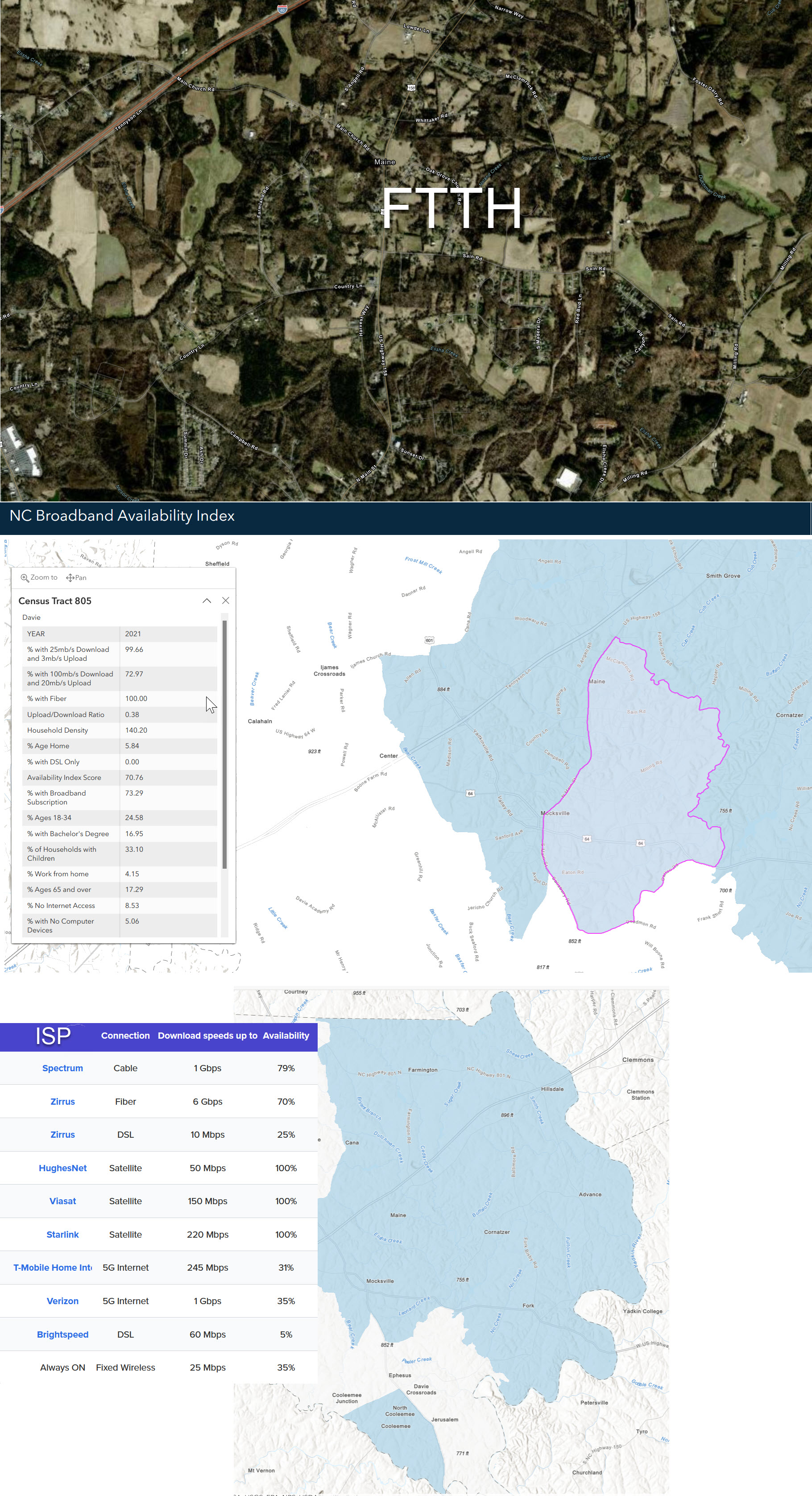
Our rural area in Davie County, NC- Rural with 2 Gig fiber

I have made my living in the broadband world for over twelve years. I spend the time at my day job analyzing broadband in counties across the United States.

While there are publications that would disagree, I can confidently say that most of you might at best have a choice between two providers. Sometimes it is between an expensive provider and a lousy provider, one with high costs and terrible customer service and the other with dead slow or unreliable service.

All this results from the broadband world being cut up into little fiefdoms. Competition to broadband providers is “I am going to lock up this subdivision before you have a chance to wire it.”

Competition in the broadband world is rarely here are three services competing for my business, I will pick the one that best suits my needs.

Many of us for years have believed that community-run, open-access fiber fixes this problem. The challenge is that sixteen states won’t let communities run networks. I have used the road analogy many times. We don’t build different roads for UPS, FEDEX and Amazon Prime. We build one road they all share it.

In broadband each provider builds their own network. They like to do that because it locks the customers into them. If we built fiber once, there is plenty for them to share but what mini-monopolist wants to share customers.

If Amazon Prime had to build their own roads, it would be a more expensive proposition than today’s sharing of roads.

Our company has built open-access networks across the country. Some have been running successfully for over a decade. They all have multiple providers competing for customers.

The problem is that now the federal government is throwing bucketloads of money around. Many local governments who are tired of being beat up by their citizens over broadband just want broadband to go away. They know they need a network but they don’t want to go through the difficult process of figuring out how to come up with a long-term solution that fixes both availability and competitive pricing.

They opt for what I call the “Westshore Homes Model.” I came up with the name from the home remodeling outfit that promises your bathroom remodel will be easy and done in a day.

A current Internet Service Provider hears the city/county wants a network. They show up, “We will build you a network, and you don’t have to worry about the details. Just trust us.”

The government jumps into bed or perhaps better out of the frying pan into the fire with the Internet Service Provider (ISP). The ISP applies for funding with their new government partner. They get money and build another leg of their mini-monopoly. The only problem, you and I are financing their profits.

Sometimes you run across a situation where there is competition and government money has helped foster that competition. I live in one of those places.

A situation like mine where I have a choice between telephone coop built fiber, cable and other technologies while living in a very rural setting is not what I usually see in my studies.

While I work for a fiber company, I have nothing against cable companies. In the absence of a lot of open-access networks, cable competing against fiber is what keeps pricing competitive.

In areas where there is only cable or only fiber, you run the risk of someone taking advantage of the situation. Having both around usually fixes that.

I will make one prediction. In ten years, someone is going to ask why did we spend so much government money creating mini-monopolies to carve up the world?

The government is helping Big Telecom squeeze out city-run broadband is a great article from the Verge that tells the broadband story better than I can. It is a good education on the problem.

Below you see that same rural area with fiber to the home (FTTH).

Below the first map are state maps showing broadband availability.

Keeping Updated Just Enough to Stifle Giggles

The back panel on our 2021 LG TV

When your children grow up and leave the house, you can forget about the times when you are just a momentary embarrassment to them and move to living on the edge of potentially being a permanent embarrassment.

It can be how you dress or drive, what foods you like or what television shows you watch. Most likely in our technology-rich society, we are looked down upon because we appear to be missing all the technology trends that have been declared to be essential to modern life.

Being older we are just not like the people with whom they spend most of their lives. It is understandably hard for them to slow down enough to figure out that we are not doing too badly for people who started out on party lines with rotary dial phones and no television.

Modern life is not kind to those who would prefer to ignore technology. NC’s DMV is now requiring you to understand QR codes in order to check in at their offices. Increasingly businesses would prefer not to handle cash.

People now want to pay you with apps like Zelle. Our teenage granddaughter would much prefer that we deposit money in her Step account that she can use like a credit card in stead of giving her cash. She has even given me cash and asked to deposit it for her in her Step account. My grown son won’t shop at Harris-Teeter because they do not take smartphone payments. Cash seems to be a burden.

You can try living by the old adage, “if it ain’t broke, don’t fix it,” but if you read about the tech refresh that we did in 2017, you will find that waiting too long to upgrade can create even more challenges than ignoring the pressure to upgrade. I love technology, but you really have to stay on top of it or both it and your children will laugh at you.

In 2006, we spent a lot of money for fancy wall-mounted Sony HD televisions throughout our beach house. Apparently, we were not on top of things enough to know that screen technology changes regularly and we should just get a new television with a fancier screen every two or three years. You know you are behind the technology curve when your children give you money earmarked for a new TV.

Technology has always been a wild ride but the rider is getting faster. The first amazing technology that I remember coming into my life was the transistor radio around 1955. It was more important to me than our black and white TV that came later.

If you fast forward twenty-seven years to 1982, my wife and I have three children of our own and one day after work I bring home a Panasonic VHS VCR. It cost roughly $650 and while there were still concerns that Sony’s Betamax might win the VCR war, I was reasonably convinced that VHS would deliver the entertainment that we wanted in our two channel TV rural world. VHS tapes were part of our lives at least through the ballet recitals we attended in the mid-nineties.

Twenty-four years after that first VCR in 2006, we were living in a home wired so that you can plug an iPod into the whole-home stereo system which included a VHS tape player and a six disc CD/DVD player that fed a wall mounted HD Sony flat panel TV.

By 2017, most of that technology was obsolete just like the Sony television that had come before it and taken two men to move. After our tech refresh in 2018, the closest thing to a VHS player left in our technology closet thirty-five years after buying our first VCR was a Blueray Disk player which cost $49 at Best Buy.

Four years after that in 2022, we are living in another home. This one has 2 Gig fiber to the home (FTTH) connectivity. While there might be some DVDs and VCR tapes in boxes, we would have to dig around to find them. I do have a plug in DVD drive for a computer. It is as close as we could get to seeing them. We still have a wireless home phone system, but the connection is VoIP (voice over Internet protocol) that is delivered by our fiber connection. We mostly use our 5G Google Pixel phones but keep the VoIP line so I can have a second line in my office.

There are unused coax cables in our walls because our new in 2021 home was never hooked up to cable services. In addition to our television being connected to the Internet with an Ethernet cable, we also have two upstairs offices which are connected by Ethernet to our router. The fiber that comes to our house runs all the way to the optical network terminator (ONT) on the same table as our TV. There are close to thirty network devices on our network including our garage door. The oldest technology that we have is the FireTV Cube that is a couple of years old and which provides the streaming channels for our television. We cut the cord in February 2021, and have never looked back.

For a short moment we riding the crest of the technology wave (as long as the kids don’t ride in our 2005 cars) but without diligence (and probably a new car), it will crash right on top of us and once again upend our world.

Interested in learning if fiber to the home (FTTH) is for you? Read this post of mine, Choose The Right Technology For The Decade.

How To Be A Sensible Streamer

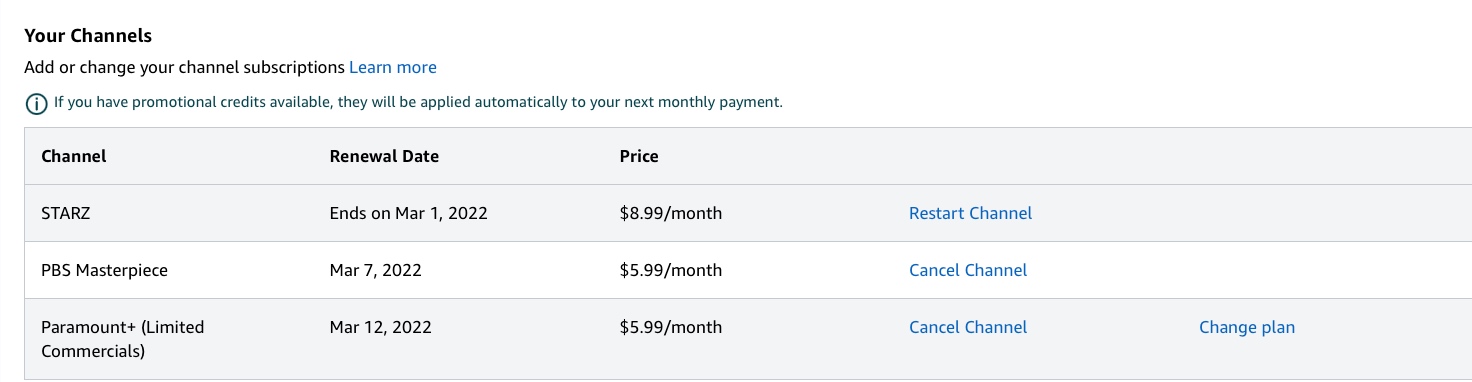
Streaming Channel Portal on Amazon

Streaming your choice of video channels is what the future holds. I spend a good chunk of my day job looking at the prices of Internet services across the county.

I studied cable, DSL, and fiber services in dozens of counties and communities last year.  That along with my personal experience with prices and as an early streamer starting several years ago has helped our family to continue to save money after switching from cable and its expensive packages to fiber and streaming services.

However, it is easy to go overboard with streaming.  The grandchildren show up and their favorite shows are on Disney+, so you subscribe. An older child comes home and wants some Apple TV channels.  It only takes three or four spur of moment decisions added to your regular streaming services and you will be paying more than you would be for a cable package.

The way we handle our streaming services is to keep them on a budget.  We budget $40 monthly for streaming services.  We are Amazon Prime members so I am not sure we would allocate the full $8.99 (stand-alone cost) for Prime video but as you will see, even when we do that, we are still well under budget.

Our four current services for a fee are Prime Video at $8.99 monthly, Paramount+ $5.99 monthly, Britbox $6.99 monthly, and PBS Masterpiece $5.99 monthly for a total of $32.96 for all our streaming services.  We also subscribe to the free version of Peacock.  I recently canceled Netflix and Acorn  while adding Masterpiece and Britbox.

We stream so much that it is easy to run out of new, watchable programs in two to three months.  I manage all but one of our channels on Amazon prime so it is easy to see them and the costs  all in one place. You also have the advantage of being able to snare some Amazon specials like HBO Maxx or Starx for $1.99 a month for two months.  You just have to remember to cancel them.  The picture at the top of the post is what you see in Amazon’s Video channels management console.

My studies across the country along the current Hulu and YouTube pricing I see tell me that about $70 a month will get you full range of video services.  So if you are paying $70 or more for your streaming services, you are not saving money and it is time to go on  a streaming budget. 

Not Enough Wilderness To Save Us

Sunset on White Oak River Near Swansboro, NC

Towns are magnets and they suck people from the countryside, especially the young and talented. We noticed this happening when we returned to New Brunswick in 2012.We farmed there in the seventies and early eighties. Since our trip, what remained of the three churches in our old town disappeared. The community store closed. Yet the provincial capital, Fredericton, is thriving as the small towns wither.  It is a story repeated time and again in Canada and the United States.

I still worry that some of those wild places like the North Carolina coast will become too populated. I sometimes think that what we call the Northern Outer Banks from Corolla to Cape Hatteras will sink into the seas just from the weight of all those beach castles. I offer up my profound thanks for those who created the National Seashores. Beyond nourishing our souls places like coastal Carteret County and hilly Davie County where we now live grow a lot of food that North Carolina cities need.

(Read More)

Empowering Technology

Asus Chromebook

Technology that empowers you is more than just the technology.  To be really successful technolog has to be packaged in an affordable way and be easy to use to accomplish tasks that are important.

I was working for Apple Canada and living in Halifax, Nova Scotia in January 1985 when Apple introduced the LaserWriter, the first laser printer to be widely used. Ignoring the first home computers, this was also the first time I was involved with the rollout of technology that had the power to fundamentally change the way we did things.

The list price was $6,995 and more important to those of us lugging it around for demonstrations, it weighed 77 pounds.

I was happy that my previous career was running a cattle farm where I spent much of the winter hauling around 100 lb+ bags of feed.

It is a measure of how technology change accelerates that the third week in December 2011, just about twenty-six years later, I bought a Brother HL-2270DW laser printer for $99.98.  It only weighed 15.4 pounds.

The original Apple LaserWriter printed eight pages per minute of 300 DPI text and graphics using a 12 Mhz Motorola 68000 chip.

The Brother printer that I bought in 2011 printed at 27 pages per minute at up to 2400 X 600 DPI.  It had a 200 Mhz processor.  The Brother printer comes with Ethernet and wireless connectivity.  The Apple LaserWriter only had LocalTalk, a very slow but revolutionary network for 1985.

The original LaserWriter were heavy and expensive. Few of them made it into home offices in the early days. The most recent Brother Laser that I purchased was only $85. (Read More)

Breaking Your Inkjet Cartridge Addiction

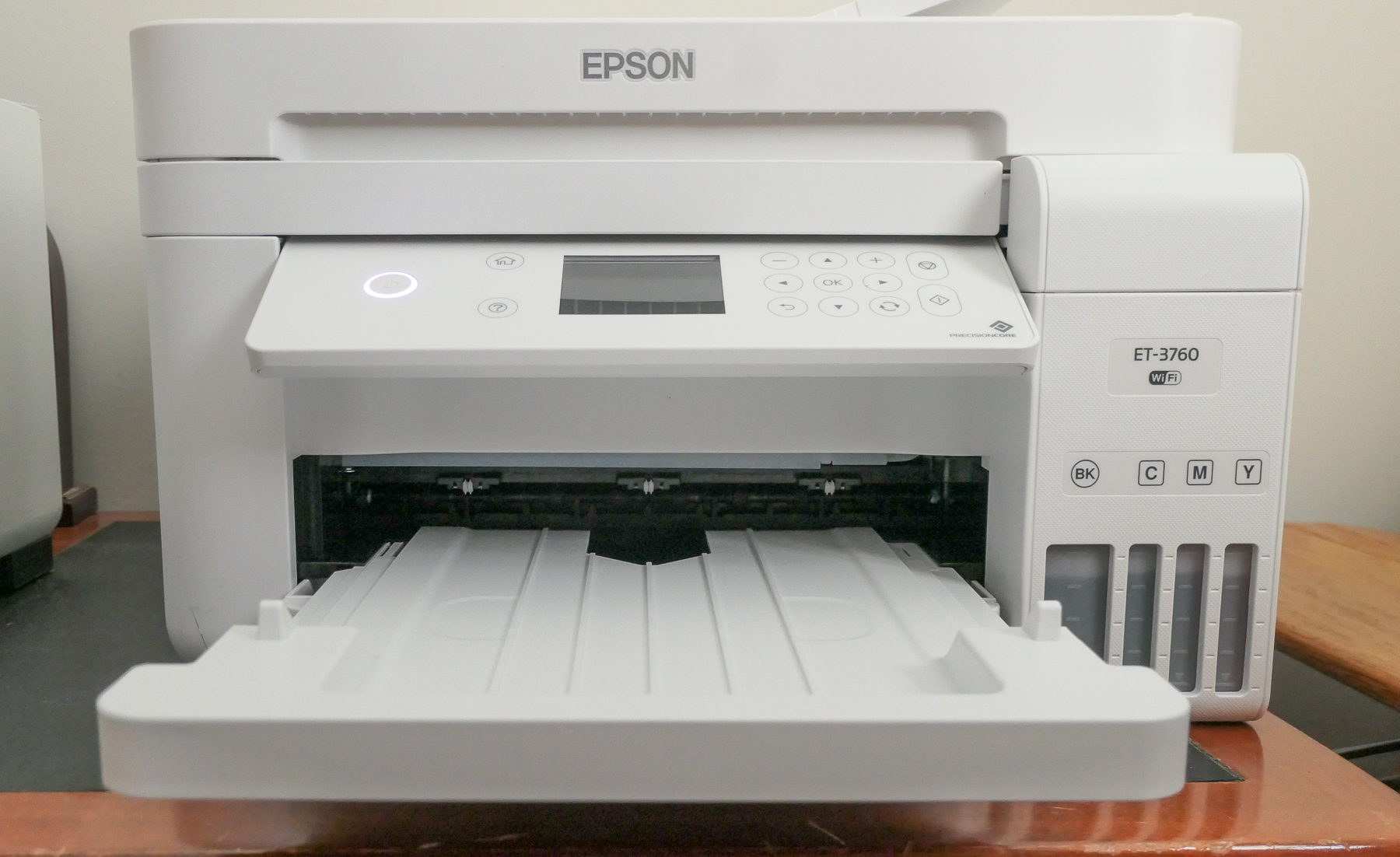
Epson ET-3760 with ink tanks

I have used a lot of different printers over the years. Printing needs change over time and old printers eventually stop working or no longer work so well with new computers. Eighteen months ago, I donated my fourteen-year-old HP inkjet AIO printer to a local charity. It was still working but a challenge to use with my newer computers. I bought a new and smaller Canon inkjet AIO printer. In mid-June it dawned on me that if I purchased the ink cartridges that I was going to need for the summer that my ink expenditure would be greater than what I paid for the printer. I decided to get off the inkjet-cartridge-wagon train. Read about the printer that I chose at this link. There is nothing like the potential of saving money to push us to change our habits.

Connecting Electronically Not Always So Easy

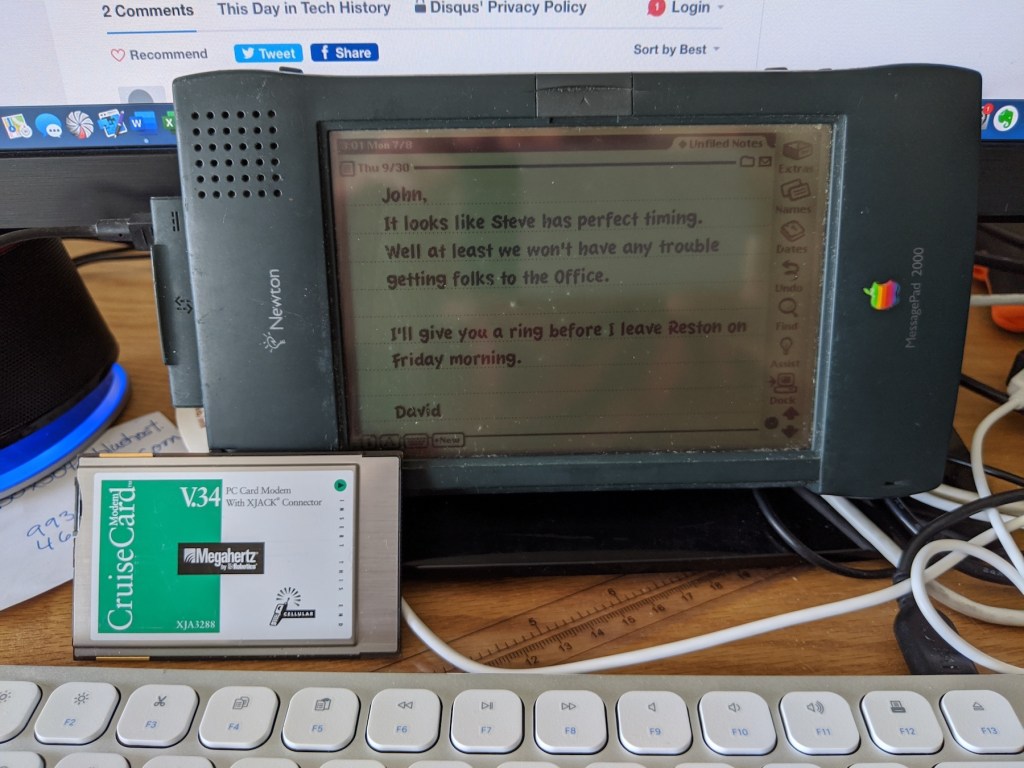
The Newton 2000 that I used for email in 1999 when I was working for Apple

Electronic communications were not always as easy as tapping an app on your Smartphone. For years most electronic communications were stove-piped with almost all communication limited to internal emails to people who worked for the same company. Even once the Internet made it possible to communicate between companies and organizations, getting hooked up and communicating was an evolving challenge. Read more at this link.

There is more to working from home than your laptop

The view from my office on the Crystal Coast

I recently wrote a post, Success from Working at Home. As I have seen people struggling with their first efforts at working from home, it occurred to me that people might need more suggestions, particularly with the things that I take for granted and the habits that I have developed over my thirty-five plus years of mostly working from home. Many of these things do not seem special to me.  They are just the way that I have learned to accomplish tasks for decades.

Once you take the step of working from home, the back end system that provides services to your office will become very important. 

VPNs allow us to access file servers on the corporate network. If you do not have a VPN that gives you file access, you will need some cloud services.

In order to get to those files on the servers or in the cloud, you need a good, fast, reliable Internet connection. DSL usually just does not work well enough to be useful. The fastest cable connections are okay but if you are uploading large files, you are probably going to wish you had a fiber connection.

A good phone that provides clear sound is essential and if you are getting your phone from your Internet service provider and have a flakey Internet, remember to not count on your phone.

If you do a lot of conference calls, a good microphone will help.

A good collaboration tool which let you talk, text, and share files is essential.

Of course you also need the right software, the knowledge to use it, and the discipline to use the cloud tools or VPN so that people can collaborate with you.

Read more detailed information on how to be successful working from home at the following link. [Read More Here].