
Doing it the hard way

In the sixties or early seventies, the back to land movement was well known. The 1968 Whole Earth Catalog was the instruction manual dedicated to it. Helen and Scott Nearing were its inspirational grandparents. Many in my generation’s back to the land movement were vegetarians like the Nearings. Some were vegetarian by choice and others because of necessity. Because of my proclivity to cattle and farming, I studied Louis Bromfield’s book, Malabar Farm. Today there there is a new generation of people going back to the land.
In this century they are known by the label “off grid.” Few of those folks are openly vegetarians. This new generation proudly hunts and fishes for protein to supplement what they grow. Though their animals are more likely goats than cows, there are some with cows and even horses.
Many of today’s off grid folks are often in places deliberately difficult to reach. Most back to the landers in the seventies went where they could find cheap land whether it was alongside a road like my house and barn or back in the boonies where my friends in the dome lived.
During the seventies, the rural Annapolis Valley where we shopped did not have supermarkets. It had small grocery stores and cooperatives where you could get your food, your baler twine, and some beef fattener for your steer all in one shopping trip. Beaver Fruit Cooperative got most of our business. I also did some bulk orders with the folks in the dome. We had a local hardware and a Sears catalogue store which is where we ordered our appliances.
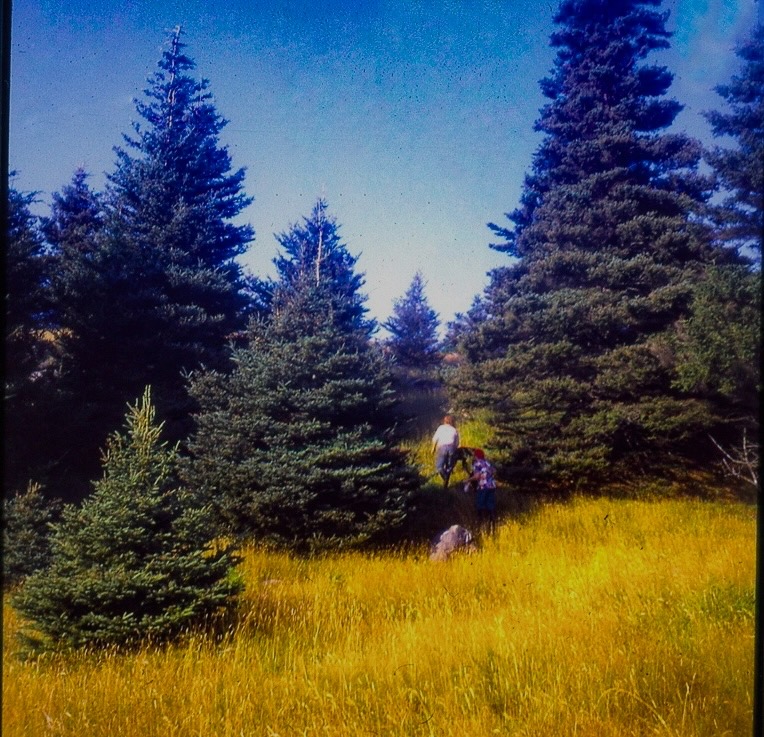
There were times in the early seventies when I thought about getting farther from the roads that connected us to the rest of the world. Reality always intruded. I thought about homesteading in Newfoundland, but my wife took one look and said I would be homesteading alone. I even found a great spot high on a hill on my land in Nova Scotia.
It is pictured at the top of the post. It was over a mile off the road which does not sound very far until you factor in the heavy clay soil and the astronomical expense of building a mile-long gravel road where gravel is in short supply. Then there would be the likely impossible task of getting power to the homestead. In those days there were no solar panels and battery systems to give you electricity off grid. Drilling water wells on our North Mountain was also problematic.
By the time we moved to New Brunswick we were well on the track for serious farming. We still gardened on a large scale, had chickens, and a milk cow. We did move to having someone butcher our annual steer for us instead of doing it ourselves. In creating our farm, we built well over a mile and a half of roads with New Brunswick’s ready supply of gravel over our rocky soils. I also convinced New Brunswick power to bring power a quarter of a mile back to the new barns that we built. We drilled a well back by the barns. It provided so much water that it was hard to measure.
So by 1976, all the elements were in place for us to move farther from the village of Tay Creek near our new barns but with no close neighbors. It wasn’t in the cards. While we had not had a great experience with the people of St. Croix Cove, the people of Tay Creek had been so welcoming that neither my wife or I would consider having the village become less accessible. It was also a great convenience to be by the road where the school bus picked up our children. It turned out we liked being part of our small farming village. We valued the connections of people dropping by to chat. I did not even mind cleaning the driveways of some residents who became close friends. When we needed them, our farming neighbors were there to help as much as they could.
In the end it seems the biggest difference between the back to the land movement of the sixties and seventies and today’s off grid homesteader is that the homesteader of today is often working to isolate themselves from others. In the sixties and seventies back to landers were still interested in community. I loved the small country stores, but today’s off grid folks are much more likely to seek out the anonymity of COSTCO. The money that some make from YouTube makes it even easier to not have ties with nearby communities. We were part of communities because we needed connections and income. Even today you will find exceptions and some off grid folks are much more community oriented than others. However, when I hear the term off grid what comes to mind are people living in places that are only accessible by four wheel drive, snow mobile or ice road for at least part of the year.
Paths Not Taken

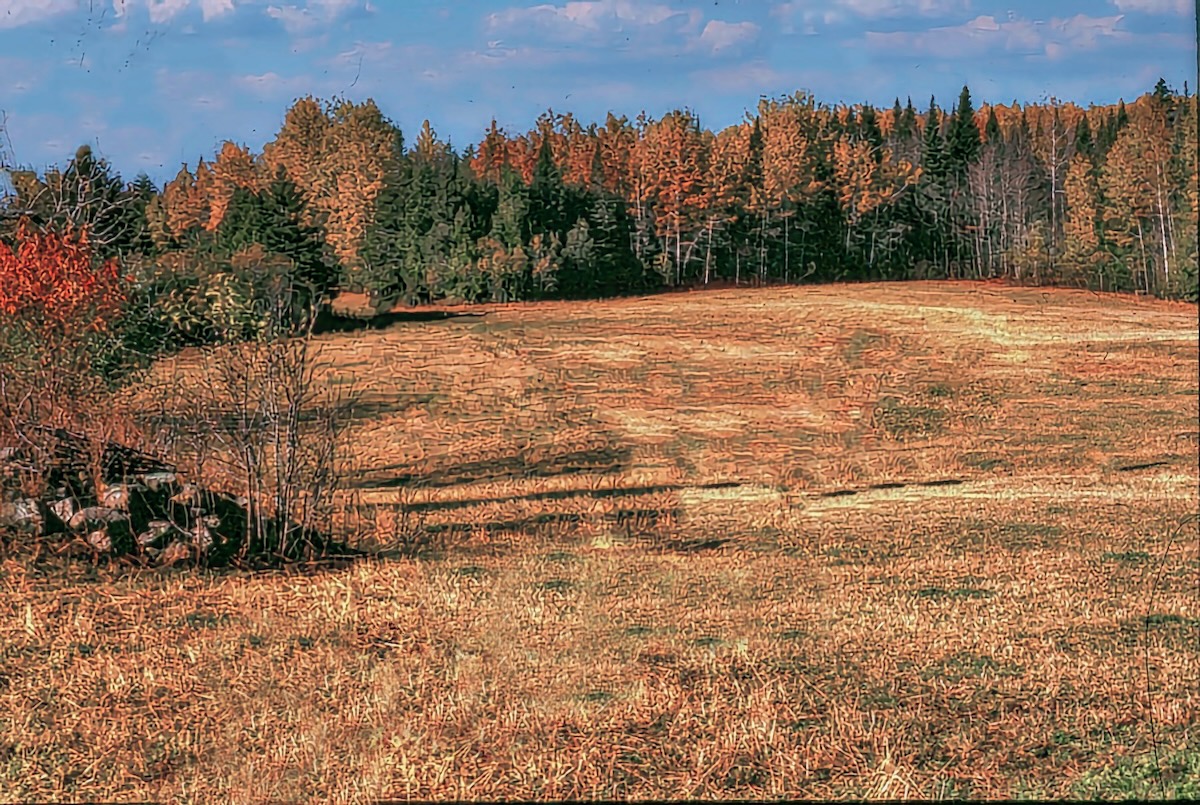
The backfield at our Tay Creek farm where I am homesteading and splitting wood in my dreams

In every life there are decisions which determine what direction your life will take. I have been fortunate to be in positions where I had enough flexibiity to guide our life in certain directions. Even now fifty years after some of those decisions, it is hard to say that what we did was the right decision for us. Our decisions worked out for us but it is impossible to tell if another path might have given us an even more rewarding (and not in monetary terms) life.
I graduated Harvard and instead of going to law school, I went back to the land in Nova Scotia. Whether the neighbors ever called us hippies or not is still an open question, but my bet is that they didn’t because we had a John Deere tractor and were trying to farm the land. We were friends with hippies living in a Dome in the woods, but I worked hard to wire our house so we could have electricity and the modern coveniences that came with it
We did grow a huge garden and put up prodigous amounts of produce both canned and frozen. We butchered our own steer and hogs. We collected wild Chantrelle mushrooms from the woods. We even tended a gill net for a while.
The old house I bought and fixed up had 140 acres. Of that well over 25 acres was a cleared hayfield with a small pond. Though the woodland with it was mostly spruce, I did eventually get another piece that had some hardwood. It is not too much of a stretch of the imagination to think that we could have kept a few cows, had a huge garden, and lived a very simple life. Looking at recent aerial photos of the property which I sold in 1976, the property appears to now have lots of gardens, more trees and little pasture though I am sure goats would be happy with what is there now. I might well have done something similar had my partner in the enterprise not been such a jerk. He married the local school teacher in our small community and devoted far too much time to telling our neighbors what a terrible person I was. While my new bride stayed with me there for a year, we were determined to move a friendlier place.
We found the better place in the hardwood hills north of Fredericton, New Brunswick. Instead of people being petty and mean, the residents of Tay Creek were welcoming, helpful, and supportive. I can think of no better place to raise a family. The community when we moved there had two country stores, three churches, a town hall, and a lot of opened minded people.
We stayed in Tay Creek for over a decade. Our three children were born while we were on the farm. Our two Labrador retrievers are buried there a long with a good chunk of my soul. This would have been an even better place to have a few cows, lots of gardens, and even fill the freezer with trout to supplement our beef.
We did not take that path, I wanted to work the soil and to raise high quality cattle, selling bulls to improve the local herds. We accomplished that goal, along with continuing to grow much of our own food. We had chickens, a Guernsey milk cow and a beautiful farm.
We eventually had to give up farming because interest rates soared to over 20% during the early eighties when our herd had grown to two hundred head. We couldn’t handle the high interest rates on our $100,000 operating loan, so we had a very successful dispersal sale. . After selling the cattle we could have hunkered down on the farm which was paid for, sold off some of the machinery, and continued to work the land, but we had three children, and we wanted them to go to college. Like many others I went to work in town after taking a few months off. My job was in an early computer store and led to a twenty year career at Apple. After Apple I worked as a vice president of a network construction and consulting firm for over a decadsa.
It has been a good life. All three children who were born while we were living on the farm have gone to college and done well. Yet as I have been watching some of the Alaska homesteading YouTube videos, I can only wonder how would things be different if we had stuck with working the land instead of keyboards. After all, I made the trip to Alaska before I moved to Nova Scotia and I even considered homesteading in Newfoundland.
Instead of that I ended up walking the halls of government as Apple’s director of federal sales. I know the people that I would have gotten to know working the land would have made much better friends than the politicians that I have met.
Still in my dreams I am splitting hunks of birch, milking the cow, collecting eggs and filling the freezer with brook trout, beef, pork and the cupboards and root cellar with homegrown veggies. We still garden in a token fashion and I still make sourdough bread but we buy more from local small farmers thsn we grown. At my age the amount of wood, even birch, that I could split would be limited.

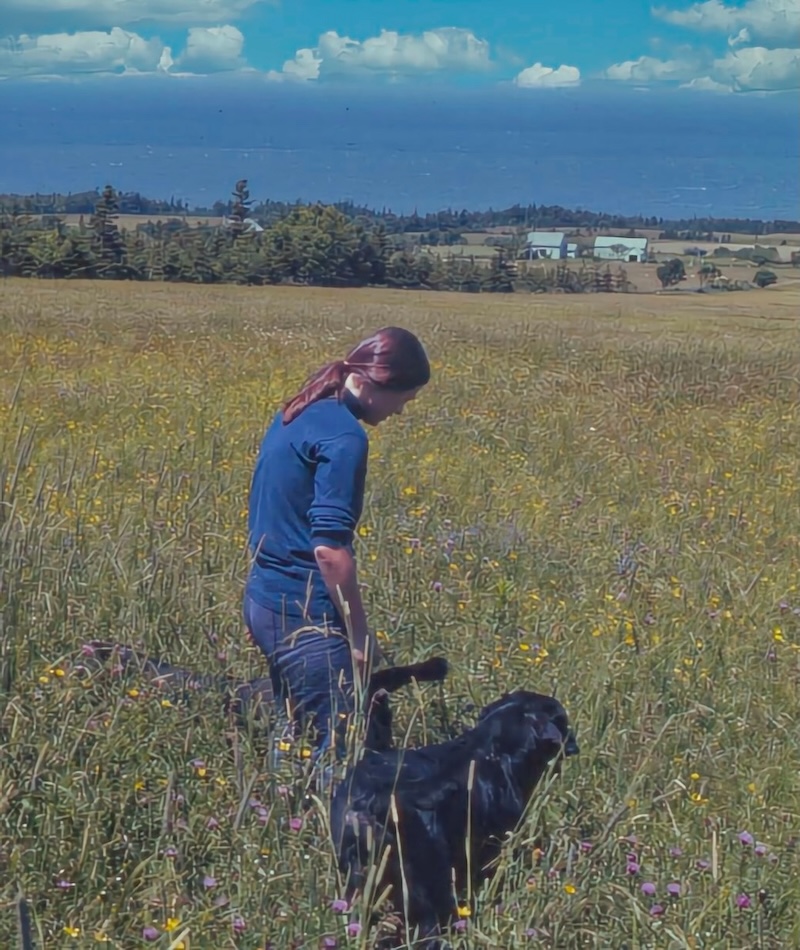
My wife in the large hayfield behind the house at our first farm in Nova Scotia