Subscribe to continue reading
Subscribe to get access to the rest of this post and other subscriber-only content.

Subscribe to get access to the rest of this post and other subscriber-only content.
I have been accused of being born with wanderlust in my soul. I suspect it is true. The urge to travel was nurtured by mother was traveler in her own right. At the age of twenty-six she went to the World’s Fair in New York City, managed a boat trip up the Hudson, a visit to Niagra Fall, and took the train to Chicago and dropped down to Kansas for a visit. She might have had someone with her on the New York part of the trip but I am pretty sure that she was alone on the Kansas leg of her journey. She was a single mother, but she would throw me into the old 1953 Ford, hand me a map, and say let’s go to the beach. Often the back seat had two or three of her neices that were ten years older than me. When she was in her late sixties, she managed a solo air trip from North Carolina to Nova Scotia by way of the ever complex Boston airport. She was never afraid to travel and once she call too old to make long drives herself, she always found a driver. I like to think she taught be how travel and enjoy it with not a lot of money
There are people who never want to leave home. I am not one of those people. Part of me wants to see what is around the next curve or over the top of the next hill. Not only do I want to see it, I want to experience it. I still remember seeing the Montana mountains towering above the plains on my first cross-country trip when I was seventeen and traveled with a nineteen year-old friend in 1966. Seeing mountains so different from those near me made me want to see more serious mountains. We briefly slid into Canada into on that first trip. In 1969, I got another opportunity when a college roommate and I drove to Alaska. We went right up the spine of the Rockies.
While some take pleasure in knowing a community intimately, I find my pleasure of living in a community is greatly enhanced by having seen and even lived in other communities. Living in a wide variety of places makes you appreciate where you live. For the most part, the communities that I have figured out have been warm welcoming places where you feel like making a home and improving your surroundings.
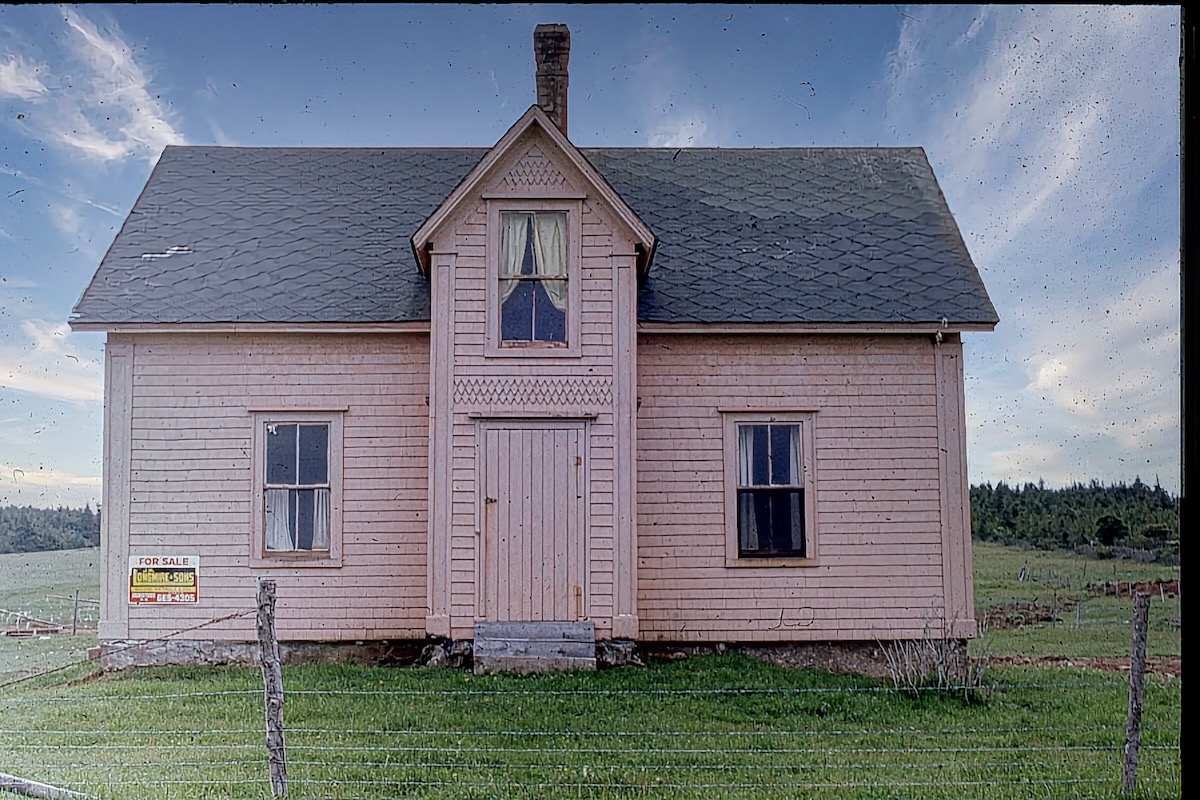
One rule has been my companion, always try to leave a place better than you found it. The first house I bought for six thousand dollars was pink and something of a wreck when I first found it and convinced my college roommates to help remodel it. Though it was not finished when I left three years, it had been stripped to walls, insulated and rewired. It got copper pipes, a new roof, new pine paneling, a new chimney and fireplace, a new bathroom and water supply. We also created a great organic garden and put new roofs on the barn and brought the hayfield back to life. The house looked a lot different when we left.
St. Croix Cove along the Bay of Fundy was not the right place for cattle so we found an old farm in New Brunswick. We didn’t do much to the New Brunswick farm house other than paint it and add a chimney but we built two huge barns, renewed some pasture, and turned another abandoned farm into great hay fields. We farmed until twenty-two percent interest rates pushed me into a job in the city.
By then responsibility for a family had put my wanderlust in the backseat so we went where the job took me and that was Halifax, Nova Scotia. Halifax was a wonderful place to figure out. We would still be living there but we learned most children had to go to Toronto, Alberta, or British Columbia for jobs. We fled back to the states and eventually ended up on the top of mountain overlooking Roanoke, Virginia. We were there when we took our children on their three week journey around the country. I hoped that travel might get in their blood, but perhaps home was too comfortable a place. Though they have traveled, it has never been just for the thrill of it like I have done most of my life.
When I was still living in Nova Scotia and not yet married, I ventured off to Newfoundland and dreamed of homesteading there. My new wife put an end to that but she was okay with farming in the hardwood hills of New Brunswick where we built our cattle operation. She was also okay with leaving all the friends we made during our twenty years in Roanoke for an extended adventure on the North Carolina coast which she grew to love.
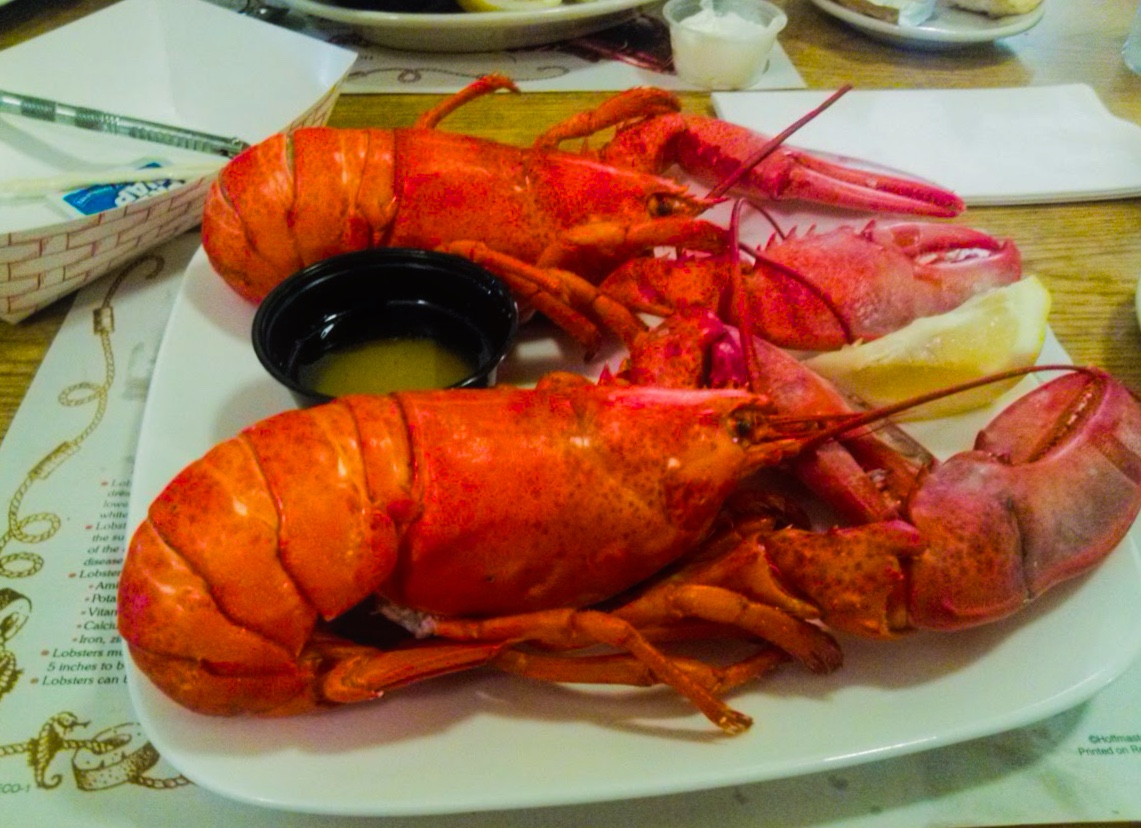
We went to the coast wanting to be out on the water. At the age of fifty-seven, I began the journey of becoming a capable boater in the challenging waters of the White Oak River, Bogue Sound, and the Atlantic Ocean. I logged over 500 hours at the helm of my skiff until someone convinced me that seventy years was too old to be boating out in the Atlantic by yourself. Figuring out the coast and how to prepare a house and boat for a hurricane was a lot more complicated than I imagined, but we did it. We stayed through Category 3 Irene and in sixteen years there only evacuated for Florence. While living at the coast, we made a trip back to our Canadian stomping grounds in 2012. On that trip in Bangor, Maine, was where I found those beautiful lobsters.
You can have wanderlust but still want to enjoy and thrive where you are. We added to and improved every house where we lived. We made the places ours . Even after leaving the farm, isome places we were able to have extensive gardens. Our gardens were amazing around our coastal home and here in the Piedmont.
Perhaps the most unique change we made to a place was the small house that we built on the upper back porch of our coastal home. we created an amazing home but there too many steps for our aging knees. In 2021, we looked foreward to a move from the coast to the piedmont. Because we were old there was some exhaustion mixed with excitement, but we have enjoyed getting to learn our new area. I still miss the marsh and all the creatures there, but I have lots of pictures. The trips now are much shorter now but my mind wanders freely.
The first time that I can remember facing an icy road, it was probaby 1961. I was a twelve-year old passenger in car headed back from Camp Raven Knob, a Boy Scout camp west of Mt. Airy, North Carolina. Adults had come to rescue us from another frozen, icy night in the three-sided Adirondack lean-tos. I wasn’t particularly worried about the icy roads because I wasn’t driving.
Seven years later I am home for the holidays from college and my mother is hosting a Christmas party in Mt. Airy, NC, for her extended family which are mostly from the next country over. Mount Airy is in the transition area between the hill country and the Blue Ridge Mountains. Weather forecasting in the sixties was a little more rudimentary and a snowstorm hit early in the afternoon. Snowstorms are not every day occurences in the North Carolina foothills. Our relatives were becoming worried about getting home. I was going to school in Massachusetts so my old Bronco had snow tires on all four wheels. I offered to escort a convoy through the worst hills. It might have been the first time I had driven in North Carolina snow which isn’t anything like northern snow. It is rare when NC snow isn’t slush or packed ice. That first trip was in slush which is no problem with snow tires. Everyone drove in my tracks and I took them half way home to the point there was hardly any snow on the road. I was young and probably didn’t worry about it very much.
There were many opportunities to drive on snowy roads during college. Four of us even took a trip to Nova Scotia’s Cape Breton Island in November our junior year. Cape Breton welcomed us with snow, sleet and freezing rain. We faced some very cold camping and tough driving in the old Bronco.
After graduating college, I moved to eastern Canada. Over the course of the next seventeen years I owned a variety of snow worthy vehicles from Land Rovers to Land Cruisers and 4WD trucks. We even had 4WD drive tractors on our 400 acres farmland.
My wife was in her orange rear wheel drive Volvo wagon on a very snowy day coming back from the doctor with our first child who had swallowed a bunch of Flintsone vitamins. The syrup of ipecac hadn’t worked at the doctor’s office. I had just found out when I came in from barn chores and rushed to the doctor’s office in my trusty 4WD Chevy pickup. I crested a hill as I was speeding to the clinic and there was my wife’s car stopped in the middle of the road. She had stopped because our daughter had started throwing up and she was afraid she would choke in her car seat. I didn’t have time to think, I avoided hitting my wife and daughter by putting the truck into a snow filled ditch. With the big snowbanks, I ended up safe, and I rode home with my wife, grabbed a tractor and a neighbor and we retrieved the truck without any problems.
Snowbanks along the rural roads were a great safety feature. You could slide into a snowbank without worrying about damaging your car. After we quit farming, I became a sales manager for the first Apple microcomputer dealer in the area. I had to travel to three locations in New Brunswick, one in PEI and another in Halifax, Nova Scotia. At first I did it in my old front wheel drive Subaru. One time I came home from a trip and was barely able to get the Subaru far enough in the driveway so I could get our tractor and snow blower around it.
Soon after that I switched to a rear wheel drive Volvo sedan. I put snow tires on all four wheels and fifty pounds of sand over each rear wheel in the trunk. I went everywhere in it. After I joined Apple, I once drove my sales manager from Toronto from Fredericton, New Brunswick to Charlottetown, PEI in a blizzard. He was amazed what the Volvo would go through and even more surprised at the ice encrusted ferry that we took to the island.
Four years later we are living on a mountainside overlooking Roanoke, Virginia. We bought an AWD Nissan our first winter there. We had a variety of AWD vehicles there from Subarus and Grand Cherokees to my wife’s AWD Volvo wagon and my AWD Acura MDX. The little Nissan Axcess was a favorite because I could put chains on all four wheels. There were storms when Little Limo as she was fondly known was the only safe way up and down our mountain. I ferried many people with groceries up and down the mountain to their parked cars at the foot of the hill over our seventeen years there. The Acura with its locking AWD mode was the second best vehicle on the mountain. It is still with us and now 21 years old.
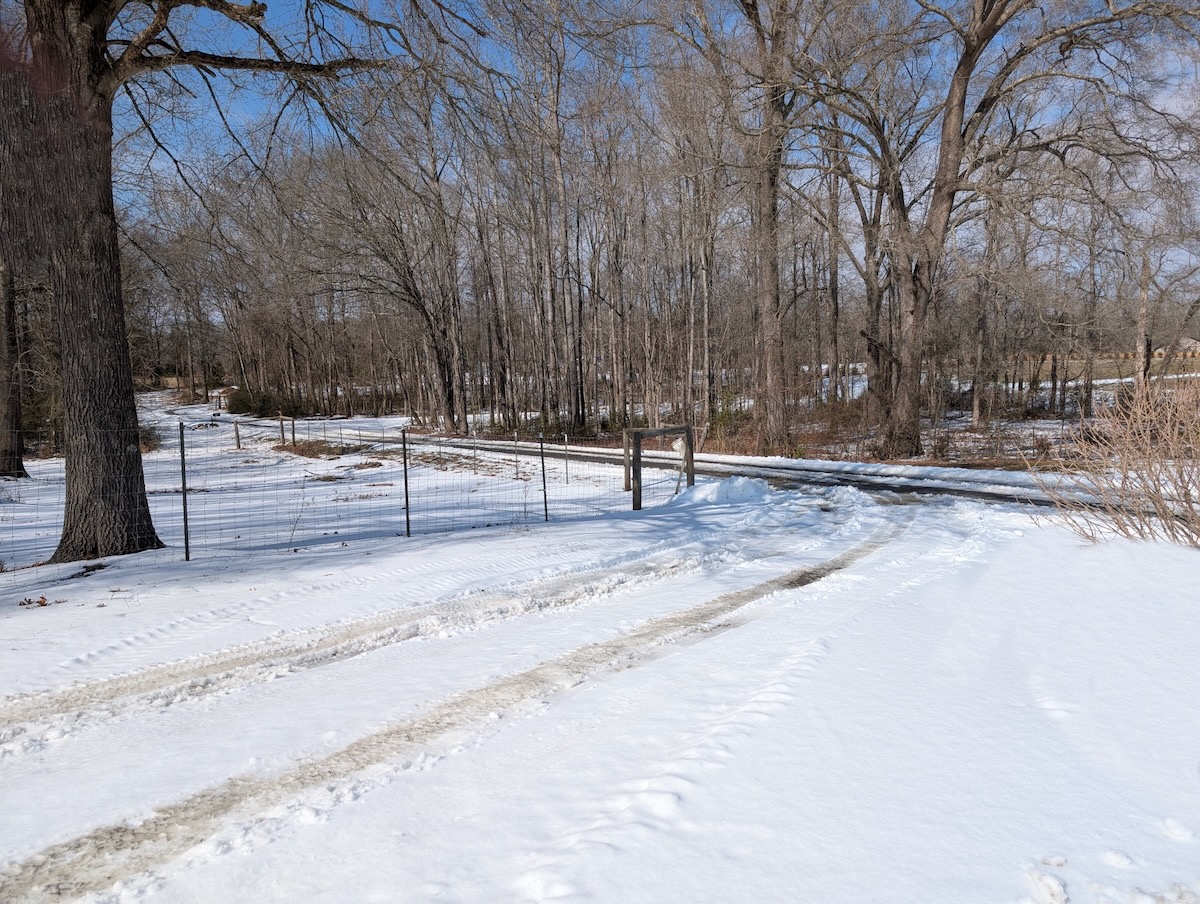
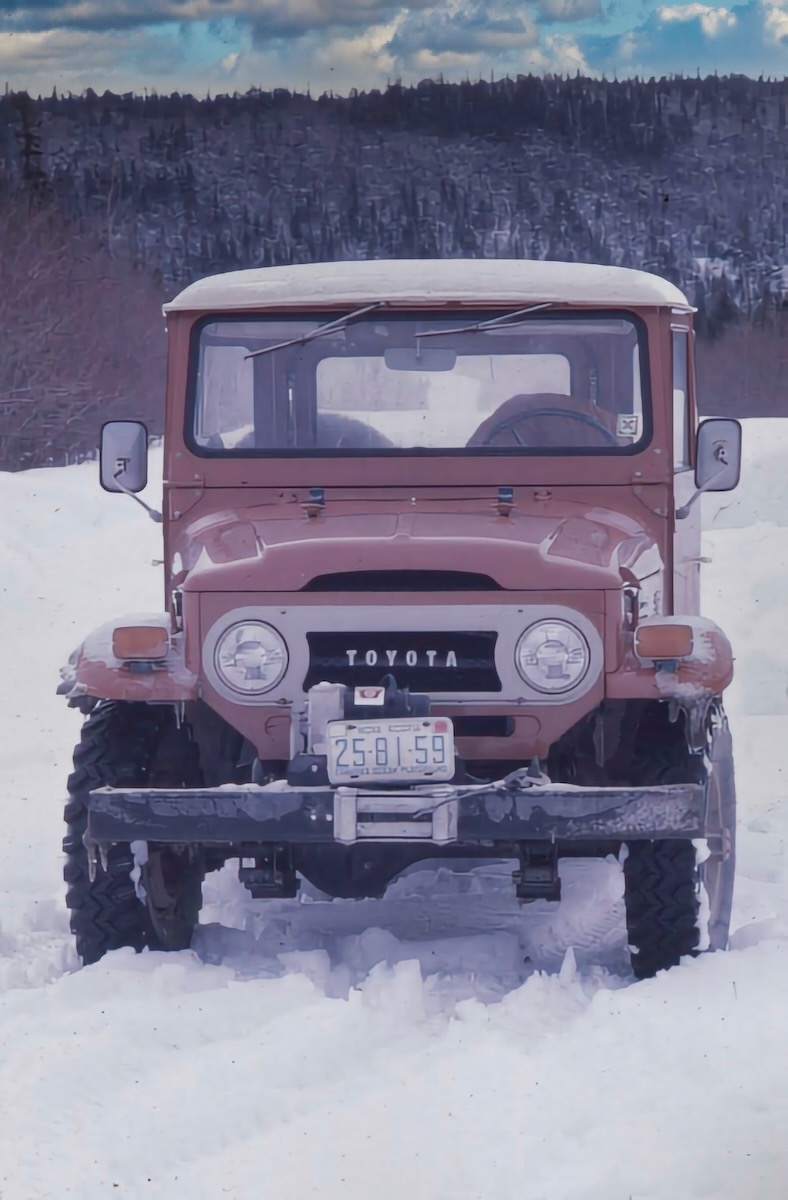
We lived on the NC coast for sixteen years and only had ice a few times. With no hills it is not much of challenge. Here in the Piedmont where we now live there are certainly enough hills to make things interesting but snow and ice is a rarity. Still in the last two weeks we have had two storms, one four inches of sleet and the other a foot of fluffy snow. We had no need to go out but I did go to our butcher shop located on the ice road pictured at the took. The Acura MDX never hesitated even a couple of really icy hills. It brought back some memories, even a snowy one to Newfoundland pictured below.
Americans are famous for their Sport Utility Vehicles (SUVs) that never leave the paved roads. Unfortunately, some people get behind the wheel of a SUV with the belief that it makes you invincible. There are a few things I have said in life that seem to have some staying power. One of them is that all an AWD, 4WD, or SUV will allow most people to accomplish is to get stuck in a more difficult to reach place.
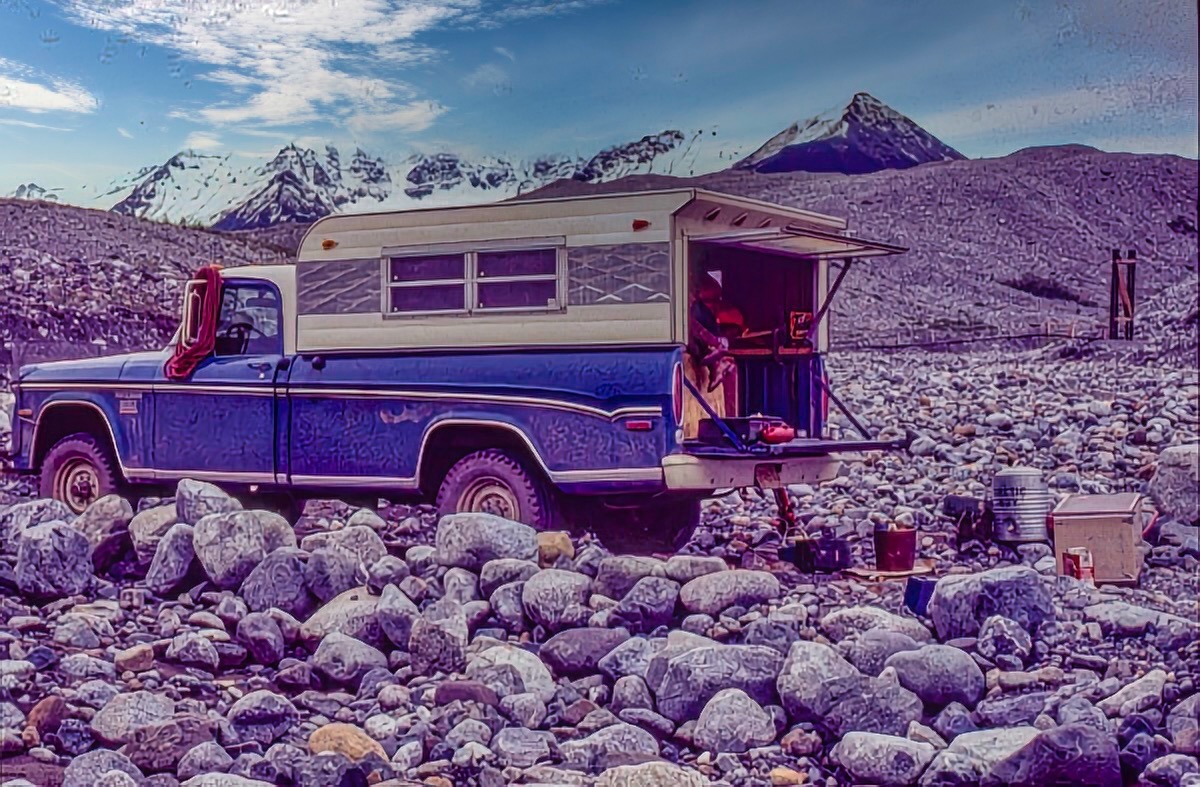
I have been stuck or broken down in some pretty remote places like the one above a few miles off a road in Alaska. That vehicle had a winch and it was useless in that situation. Farms are places where people can really get stuck. However, the rule on a farm is do not get the biggest tractor stuck unless you have the gear to pull it out. We kept an old bulldozer around for that. It got used for that.
Our herd of cattle wintered in the woods about a mile from the barns and the area where I kept the round bales of hay. It was not unusual after a big storm to blow the road to cows at night. One night after a particularly nasty storm when the temperature had already dropped into the minus twenties, I was blowing the road. I had successfully cleared one lane out to the cows and I was headed back widening the cleared road. As you get within a quarter of a mile of the barns, the road dips down into a small valley and crosses a culvert. There is a small pond on one side of the road and the culvert that allowed for overflow from the pond on the other side. I had a rear mounted snowblower that cleared eight feet of snow at a time but because it was rear mounted, you backed the tractor as you blew the snow. That gets a little tiring after an hour or so. The tractor had a nice unheated cab, weighed about 12,000 lbs., and ring chains on the tires. They are necessary on farm roads which often have ice as a base coat.
Just as I started across the culvert one of my large rear tires slipped off the road into the pond. Fortunately the pond wasn’t very deep but it still put the tractor in a precarious position. Experience told me the best thing to do was to wait for daylight and get a neighbor to help me pull it out. I walked home and spent my dreams figuring out how to retrieve the tractor.
By the next morning the temperature had dropped to minus twenty-eight degrees, but it was no problem to get my farm helper who was in his sixties to go with me to unstick the tractor. It was a complex operation. I loaded a generator in the pickup, some salt and a chain saw along with our three quarter inch logging chain.
First we drove down to the tractor, started the generator and hooked it to the recirculating block heater that would hopefully warm the engine of the tractor so we could start it. Next we made cuts into the ice around the tractor’s wheel that was now frozen in ice. We put salt in the cuts in the ice. While all that was working we went to start the bulldozer. It was a very old Cat D5 bulldozer which originally had a small gasoline motor that you started and used to start the big old diesel. Unfortunately the gas motor had died shortly after I got the bulldozer and I found it would cost more to replace it than the bulldozer was worth. However, we quickly discovered that towing the bulldozer six feet would start it. I had another large tractor and we used that to start the bulldozer that cold morning.
I drove the old 16,000 lb. bulldozer down and positioned it so we could hook the big chain to it. My neighbor got in the stuck tractor and fired it up. All he was supposed to do was steer the tractor. I moved the generator to safe ground, got on the bulldozer and carefully pulled the stuck tractor out of the shallow pond. While the actual pulling seemed effortless for the bulldozer, It likely took us two hours to get to that point. It is unlikely that I could have gotten a wrecker out to do the same thing without the wrecker getting stuck. We were fortunate to have the equipment. Most of the time when you get stuck, you have to make do with what you have.
Not every time you get stuck is going to be that complicated but as I said if you wander far off the road, you run the risk of being stuck in a difficult place. We were actually stuck in the picture at the top of the post. The locking hubs on our four wheel drive quit working. I had to take one hub apart and adjust things. Fortunately, I had the tools to do it.
With many four wheel drives vehicles all you have to do is get one wheel spinning and your vehicle might as well be a turtle on its back. I am a big believer in chains for ice in spite of the pain putting them on a vehicle. Chains make more difference than either four wheel drive or AWD.
AWDs are also not all created equal. Some will get stuck in nothing and some will walk up a mountain of snow. My old Acura MDX has a locking mode that is amazing but I still avoid ice.
Just after the first big snowstorm of the year is not the time to figure out how good your vehicle is at getting stuck. At a minimum, an emergency kit includes a tow strap, shovel, a square piece of 3/4 inch plywood, gloves and a good jack which should be a bumper jack if you are headed into sand or mud. If you have a winch on your vehicle, be very careful, they are exceedingly dangerous if you don’t know what you are doing,
Sometimes I miss living up north. Once the ditches were full of snow, the safest thing you could do to avoid an accident was to drive into a snow bank and get stuck on purpose. I avoided a few accidents that way. Most were close to home and only walking distance to one of those big tractors.
My seventy-seventh birthday is coming up in a few weeks. The thought of being that old has prompted a lot of introspection. Someimes we know why we do something but there are some forks in the road where our motivations might not be so clear. There are also things you remember which make you wonder how much influence they had on your decisions. I was in high school, a military one, when President Kennedy was assasinated. I remember the deaths of Robert F. Kennedy and Martin Luther King. I also vividly remember the election of Richard Nixon, the Vietnam War demonstrations and the feeling of relief when I found out that I wasn’t going to get drafted to fight a war which I thought was wrong on more than one level. When I graduated college, I went back to the land on shores of the Bay of Fundy in Nova Scotia. Some dissatisfaction with the political direction in the United States helped direct me to the north in 1971.
I spent first weeks of 2026, entertaining myself with YouTube videos of the new generation of homesteaders. Many of them are young, and all that I have seen appear to be healthy enough to handle all the wood splitting required to live off grid. I often wonder how their lives might change a few years down the road when their families include two or three children who need educating while the unrelenting work taking care of farm animals demands much of their time. Some of these homesteaders seek purity and will not even consider using a chainsaw. Others seem to believe that doing everything with used equipment shows their dedication to a different kind of life with ingenuity and a dose of poverty. Some fully embrace ATVs, snowmobiles, tractors and even excavators. Most it not all of them embrace solar power. There is a propensity for them to have goats and chickens with few pigs and cattle sprinkled around. Some have subsistence permits and live off Alaska’s. bountiful salmon and wild game. No one seems to have the land to grow their own hay, but many are investing huge effort into growing vegetables in places were vegetables are very hard to grow. Some have very young children but very few have teenagers. I am sure there are many reasons why they are living off grid or in my world have gone back to the land. They will likely wrestle with their decisions as they get older. A few have figured out how absolutely brutal longterm homesteading is on the homesteaders. It will be interesting to see how many are still around five eyars from now.
Long before I graduated college in the summer of 1971, I wanted to move north There were all sorts of reasons but four years at military school along with four turbulent years at college set the stage. My freshman year (1967) at Harvard, I was one of three students out of 1,500 in our class from North Carolina. At the time North Carolina was a rural place, and I had grown up loving camping, fishing, and wandering the woods. No one from our family had ever been to college so there was no famial advice to lean on for a career. My single mother raised me by running a beauty shop in the back of our house. Her one piece of advice was whatever I chose to do, I should do it to the best of my ability. She had grown up on a mill pond with a father who was a miller. She had become the lady of the house for her five sisters and brother at the age of nine when her mother died in 1917 flu pandemic. She left home by her middle teenage years when her father remarried..
With those ties to the land and the family of one of mother’s sisters still farming, it was not a stretch for me to want to go back to the land and farm. A trip to Alaska and another to Nova Scotia fanned the flame. In the spring of 1971, I found an old farm on the Nova Scotia coast that was listed for $6,000. It included an old farm house and 140 acres with about thirty acres of that in a hayfield.
Restoring the old house, buying some farm equipment and a few cows are all part of my history. When we decided to get serious about farming we moved to New Brunswick where we built a farm where we eventually had sixty-five cows calving every year.
There were lots of other easier paths to take to adulthood. I needed a path that let me learn everything the hard way. I learned how to wire a house and do copper plumbing by reading Sears How-to-do-it pamplets. I learned to farm by reading books and listening to my neighbors in most cases. I built barns with just common sense, skill saws, and a chainsaw. We only left the farm when interest rates got to over 20%. We also made the decision three years after leaving the farm that we wanted our children to know their North Carolina based grandparents and hopefully find lives not far from us.
It was a huge effort to move from the farm to Halifax, Nova Scotia, where I went to work for Apple. It took even more effort to move back to the states.
Now as I sit in my comfortable house eating food from local farms and exotic places like Trader Joe’s, I struggle to remember the day to day challenges we faced on the farm. I can remember all the wood splitting, the hauling it into the woodshed, the years of milking our Guernsey, Rosie. I also remember all those trips, often three times a night, to check for new born calves in the depths of winter. All the work that went into haying and gardening is clearly burned into my mind. The freezers were always filled with beef which is a luxury today. We had more garden produce than we could dream of eating but it was a lot of hard work especially when the black flies were around. We saw weather as cold as minus forty with sixty mile per hour winds and heat over one hundred degrees. We lived on the edge of civilization but most days we had power. We also had the equipment to move snow and take care of 200 head of cattle without hiring another person. There was a ten year stretch with no vacation. When we finally did get a vacation to Prince Edward Island, we did not know how to act on vacation. Farm life was brutally hard at times, often money was very short, but we all slept well at night.
Even with all the hard work, I would sign up for it again but with fewer cattle if somehow I miraculously got a body forty years younger. Whatever the reasons behind this generation going back to the land, it might well burn brightest in their memories like it does in mine.
In the sixties or early seventies, the back to land movement was well known. The 1968 Whole Earth Catalog was the instruction manual dedicated to it. Helen and Scott Nearing were its inspirational grandparents. Many in my generation’s back to the land movement were vegetarians like the Nearings. Some were vegetarian by choice and others because of necessity. Because of my proclivity to cattle and farming, I studied Louis Bromfield’s book, Malabar Farm. Today there there is a new generation of people going back to the land.
In this century they are known by the label “off grid.” Few of those folks are openly vegetarians. This new generation proudly hunts and fishes for protein to supplement what they grow. Though their animals are more likely goats than cows, there are some with cows and even horses.
Many of today’s off grid folks are often in places deliberately difficult to reach. Most back to the landers in the seventies went where they could find cheap land whether it was alongside a road like my house and barn or back in the boonies where my friends in the dome lived.
During the seventies, the rural Annapolis Valley where we shopped did not have supermarkets. It had small grocery stores and cooperatives where you could get your food, your baler twine, and some beef fattener for your steer all in one shopping trip. Beaver Fruit Cooperative got most of our business. I also did some bulk orders with the folks in the dome. We had a local hardware and a Sears catalogue store which is where we ordered our appliances.
There were times in the early seventies when I thought about getting farther from the roads that connected us to the rest of the world. Reality always intruded. I thought about homesteading in Newfoundland, but my wife took one look and said I would be homesteading alone. I even found a great spot high on a hill on my land in Nova Scotia.
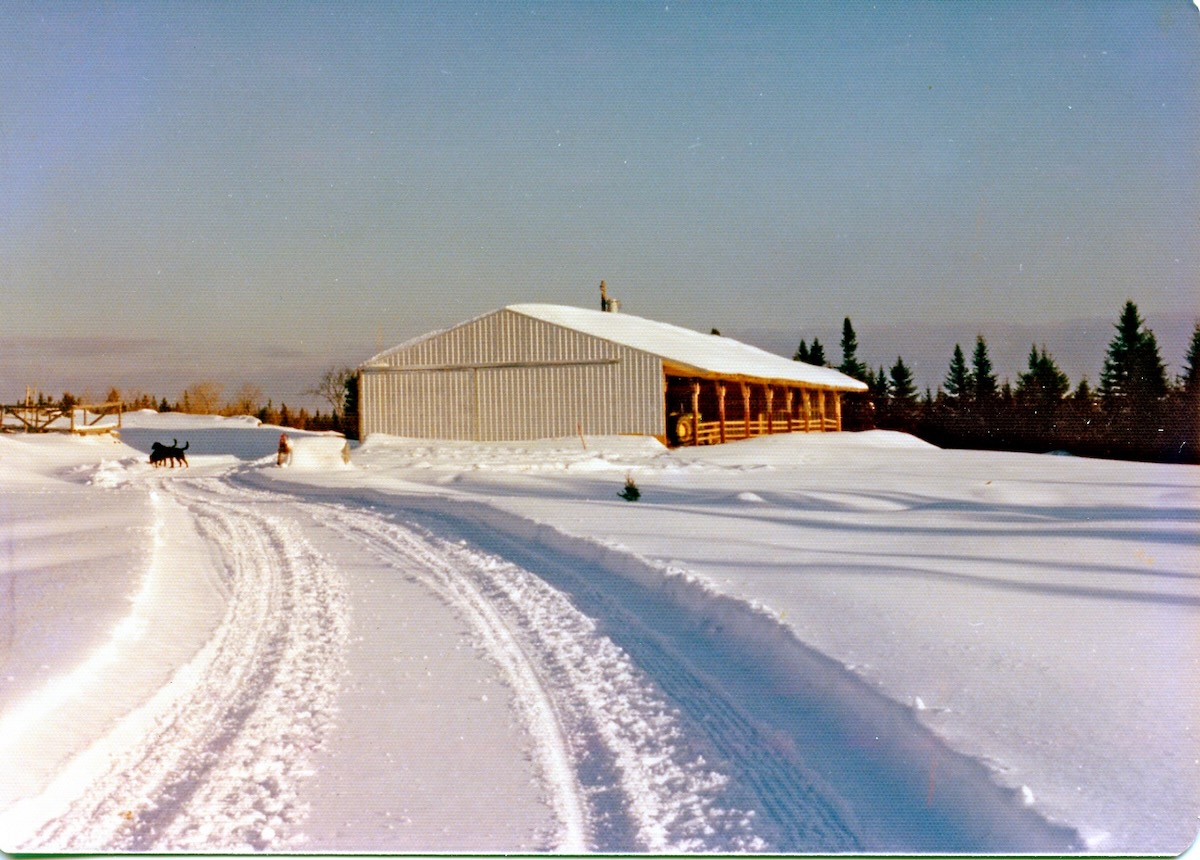
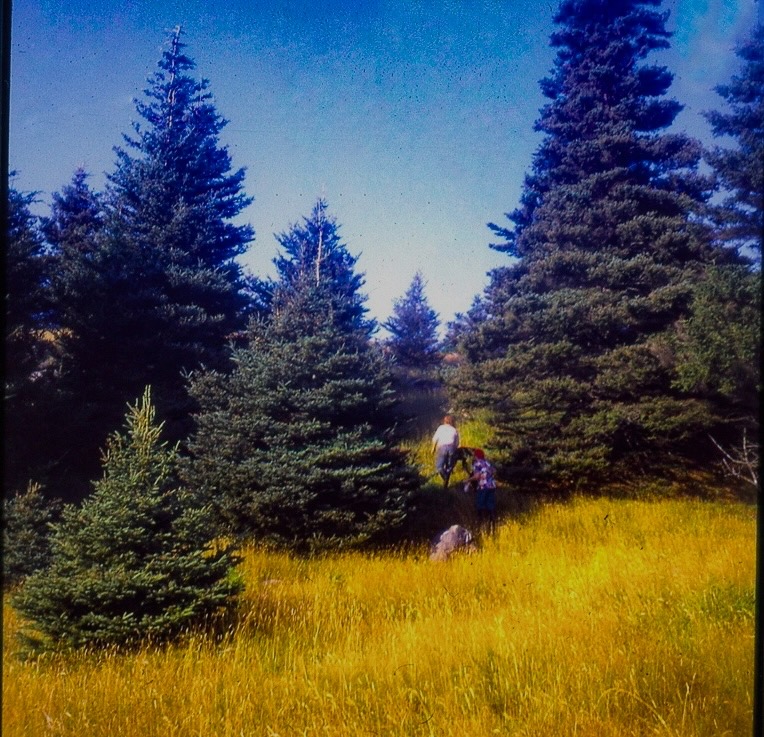
It is pictured at the top of the post. It was over a mile off the road which does not sound very far until you factor in the heavy clay soil and the astronomical expense of building a mile-long gravel road where gravel is in short supply. Then there would be the likely impossible task of getting power to the homestead. In those days there were no solar panels and battery systems to give you electricity off grid. Drilling water wells on our North Mountain was also problematic.
By the time we moved to New Brunswick we were well on the track for serious farming. We still gardened on a large scale, had chickens, and a milk cow. We did move to having someone butcher our annual steer for us instead of doing it ourselves. In creating our farm, we built well over a mile and a half of roads with New Brunswick’s ready supply of gravel over our rocky soils. I also convinced New Brunswick power to bring power a quarter of a mile back to the new barns that we built. We drilled a well back by the barns. It provided so much water that it was hard to measure.
So by 1976, all the elements were in place for us to move farther from the village of Tay Creek near our new barns but with no close neighbors. It wasn’t in the cards. While we had not had a great experience with the people of St. Croix Cove, the people of Tay Creek had been so welcoming that neither my wife or I would consider having the village become less accessible. It was also a great convenience to be by the road where the school bus picked up our children. It turned out we liked being part of our small farming village. We valued the connections of people dropping by to chat. I did not even mind cleaning the driveways of some residents who became close friends. When we needed them, our farming neighbors were there to help as much as they could.
In the end it seems the biggest difference between the back to the land movement of the sixties and seventies and today’s off grid homesteader is that the homesteader of today is often working to isolate themselves from others. In the sixties and seventies back to landers were still interested in community. I loved the small country stores, but today’s off grid folks are much more likely to seek out the anonymity of COSTCO. The money that some make from YouTube makes it even easier to not have ties with nearby communities. We were part of communities because we needed connections and income. Even today you will find exceptions and some off grid folks are much more community oriented than others. However, when I hear the term off grid what comes to mind are people living in places that are only accessible by four wheel drive, snow mobile or ice road for at least part of the year.
The dearth of good programming this holiday season has sent me to YouTube where I have enjoyed watching this generation’s homesteaders who would have been part of my generation’s back to the land movement in the late sixties and early seventies.
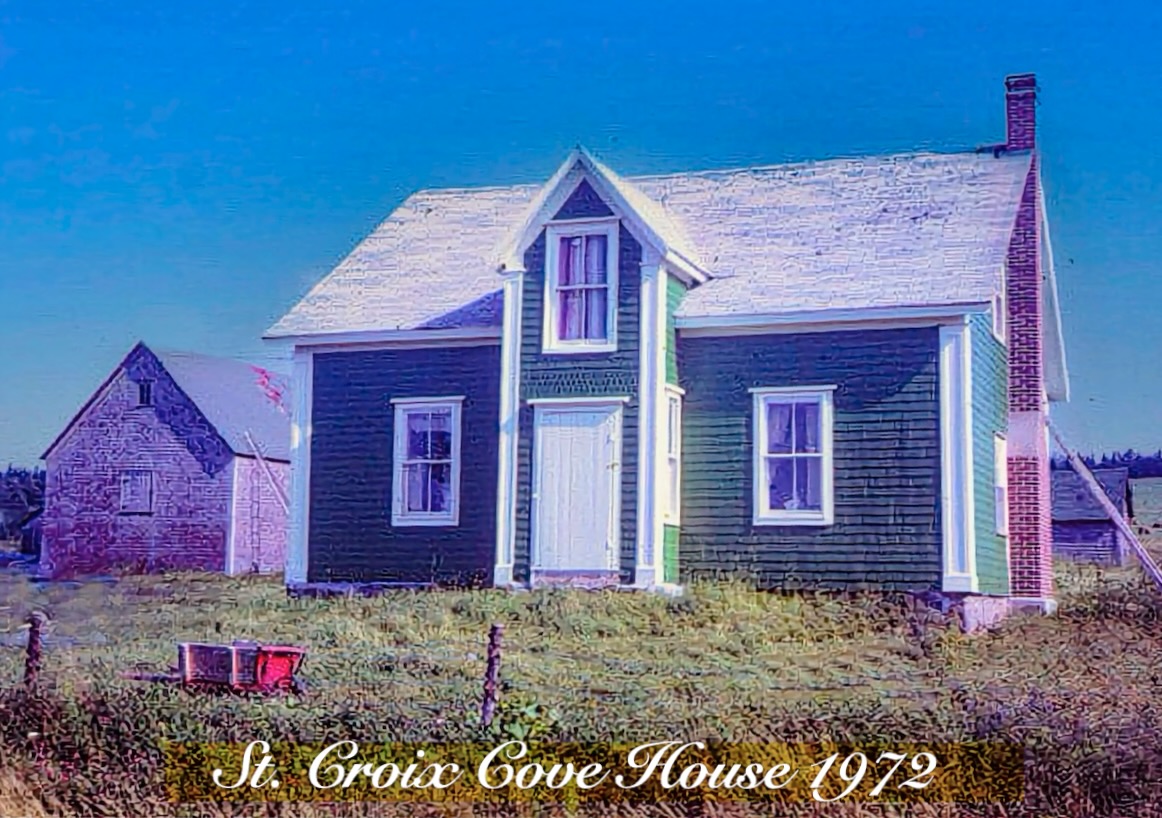
I was on the fringes of that movement back in 1971 when I bought an old farm including 140 acres, a two-hundred-fifty year old farmhouse (pictured above after a year’s hard work), with a barn and out buildings. I had just graduated from Harvard but had chosen Nova Scotia over law school. Four, also disillusioned, college friends went with me to Canada, but I was the only one to make the commitment to become a landed immigrant. My Dodge Powerwagon and Landrover came with me to Nova Scotia. They carried all that I owned including a TV and lots of spare kitchen utensils from my mother in Mt. Airy, North Carolina.
The pink house in the middle of a sheep pasture was in rough shape when I took possession. We set about tearing it down to the hand hewn beams, insulating it and attempting to bring some modern conveniences to the house. That was probably what set me apart from most in the back to land movement who leaned towards off grid domes, hauling their water, and hand tools for gardening and no modern conveniences,
Maybe it was a childhood in rural North Carolina which was still close to the land filled with small farms that made me different. My mother had been born on a millpond in 1910. I had listened to plenty of her stories of ice being stored in saw-dust insulated holes in the ground and cooking over a wood stove. When I was growing up in the fifties some of relatives still had outhouses on their farms. I also probably had camped in the woods more than most. For whatever reason, I was fine with the conveniences that electricity brought including hot water and a dishwasher. I was also happy to use a diesel tractor on our farm.
I became the electrician and plumber for the modernization of the old house. By Thanksgiving of 1971 we were ready to host some college friends who were sure that we were crazy. It was the first Thanksgiving on our own for all of us. It was pretty rough with everyone sleeping on the floor, a blanket for a bathroom door, chicken crates for kitchen cabiinets, and mayonaise jars for glasses. Still we had an electric stove and a dishwasher. Still it was a great celebration of our independence.
The next year the house was more livable but we poured our energies into gardening and farming. My dad gave me $11,000 to buy a tractor, three furrow plow, disk harrows, front end loader, manure spreader and a bush hog. I took $1,500 and bought our first herd of six or seven cows. We also started refurbishing the old baler that had come with the farm. We converted it to a PTO driven model instead of one powered by a mounted gasoline engine.
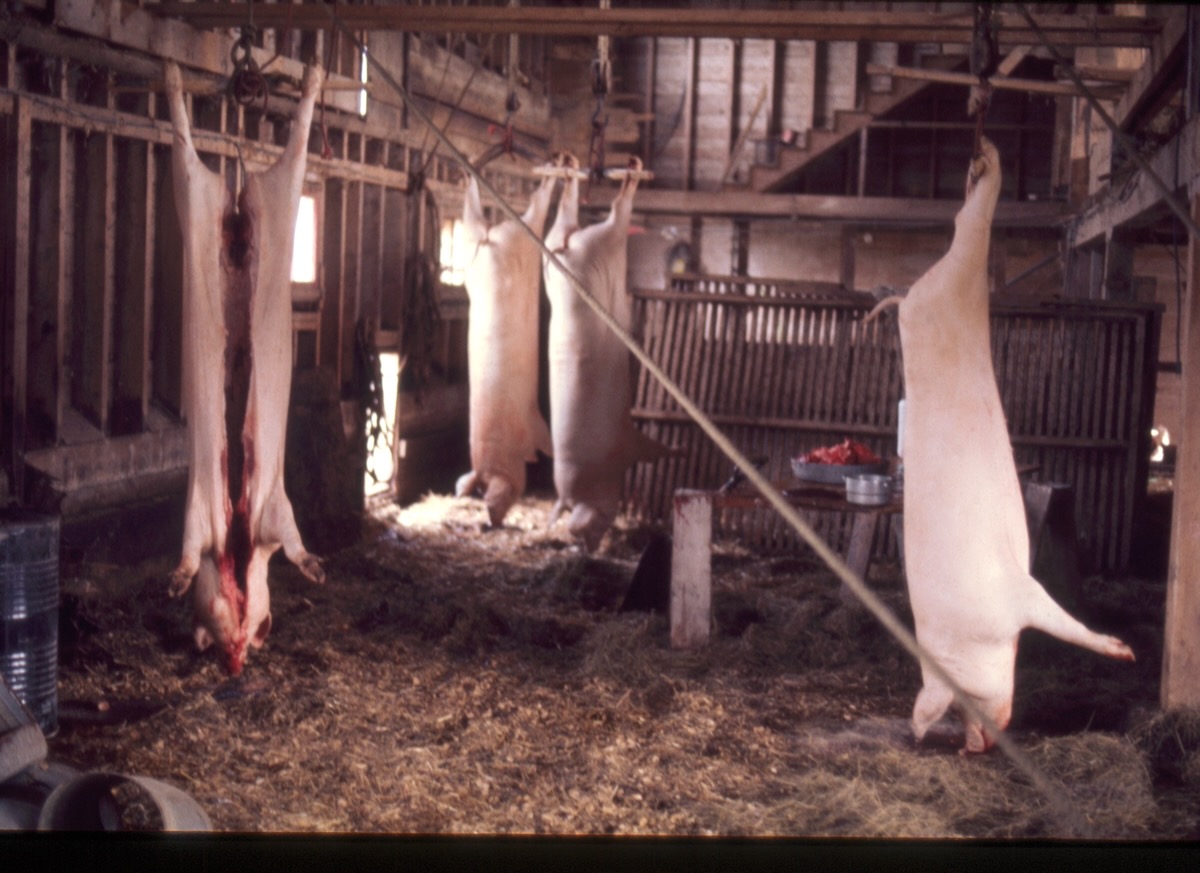
We had unlimited compost from chicken manure that had rotted for years behind some old chicken houses. I had little experience gardening besides helping my mother grow tomato plants in North Carolina. What I did have was inspiration from Helen and Scott Nearing and Malabar Farm. Gardening in Nova Scotia on the foggy North Mountain by the Bay of Fundy required a lot more expertise than in North Carolina. Still the abundance from the garden was overwhelming until my mother and her sister, both experienced canners, showed up to help us through that first harvest. We filled the freezer and the cupboards. That winter we butchered a steer we had fattened from our herd. We hung it age in our cellar before carving it up. The next summer we raised pigs, one for us and three more for neighbors. We butchered them with the help of neighbors in the fall, topped up the freezer and made crocks of salt pork. It was an amazing amount of work that made me appreciate all the fresh pork in the fall that our relatives had always given my mother and me.
That winter of 1972 was something of a lonely one. One member of the college crew married the local school teacher and moved into another old house across the dirt road. The last one of my college friends left for a warmer climate. That left me wintering on the Bay of Fundy with our two Labs, Tok and Fundy, and a handful of cats. I made friends with some back to the land folks who lived far in the woods in a dome. I ordered some supplies with them including a giant tub of honey that was still with me when we moved. Mostly what we didn’t grow came from Beaver Fruit Cooperative in Lawrencetown down in the Annapolis Valley or from itenerant peddlers who sold salt fish and winter vegetables. I say we because that was my last winter alone.
I got married in the summer of 1973 and brought my new North Carolina bride home that September just in time for an early season snow storm that took the power out for a week. We stayed warm with the fireplace and cooked over the same. It was not unusual for the powe to go out on our dirt shore road but a week long outage was rare. That next summer my wife and I continued to garden, work on the house, and farm a little. Farming was a little because I had sold the cattle and part of my land to disolve an uneasy partnership with the friend who had married the village school teacher. Well before garden season my wife and I had made the decision to move to a better farming area with more and friendlier people.
We found the perfect place for us in Tay Creek, New Brunswick. We moved there in the fall of 1974 and started the process of building a real farm with the help of some great neighbors. We built our first barn in 1975 and converted to round bales in the summer of 1975.
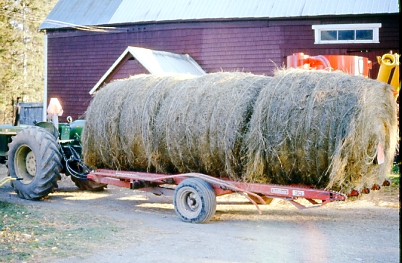
Annually, we put up 200 large round bales for our herd which eventually grew to 200 head of purehred Angus.
We were actually even closer to the land than we were in Nova Scotia. On our New Brunswick farm we had spring-fed water for our house. We continued to garden, added chickens, and a milk cow. However, we found a local butcher to do our annual steer. We were still on the edge of the grid. Our first winter we got twenty-three feet of snow. We saw weather as cold as minus forty with sixty mile per hour winds. We went back to mostly heating with wood, burning three to four cords per year in our much newer home which was only one hundred years old. It was cold enough that we unplugged our freezers in the shed which was attached to house so you could get wood without going outside. The first winter there I fed hay that had been put up with horses. One thing we did not do is fight snow with tiny all terrain vehicles. A couple of miles of road to keep clear required real snow removal equipment.
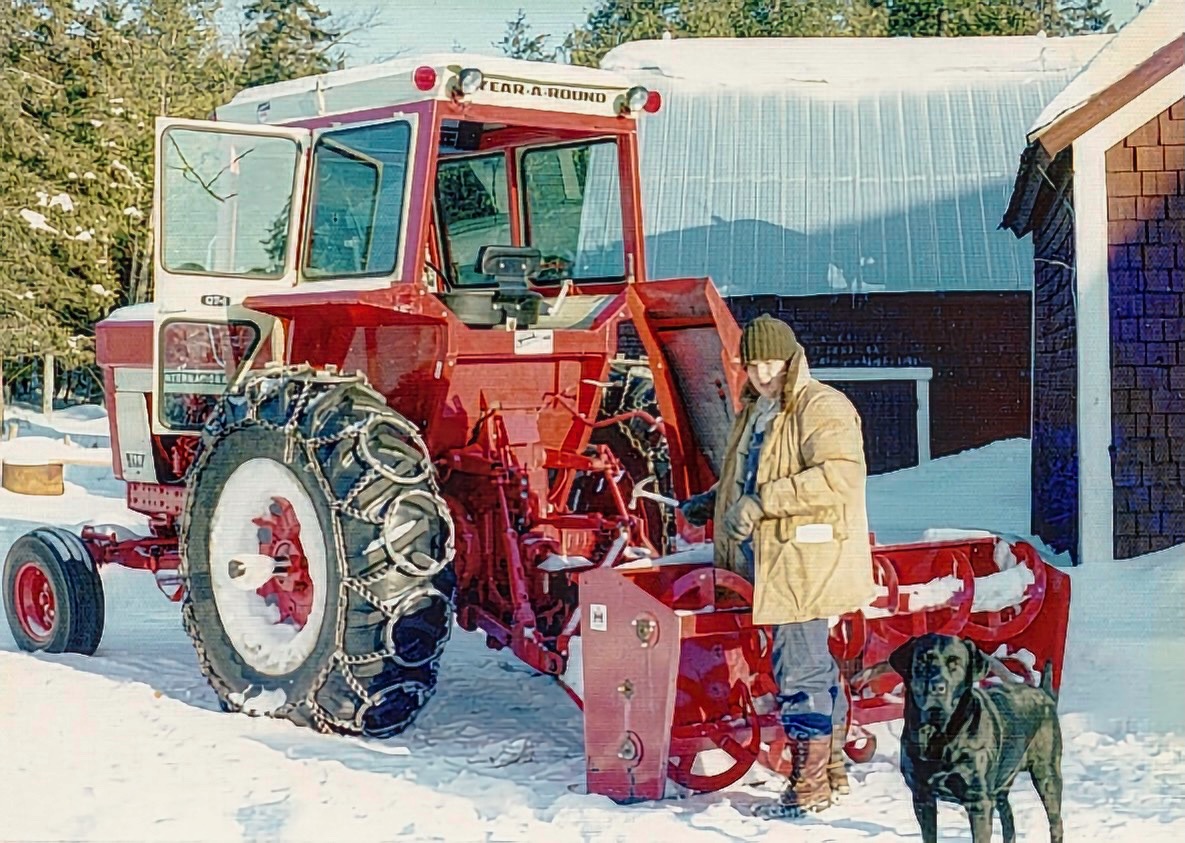
When I look back on it all, I am amazed that we did it without someone getting really injured. There was no Internet or YouTube for advice. Advice either came from a book or your neighbors. I learned to be pretty self-sufficient often repairing broken equipment with my torch and welder. I added chain saw carpentry to my resume as we built the barns. We ran our cattle in the woods in the winter and managed to get through our farming years without ever having a vet come out for a sick animal. We might still be farming if interest rates hadn’t surged to 20% and drove me to working in the city with computers and eventually to a career of nearly twenty years at Apple Computer.
We were never off grid but if your farm doesn’t have any cattle fences in the back because there is no place for the cattle to go, you can justifiably say you were barely clinging to the grid.
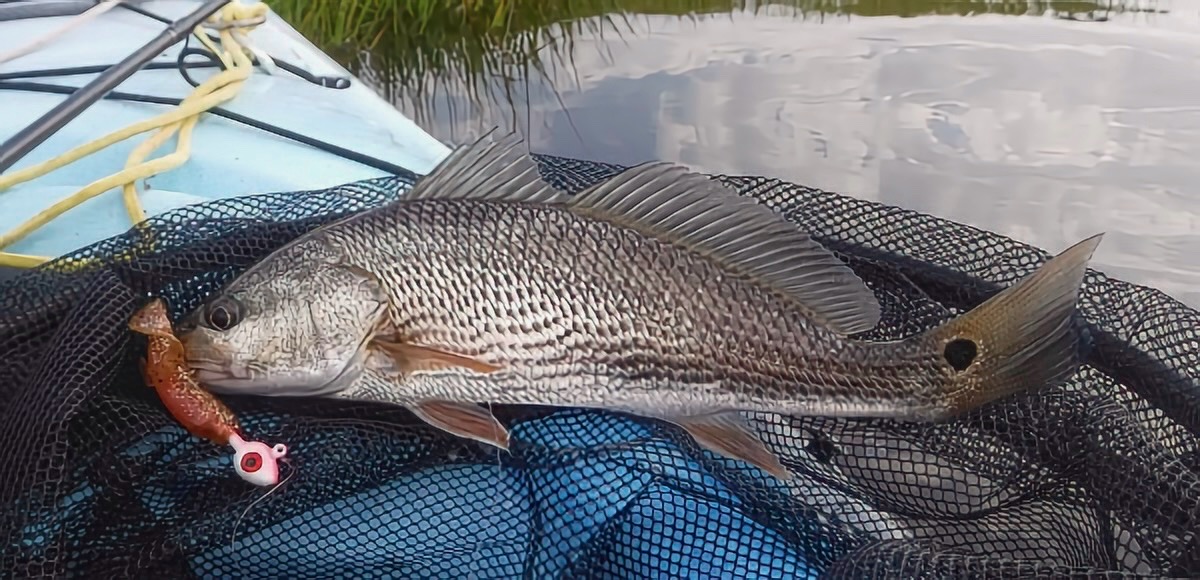
The society of fishermen (and women who fish) is far more open minded thanyour average members of the population.
In politics, the mobility between conservative and liberal groups is almost non-existent. It would be fair to say that without some extraordinary circumstance once you are born a conservative, the chances of becoming a liberal are very slim unless you get whacked on the head with a police billy club. Likewise most liberals would only become conservatives if they won the lottery and caught a bad case of greed.
Fisherman really do not care about your history unless it is fishing history, they care about what you are catching today and how you are doing it. Everything beyond that is pretty much irrelevant unless you are trapped inside a house in a blizzard and have no entertainment beyond the stories you can spin.
Actually you can be a worm dunker one day, and a dry fly fisherman the next day. No one will care except the worms. Fortunately, I was born into a Presbyterian family which if you have seen the movie, A River Runs Through It, means I should be a dry fly fisherman. For many years, that was most of fishing.
Actually, I fished with a fly rod before I was even a teenager, but I have avoided the purity of only one type of angling. I came from a long line of worm dunkers on my mother’s side. No only did they dunk worms, they also dunked shrimp and fished along the North Carolina coast for whatever was biting. They caught a lot of fish every fall that they took home to fill their freezers.
When it comes to fishing, I have tried almost any method though I now lean away from the dark side of using live bait . There is a certain point in your fishing life when catching fish is not nearly as important as catching certain fish by a particular means. While most sports seek out ways to be more productive, fishermen often seek out ways which are more difficult and which result in fewer fish being caught. Often it doesn’t even matter if you catch something or not. It is the time on or by the water and the comradeship of your fishing buddy.
I was blessed to live for sixteen years on the NC coast in what was close to fishing heaven at the time. I did catch fish to be proud of just a couple of minutes from the dock behind our home. One quest was to catch a bluefish from the surf on a light spinning rod using an artificial lure. It is not an impossible task, I had actually done it before butnfar more often from a boat than from the surf. If you get a shiny lure in front of feeding bluefish, you will usually catch something. So catching one is not a huge challenge. However, if you give yourself a short time window and a long beach to read, then the challenge becomes a little more fun.
One evenng we left our home on the banks of the White Oak for a 15-20 minute drive to one of my favorite beaches. I like it because there are rarely people there for much of the year, and I have caught fish there before. That evening we got there a little after seven PM and stayed for around thirty minutes. That was all the time I had allotted myself to catch a bluefish.
It was a great evening to be on the beach. In fact when we headed home around eight PM, the temperature was still 80F. Anyway, I started my fishing with a Gotcha plug. I probably fished with it for the first fifteen minutes with no luck. Then I switched to a gold spoon. The sun was starting to drop quickly, and I had been watching a number of jumping fish just out of the range of my casts.
I was hoping the light from the dropping sun might make my lure more attractive.It was the third cast with the gold spoon when I got a solid hit. My next cast there was nothing, but on the following cast I hooked a bluefish but it quickly threw the hook. One more throw, and I had another hit and was solidly onto a nice bluefish. It did not take long to bring him to shore. He was about sixteen inches long. I quickly heaved him back into the surf and told my wife that I was done. She could not believe that I did not want to fish more, but I had accomplished what I wanted to do and the feeling was good. I was actually using a very light, long spinning rod which was purchased more with the soft mouths of trout in mind than bluefish. Of course that added a little to the challenge.
There are always more challenges for a fisherman. One of the most exciting is catching North Carolina’s state fish, the Red Drum, on an artificial lure.
On Saturday, November 5, 2016, I only had a few minutes late in the day to fish some close-in oyster bars on the White Oak River but it was spectacularly beautiful out on the water. I managed to catch and release a sixteen inch drum and bring home a sixteen inch trout for dinner.
On Tuesday, November 8, I had almost two hours to fish the oyster rocks near our home in my kayak. I caught four red drum and one black drum. I brought home one nineteen inch drum. In ten days, I landed with artificial lures, ten red drum, the best around twenty inches and another at nineteen inches. I only kept one red drum but I kept two trout, one sixteen inches and another eighteen inches and also one black drum at fifteen inches. We have feasted on fish these last few days. Baked browned-butter, panko-encrusted drum is one of my favorites.
That is only a sample of my fishing tales. Fishing during fall of 2016 will stick in my memory. I caught some memorable fish.
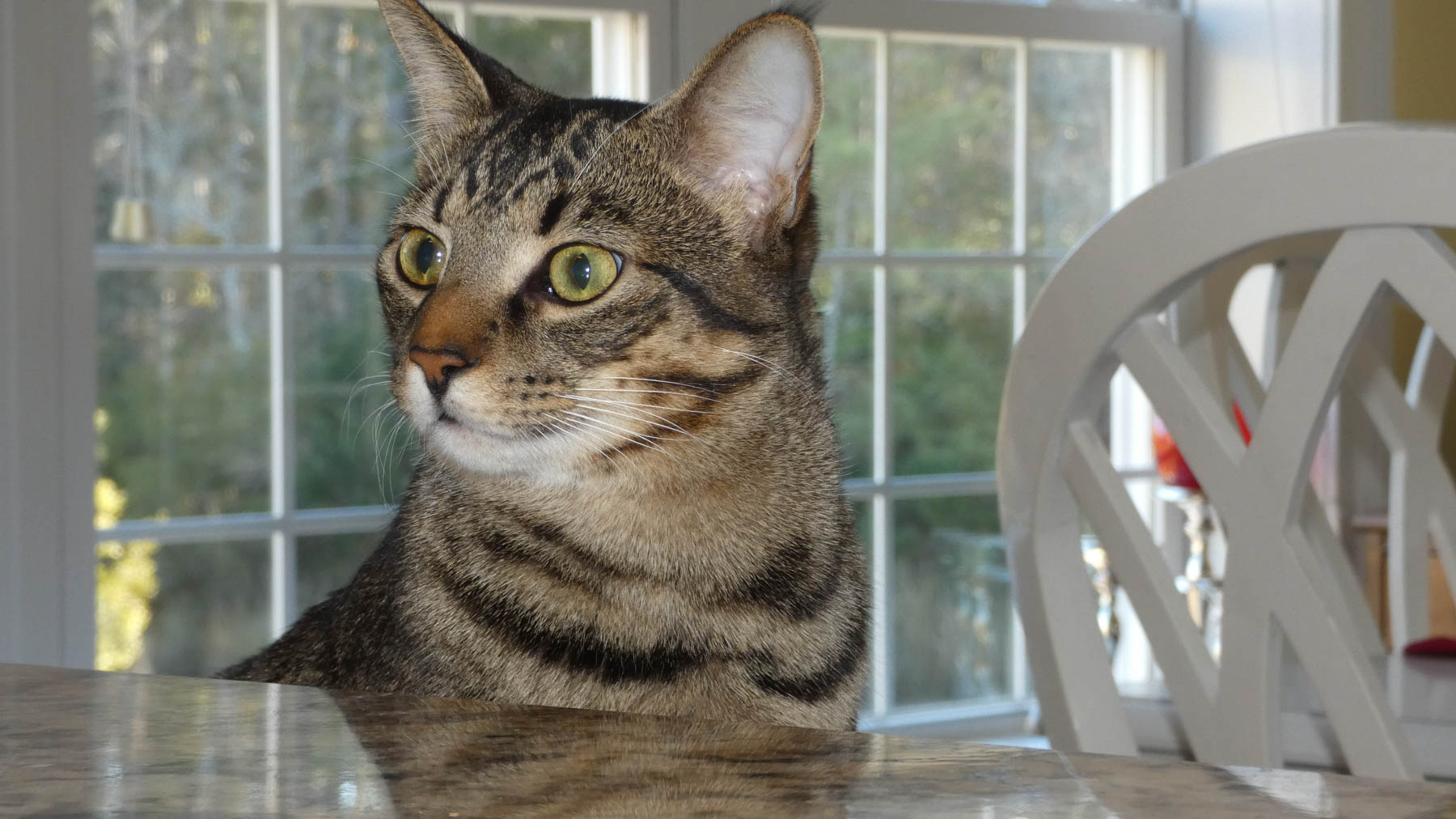
One of the reasons that I love our big tabby cat, Goose, is that he always has a look of wonder. We could learn a few things from Goose. A few times over the years I have forgotten to be pleasantly surprised at whatever has happened, but not often.
After I went away to military high school in Tennessee in 1963, I figured out within the first three months that I could either be unhappy with what was happening in my life or I could be wonderously surprised at whatever happens next because it is often an unknown piece of the puzzle that turns out to be my life.
When I got in my car to go office to college in the fall of 1967, I left with a sense of adventure which included a promise to myself to try new things especially if they forced me to step out of my box. The Vietnam war was raging during my college years and for a while it looked like I might become a foot soldier in it. Instead once I graduated and figured out that I wasn’t going to be drafted, I immigrated to Canada.
That as you might expect was a huge decision but like many decisions in the days before the Internet, not a lot of research went into it. I was in love with Nova Scotia. The beauty and wonder of the place wrapped itself around my mind. Before I got married, I came to know loneliness even in a place as scenic as Nova Scotia. Marriage to a NC girl was another moment that surprised me and left me thinking that I was living under a special star that helped me find such a wonderful wife.
There were plenty other moments of wonder. After dispersing our cattle herd, somehow I made the transitiion to working with Apple Computer. From shoveling manure to selling Macintoshes has to be an epic career switch. Twenty years later when Apple pushed me away from the company, several people encouraged me to think about my next career as finding something that would excite me for the next fifteen years. It took a while, but I ended up helping communitieis build fiber networks. Along the way, I learned how to take a skiff out into the Atlantic and how to kayak a two-mile wide river. I spent a few years rescuing an HOA.
I always welcomed the next challenge never doubting my ability to do a good job and always approaching a new challenge with a sense of wonder. That doesn’t mean I did not have any worries. There were many sleepness nights during my HOA time. I would always wake early when I was taking someone new in our skiff out into the Atlantic. It was a big responsibility.
I recently got a new heart valve by way of a TAVR procedure. While I was afraid, I never waivered. I am still facing some medical issues but I face them with a sense of wonder that something so complex can be done without cutting me open.
I have been surprised by people all my life from the British doctor and his wife who became great friends to some of the very interesting people that I met Harvard.
I continue to be amazed by people that I meet from the young farm family working on the same farm that has been in their family for over one hundred years to the New Brunswick farm couple in their sixties still haying and keeping work horses. I also amazed by the young adults finding their way through this increasingly complex world. That they can keep moving forward when most of the cards are stacked against them renews my sense of wonder. Then there is my adult son who rose up to start doing many of the things that I was doing before my heart valve problem. I am back to driving and hope to be gardening in a few weeks but I definitely have a feeling of wonder seeing my son plant flowers. If that can happen, I think we will be able to push back on the anti-democracy forces trying to destroy our country. That of course would lead me to an immense feeling of relief.
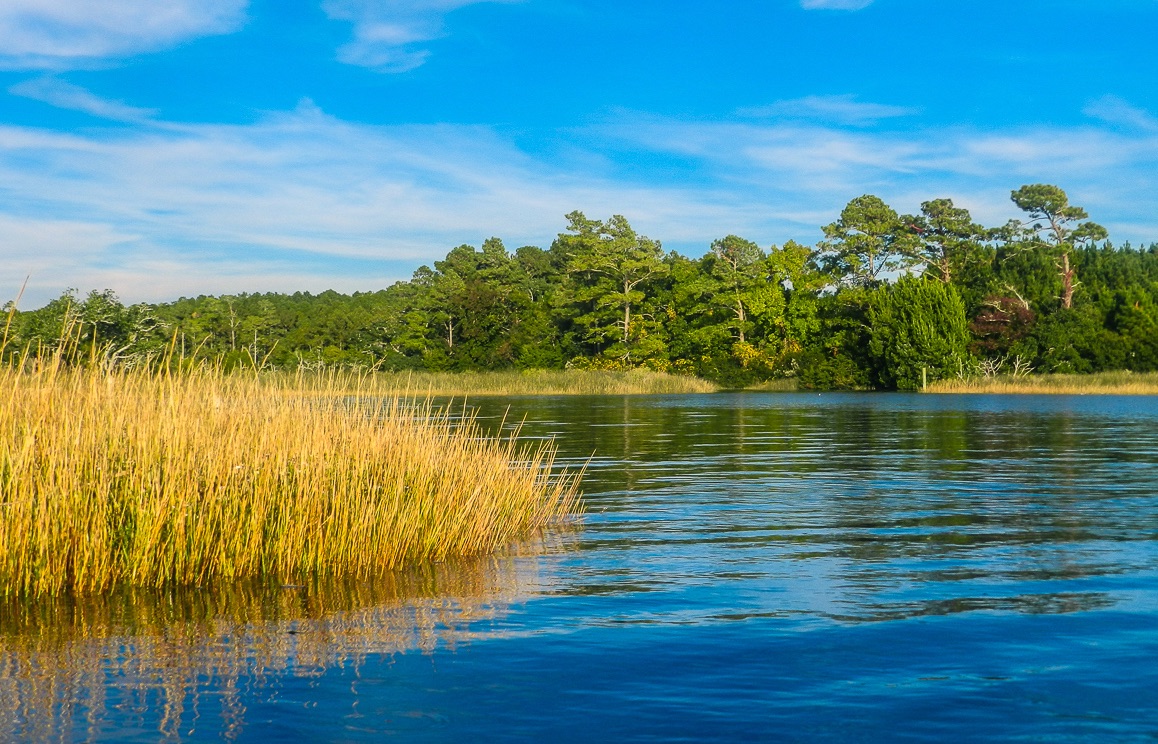
I wrote this back in the fall of 2016. It was one of the nicest falls that we enjoyed in our fifteen years on the North Carolina coast. I wrote more than one post arguing that fall was even nicer on the coast than in the mountains.
Here is a brief description of the memorable month of November 2016, as seen from the water and the beaches of Carteret County.
The good fishing and nearly perfect weather, continues but I can already feel the best of fall sliding away.
On Saturday, November 5, I only had a few minutes late in the day to fish some close-in oyster bars on the White Oak River but it was spectacularly beautiful as you can see from the marsh grass picture. I also managed to catch and release another sixteen inch drum and bring home a sixteen inch trout for dinner.
On Tuesday, November 8, I had almost two hours to fish the oyster rocks in my kayak and I caught four red drum and one black drum. I brought home one nineteen inch drum. In the last ten days, I have landed ten red drum, the best around twenty inches and another at nineteen inches. I have only kept one red drum but I have kept two trout, one sixteen inches and another eighteen inches and also one black drum at fifteen inches. We have feasted on fish these last few days. Baked browned-butter, panko-encrusted drum is one of my favorites.
Last year, 2015, we did not have a fishing season like this one. I blamed it all on the early October rain we got. It is hard to miss a fishing season when fall fishing on the coast is such a tradition. This year we have been lucky. Since Mathew dropped three inches of rain on us October 8, we have only had two-tenths of an inch on October 22, and another two-tenths of an inch on November 4.
Fishing during fall of 2016 will stick in my memory.
 Our technological infirmity